

30 Dec Forging A New Path
Something has shifted in Colorado artist Jay Moore’s landscape paintings. It’s subtle, this intensity of feeling, and it’s hard to put a finger on just what it is, but it’s there. When asked what’s changed, Moore is surprised anyone has noticed.
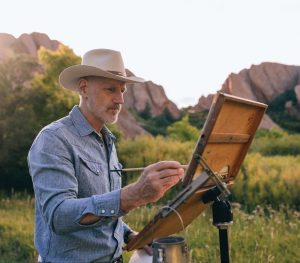
“Well, I’m always trying to up my game, I’ve done that my whole career,” he says, then pauses. “And I’m slowing down, taking more time to contemplate each painting. I’m making time to visit museums to see shows of artists I’ve always admired. And I’m hiking into even more remote places to find new inspiration. Actually, I’ve hiked more miles this year than ever before.”
That he’s hiked more miles than ever is really saying something: Moore has been painting landscapes of remote places for more than 30 years. In fact, his career took off when an art dealer suggested he paint several views of a ranch house and its surrounding property for a collector. That successful commission turned into a series of similar opportunities, taking Moore onto ranchlands across Colorado and beyond, where he created hundreds of paintings over the next 10 years.
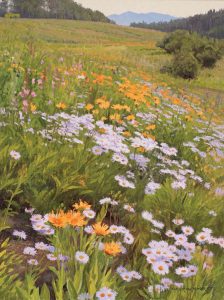
Mountain Asters | Oil | 24 x 18 inches
Exploring his chosen genre in this manner gave Moore a foundational understanding of the land and how light illuminates a mountain peak or glints off a fast-moving river, as well as a deeper feel for the myriad colors at play in any landscape — things an artist can only understand after years painting outdoors. Those ranch paintings also paid the bills, albeit with steady pressure to deliver expected imagery on time. And though it took at least a decade before galleries started to notice, Moore diligently made a name for himself so that when he was asked to join prominent galleries, they offered him one-man exhibitions, which added more pressure to trek deeper into the backcountry in search of farther-flung places to impress patrons who were discovering him and his work.
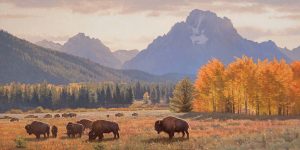
Bison’s Realm | Oil | 24 x 48 inches
Moore’s studio is situated in Parker, Colorado, a buccolic suburb of Denver, where vast acreage and horse properties are common. He maintains a retail space in downtown Parker, with a gallery up front that is open by appointment and a studio in back where you’ll find him most days that he’s not climbing some mountain trail or fording a stream.
And though his home and family are just a few miles away, looking at Moore’s paintings might make you think his real home is in the Colorado High Country. His affinity for exploring the great outdoors developed in childhood, growing up in the Colorado foothills, surrounded by national forests where he fished and hiked. “The whole reason I’m a landscape painter,” he says, “is because of how I grew up. From the age of four or five I was allowed to roam through the forests and wade in the streams. Honestly, for my whole life I’ve felt more comfortable on a mountaintop than in my own living room. Being outdoors painting brings me back to my childhood anchored in nature. I have no problem sleeping under the stars, catching fish in a stream, or climbing a mountain. Yes, I have a healthy respect for nature but I feel at home outside; that’s who I really am.”
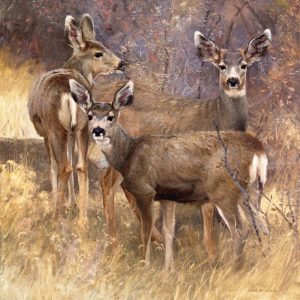
Comfort | Oil | 30 x 30 inches
That sense of peace and freedom he finds in the outdoors plays just below the surface of Moore’s work. But there, too, things have shifted. Again, it’s subtle, but important, and it’s part of his evolution as an artist. “I’m proud that I’ve supported my family for 40 years as an artist,” he says. “And that’s through good times, bad times, a pandemic, recessions. I’ve done a lot of paintings and I still have that eagerness to challenge myself with the next one. I’m not content to rest on my laurels. I don’t want to paint what I think will sell; I want to be faithful to myself and I’m going after that even more these days.”

Backwater Brothers | Oil | 40 x 60 inches
When Moore started having one-man shows in galleries, he came up with a formula: One-third of the paintings he did would be of subjects he was known for; one-third would be of familiar subjects but with a new or different approach; and the final one-third would be experimental, those things he wanted to try just for fun.
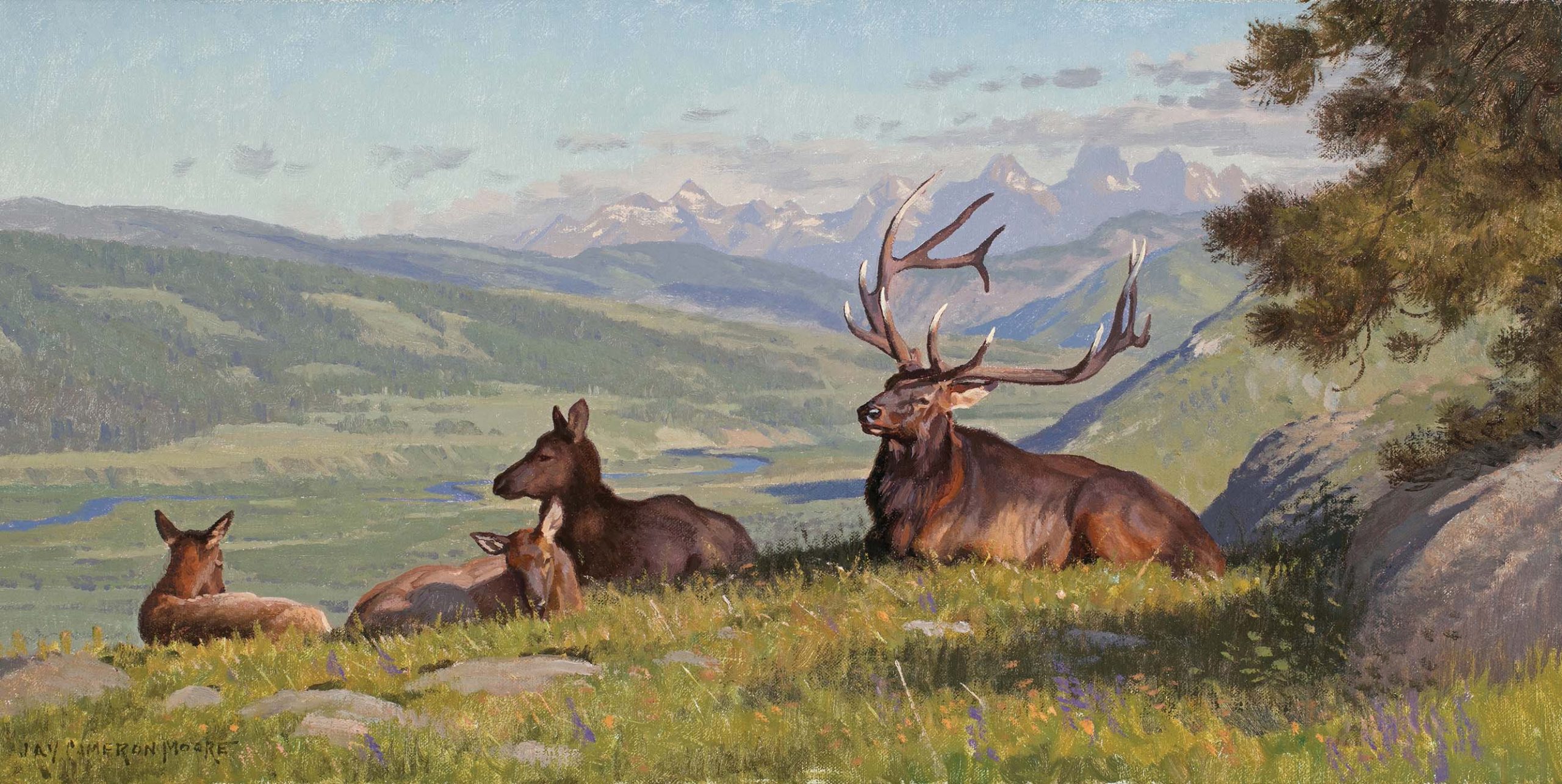
“That allowed me to be recognized for what I’m known for but it didn’t let me get stagnant. Even paintings that were “safe” gave me the opportunity to perfect some element, like water — I’m still trying to perfect painting water. I’ll probably go to my grave trying,” he says with a laugh, and adds, “My shows are like going to a concert where the band tries out some new stuff and plays those songs they’re known for, that the audience is waiting to hear.” For the paintings that are totally new and experimental, he says those come from a spark of an idea that starts to germinate. “That’s how I ended up doing some paintings with animals in them,” he says, recalling one of the first paintings where he incorporated two bull moose. “The moose symbolized me and my brother,” he says. “My brother passed away a few years after I finished that painting, so it was really important, not because it was the first one with wildlife, but because it was about more than the landscape. It was about growing up with him and our connection to the past and each other. So, yeah, that experimental thing is vital; it’s how I’ve been able to grow as an artist.”
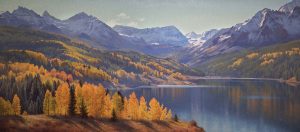
Trout Lake Aglow | Oil | 48 x 120 inches
Those sparks of ideas often first appear in Moore’s journaling, a practice he’s maintained religiously for decades. “I pay attention to those thoughts that send me in another direction,” he says. “When I’m painting, I go into the zone where I open myself up to subconscious ideas — I think most artists do. Sometimes journaling can bring up ideas that I want to try and often build on.”
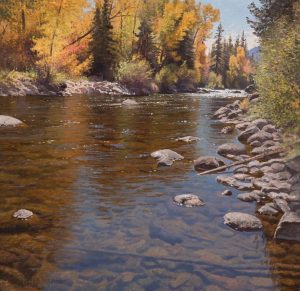
Blue River Allure | Oil | 30 x 30 inches
A couple years ago, an idea struck him about how to improve his studio and plein air practice, but it wasn’t necessarily about improving the technical side of painting; it was about nurturing his artistic soul. One journal entry led to the next until he had written down more than 50 ideas, including visiting art museums on a regular basis. His big takeaway: He needed to slow down. Amazingly, since following his intuition, incredible opportunities have come Moore’s way. “Maybe it’s a coincidence or maybe it’s come with this realization of how I can get better as an artist, so it’s a cause-and-effect situation,” he says. “The hikes led to more hikes and museum visits led to the desire to visit more museums. The changes are all behind the scenes.”
And then there’s this. Years ago, a gallerist told Moore that artists tend to do their master works before they turn 70; after that, he said, the quality isn’t the same. Moore was 50 at that time and figured, if that was true, he still had 20 good years to create his most masterful paintings. Fast forward a decade — he’s now 61 and had major back surgery two years ago — and Moore admits that the dealer’s words feel prescient. “The surgery really woke me up. It’s like, OK, I’m not as invincible as I thought I was. I’m in training now to rally and not let this be the time where I start to wind down my career. I know I have to work harder than ever to stay in shape and follow my stretching routine so I can keep painting. And I need to lose some of the stress I’ve put on myself for all these years. I purposely did not schedule as many shows this year; I don’t want to be under the gun. I just want to paint what I want to paint.”

Crystal Clear | Oil | 28 x 28 inches
Not only have collectors started to notice the shift in his work, but so did the public relations folks at Colorado Parks and Wildlife, who approached Moore to help them create ads for their recent campaign. “That was an awesome thing,” he says. “We were out in the middle of nowhere on the Blue River with a film crew and drones taking aerial videos for a 30-second spot that runs on streaming platforms. And they spun that off for a billboard campaign and printed ads. I’ve lived my whole life in Colorado, so it’s great to be part of their campaign to bring awareness to this incredible land we have here.”
This new introspection has further prompted Moore to consider painting on a grander scale. “Some landscapes are so magnificent that they have to be done on a large scale,” he says, offering another reason why he’s turning out fewer paintings these days. “I have a 54 x 72-inch canvas stretched and ready to go and a frame that’s 48 x 72 inches. Paintings on that scale just take more time, but they make a statement.”
An impeccable draftsman, Moore deftly handles passages in oil, melding translucent areas with subtle shifts in texture and gradations of color. When asked about his process he says, surprisingly, that he eschews underpainting with tonal washes, and instead finishes sections of each painting as he goes. In this manner, he focuses on completing key areas in order to find balance and accuracy, which allows him to finesse the development of a painting, rather than continually working back in and potentially losing focus of the intention he had when he started. “It’s like following a map that you create as you go,” he says. “I paint a 10-foot painting with the same approach as a small plein air painting.”

High in the San Juans | Oil | 36 x 48 inches
When asked what’s next, Moore points to a map of Colorado on which he started years ago positioning pins at each location he’d visited. Though he’s long since stopped adding pins, that map still nudges him out into the wilderness. “I use this map to see what places I haven’t explored yet,” he explains. “I was born and raised in Colorado, but I’m still finding backroads and trails I’ve never been to.” And as is his habit, Moore heads out alone. “I know it’s risky and I’ve had close calls, but I like to take diversions, change plans, or stay in one place for three hours. When I go, I go pretty hard. I hike a lot and stay late. My journeys don’t have a rhyme or reason; I rely on serendipity and have to go at my own pace.”
Painting in the field also allows Moore to absorb the environment and take in things that a camera just can’t capture. Besides, his paintings aren’t meant to be faithful representations of every rock and tree he comes across. “I think people would be surprised to know that 30 to 40 percent of any painting I do is from memory,” he says. “When I first started painting landscapes, I was trying to copy what was in front of me, but then as I went along, I started to edit scenes. That gave me the freedom to design and compose paintings. It’s like strengthening that muscle where you can do more from imagination. You can’t copy a plein air study or a photo literally. You have to break it down and build it back up to bring out your story and whatever it was that got you excited about that particular painting. Everything else has to bow to that idea.”
Recently, Moore was one of six artists invited to the Booth Museum in Cartersville, Georgia for a show titled Concept to Canvas. The exhibit, which runs through March 15, displays finished works surrounded by all the preliminary studies that went into making the final painting. But of course, any artist’s technique is only a fraction of the story; there are those subtle intangible things that elevate a painting to a work of art. “In the field, I often find myself in a state of awe. I get as excited as ever with simple little things like a field of grass with the sunlight hitting the blades as they wave in the breeze, and suddenly I can’t wait to paint it.”
When his brother died, Moore was badly shaken. They had been really close and traveled the world together. He wrote a song for him, with the line: We had so many places and mountains to climb, how was I to know we’d run out of time? “You know, there’s a term in mountain climbing called a ‘summit push.’ It’s when you’ve hiked a long way and the summit is in sight but you’re not there yet, so you take a deep breath and push on. I’m in the summit push of my career. I’ve come a long way, but still have a ways to go.”
Jay Moore is represented by Astoria Fine Art in Jackson, Wyoming; Shaun Horne Gallery, in Crested Butte; and Saks Galleries, Denver, Colorado.
No Comments