



29 Oct Art Moves In
The crates arrived before the architect did. At 8:30 on the morning of the photo shoot, American Women Artists (AWA) staff were unpacking paintings in a house made almost entirely of concrete and glass. The photographer, Luca Prodi, arrived shortly after. The homeowner, San Diego architect Matthew Segal, was at morning meetings. When he returned home around lunchtime, he found his home full of paintings and sculpture celebrating the American West.
An Extreme Pop-up Gallery
Since 1991, AWA has helped women artists build careers on equal footing with men. Its best-known effort is “25 in 25,” a campaign to secure 25 museum exhibitions for women artists over 25 years. “When AWA launched “25 in 25,” less than 5 percent of works in US museum collections were by women,” says Executive Director Andrea Bailey, who came to AWA in December 2024 after working in museums and foundations. “Today, that number has risen to 13 percent through the work of many artists and arts organizations.”
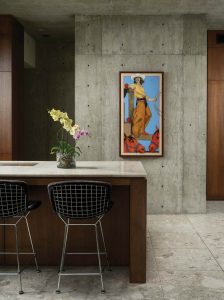
Donna Howell-Sickles’s Early Morning Consultation adds a pop of color to the restrained palette of concrete, stone, and wood in the kitchen.
Museum shows are central to AWA’s mission, but while planning its next one, A West of Her Own, opening in January at the Museum of Western Art in Kerrville, Texas, Bailey’s team saw an opportunity to do something completely unexpected: show collectors how AWA artists can instantly transform a home. “We don’t have opportunities to show our members’ work after it’s sold, so we created one,” Bailey says of the one-day photo shoot in Segal’s home. “We wanted to celebrate how art and architecture can work together,” she says. “And how one complements the other in unexpected ways.”
The Goldfinch House
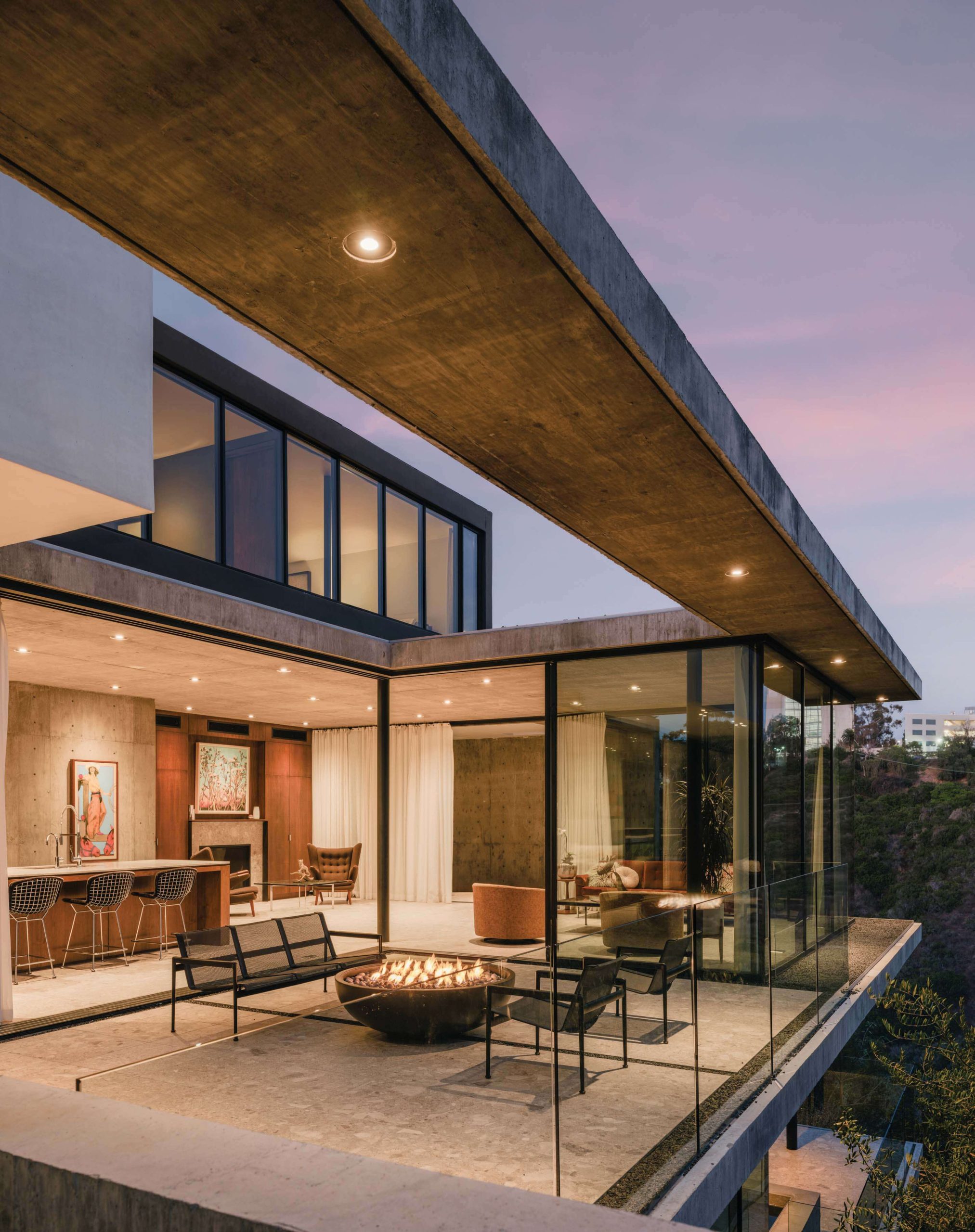
Segal’s house sits on a lot in one of San Diego’s older neighborhoods, 10 minutes from downtown. From the street, all that’s visible is a metal gate. A long path leads to a three-story house built into the hillside overlooking a canyon. The structural walls are tucked against the slope, and the house opens outward onto glass and cantilevered balconies. Segal compares it to the oaks growing on the canyon walls. “I think the house, in a very similar fashion to the trees, is grounded in the canyon, but it’s also projecting out like branches.”
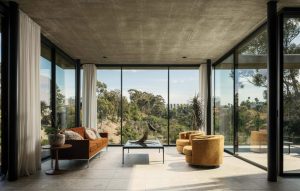
The Goldfinch House hugs the 40-foot vertical slope, with the living room looking south over a canyon in San Diego’s historic Mission Hills neighborhood. Grasshopper by sculptor Diana Reuter-Twining appears in the middle of the room, reminding visitors of the many critters living in the wilderness below.
Segal has worked with his father for 17 years in their architect-as-developer firm. They design, build, and finance mostly concrete multifamily projects that stand apart from the stick-frame housing around them. The canyon house, which Segal designed on his own for his wife and two young children, helped earn him San Diego’s Young Architect of the Year award.
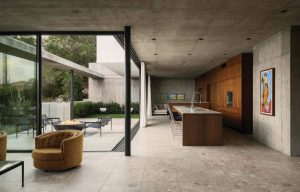
The view from the living room through the kitchen celebrates the clean lines of this fire-resistant, net-zero concrete hillside residence. The far wall is anchored by three oil paintings by Lori Putnam.
Concrete is Segal’s favorite material. “I would build everything out of concrete if I could,” he says. The material holds up against earthquakes and wildfires that he knows will eventually reach the canyon. He also likes leaving the imprint of the plywood forms on the walls rather than patching and painting them, so the surfaces carry the wood-grain texture. “There’s basically no upkeep. And
it’s indestructible.”
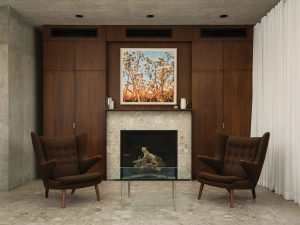
Hans Wegner chairs and a Mies van der Rohe Barcelona table frame the fireplace. Translucent drapery softens the space; Along the Fireline by Kathrine Lemke Waste sits in the niche and Lynx Lookout by sculptor Rosetta sits on the glass table.
To Bailey, the house was an ideal fit for AWA artists’ work. “Segal’s home is site-responsive, restrained, landscape-driven architecture,” she says. “The choice of a starkly minimalist home — beautifully designed to bring the landscape of the West indoors through huge windows, a unique site, and a neutral palette — allows the viewer to see Western art in a new way.”
Cowgirl as Icon
AWA curated the works for Segal’s house to interact with the architecture while also reflecting the American West. Bailey sees a direct parallel between Segal’s approach and that of one of AWA’s founding artists: “He turns the idea of ‘house’ into an icon,” she says. “Not unlike what Donna Howell-Sickles does by turning the cowgirl, once relegated to the sidelines in Western art, into the protagonist, giving her icon status.”
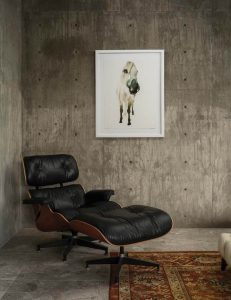
And Also, a watercolor by Carol Carter watches over the reading nook in the bedroom that features a Herman Miller Eames lounge chair and ottoman.
Howell-Sickles’s Texas cowgirl may have surprised Segal the most. “The cowgirl, I would never have chosen that for my house,” he admits. “But it looked absolutely great. The colors were vibrant. It popped.”
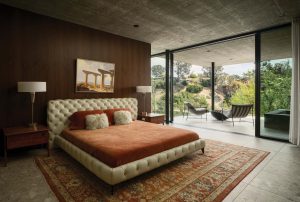
The main bedroom suite’s warm interior design creates a cozy feel that thoughtfully contrasts with the vast canyon view from the outdoor living space and spa. Over the bed, Carolyn Lord’s Eleventh Street Overpass Ruins speaks to built spaces beyond the canyon, symbolizing the dozens of California highways stretching across the state’s land.
Other works filled out the installation. Carol Carter showed a piece from her horse series. Carolyn Lord contributed a painting of the built California landscape. Kathrine Lemke Waste’s large watercolor Along the Fireline raised the theme of ecological vulnerability, which fits a house built to survive fire. Works by Diana Reuter-Twining, Kim Kori, Lori Putnam, and Liz Wolf were placed throughout the other rooms.
Finding Solutions
Hanging the show required improvisation; the last thing AWA staff wanted to do was make permanent changes to the concrete walls. So, they abandoned typical museum installation methods and opted for creative temporary solutions on the house’s unique surfaces.
And though letting AWA hang art on the concrete walls in his home — for one day — was a big ask, Segal says he agreed partly because his sister is an artist. “Women artists are underappreciated; they’re underpaid,” he says. But the opportunity also served as a surprising gift for Segal: Installing art changed the feel of his home and created “moments” that allowed him to see his work in a new light.
A West of Her Own
The art from the Goldfinch House will travel to the Museum of Western Art in Kerrville for A West of Her Own, which runs January 16 to April 17, 2027. And while the AWA serves more than 1,000 artists across North America, this show celebrates its founders: the Western women artists who banded together in 1991 for a series of exhibitions at the Tucson Museum of Art.
The mix of selected artists for A West of Her Own was drawn from AWA’s impressive list of masters. “Some of these members work exclusively in Western art and we challenged other artists who don’t consider themselves Western to create something new so we could see the West through their eyes,” Bailey says.
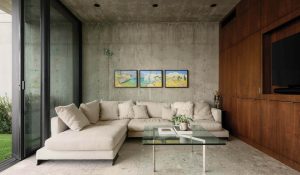
Triptych: Tribute to the Eastern Sierras by Lori Putnam adds to this comfy gathering space where the family hangs out or where individuals slip away to contemplate nature’s views or relax with a good book. High to the left of this triptych, Kim Kori’s Luna Moths float on the cast-in-place concrete walls as if they have just come in from outside for a short respite. To the right of the seating area, sculptor Liz Wolf’s The Guardian stands like a sentinel, looking back at the long architectural form that makes up the home’s main axis.
AWA’s 2027 juried exhibition for its 12th “25 in 25” initiative was already scheduled for Brookgreen Gardens in South Carolina, so the Kerrville show is an invitational featuring AWA’s Heritage Circle and Master Signature members, along with others from the general membership whose work fits the curation. “We hope this exhibit will open the door to more invitationals in addition to our annual juried museum exhibition,” Bailey says.
AWA is also reaching a wider audience with its message about the importance of women artists. Through mid-2027, the organization will be featured on public television stations nationwide in the Empowered series hosted by Meg Ryan.
As for AWA’s ambitious installation at Segal’s home, Bailey says, “If viewers see these photos and are motivated to take that visual journey with us and consider how architecture and art can work together to transform a space, then we have achieved an important objective.”
Segal was the first viewer to make that journey. “I wish everybody could have someone install art in their house, just to see how paintings and sculpture transform it,” he says. “It was a luxury I got to have for about 13 hours.”
WA&A’s editor, Rose Fredrick, is a major fan of American Women Artists and found this story of a one-day pop-up art installation simply amazing. You go, girls!
No Comments