





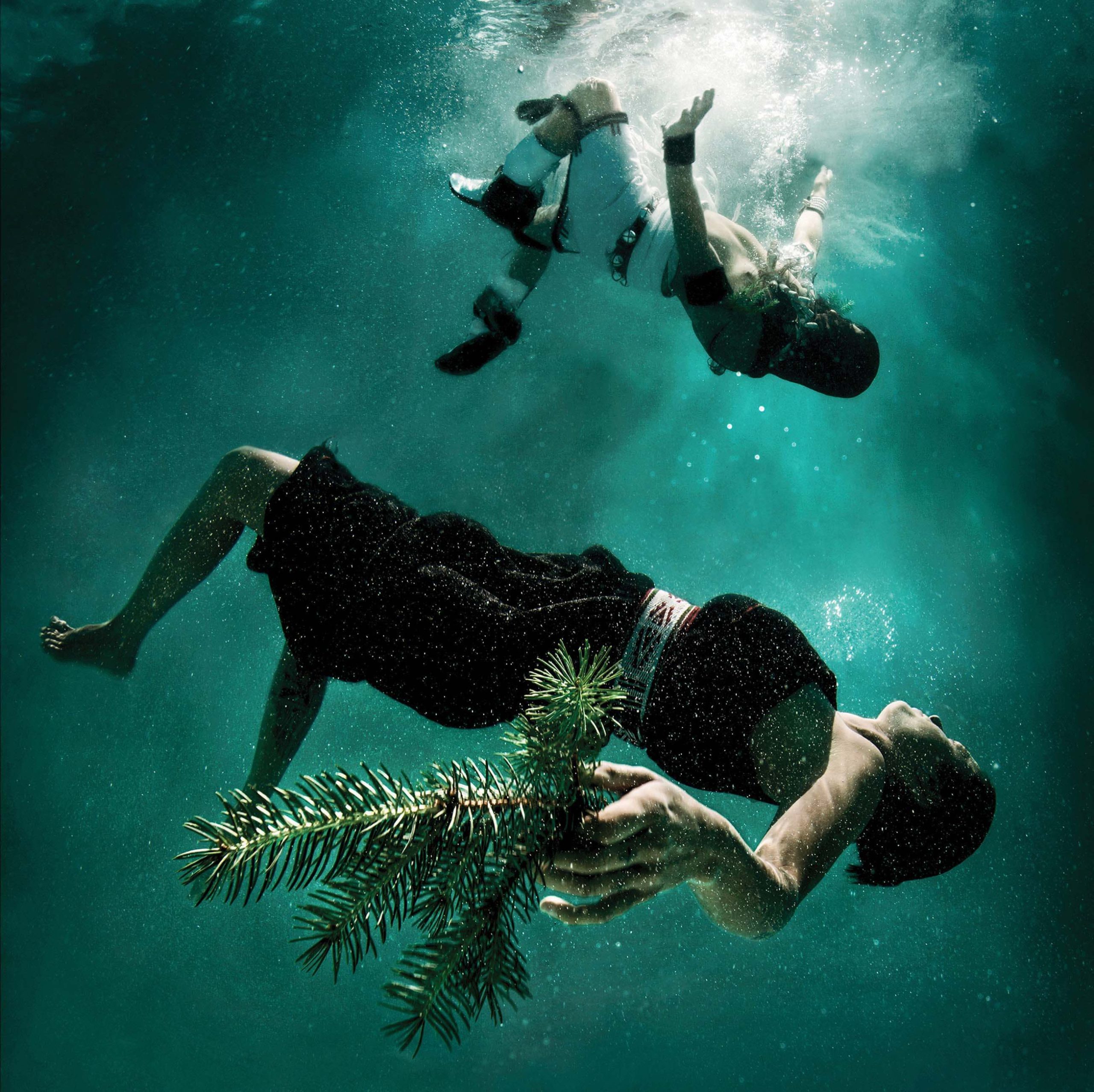
29 Oct Dream Weaver
If Cara Romero is not photographing with fire, she certainly is trying to ignite one. Romero is an artist-provocateur upending a tradition that has seen Native Americans and their images pushed into the pages of history. Her mission as a member of the Chemehuevi Indian Tribe and a fine art photographer is to instead place Native Americans at the center of an evolving present.
Romero’s works, which she calls staged photographs, are meeting grounds of truth and potential, of figures that bridge an ancestral past and an impending future.

Weshoyot | Archival Pigment Photograph | 2021 | ©Cara Romero, Courtesy of Cara Romero Gallery
In a time when Postmodernism and Late Modernism in art and architecture have battled for supremacy, Romero is bringing realism into focus with a flourish. That approach is evident in such images as traditionally dressed figures in juxtaposition with 21st-century objects and backdrops, which suggest the dotted line that reaches from the canons of Classicism to Contemporary Indigenous Art.
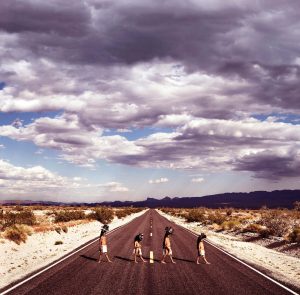
17 Mile Road | Archival Pigment Photograph | 2019 | ©Cara Romero, Courtesy of Cara Romero Gallery
“As an artist, you can just start the conversation; you don’t necessarily have the answers,” says Romero, whose solo shows have been staged across the US and Europe and whose works are in permanent collections of such institutions as the National Gallery of Art in Washington, D.C., the Autry Museum of the American West in Los Angeles, the Museum of Modern Art in New York City, and the British Museum in London.
A high-desert highway has never looked so evocative as it appears in Romero’s 17 Mile Road, a study of four Chemehuevi boys stepping out in Native American adornments. The photo is Romero’s reprise of the cover of The Beatles’ Abbey Road.
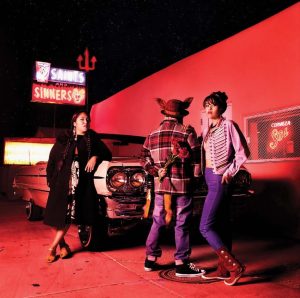
Coyote Tails No. 1 | Archival Pigment Photograph | 2018 | ©Cara Romero, Courtesy of Cara Romero Gallery
Yes. The artist has shaken, not stirred, the foundations of popular culture and asked us to share in a moment of celebratory laughter that starts from the inside and bubbles its way out.
Romero assesses her medium, photography, with the same long view that is her lens into the nature of nature, human beings, societies, and their mores.
“Photography is still the capture of light and time; the constant change is the technology,” she says. Her staged, cinematic, even theatrical assemblage of people, places, objects, and relationships is designed to create a narrative: the story of the story that Romero is writing in visual script.
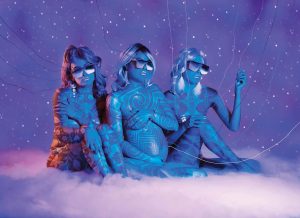
Three Sisters | Archival Pigment Photograph | 2022 | ©Cara Romero, Courtesy of Cara Romero Gallery
Three Sisters, a futuristic play on the trio of Indigenous peoples’ intertwined plantings of corn, squash, and beans, shows how adept Romero is at fostering a multitude of ideas under an overarching theme. Here, the artist has projected on the skin of each woman the patterns of her tribal affiliation. Wires attach at seminal points, including the heart, an electrifying portrayal of all that flows from the life within.
At the heart of the image is Romero’s own heart — and it is flowering. Romero was educated and formally trained at the University of Houston, the Institute of American Indian Arts, and Oklahoma State University, and her style evolved as she did. Vital to that evolution is the artist’s chief role, the one she cherishes above all — that of a mother.
Romero could boast of seeing her pictures in group shows in exhibitions that have played across the United States, including the Denver Art Museum and the Guggenheim, but the core of her joy is informed by her three children and husband, artist Diego Romero.
In fact, it was performing the mundane but necessary chores of the household that, ironically, helped give rise to Romero’s genius for digital storytelling. Where once she could freely trek through desert and mountain lands in search of outdoor images, or spend hours in the darkroom bringing what was hidden to light, family life demanded her presence at home.
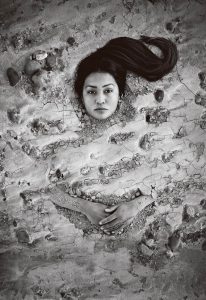
Sand & Stone | Archival Pigment Photograph | 2020 | ©Cara Romero, Courtesy of Cara Romero Gallery
“I had to find a different rhythm,” she says. “I would be creating artwork in my mind while folding clothes and washing dishes.”
Everyday tasks gave rise to great dreams, many of which Romero has realized.
The sole Indigenous owner of a gallery in the heart of Santa Fe, New Mexico, where the Romeros reside, the artist mentors young Native American women, working to give them the opportunities her own career has provided her.
In Western civilization, where more is expected of words than they can deliver, Romero stands out for her sense that artistic images can bring new worlds into view. She is captivated by the allure of extended metaphors.
“It is an idea of creating a moment that can be many things,” says Romero, whose solo show Living Light was exhibited at the Phoenix Art Museum through June 2026. “I can play with time. I can play with layers of subject matter. I can play with the subconscious. I can play with the real and the abstract. This is what I am in love with.”
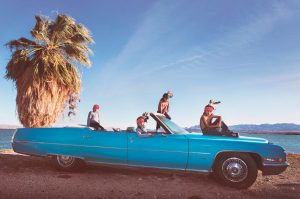
Shameless | Archival Pigment Photograph | 2020 | ©Cara Romero, Courtesy of Cara Romero Gallery
Romero is equally entranced by the prospect of opening for her three children — two of whom are adults, the third a teen — the heart of a mother who is an artist.
The fine art photographer is on an epic quest: documenting what she calls the great absence and the great presence.
It is not an unsolvable riddle. There is no Sphinx involved, no ill-fated plague, and no Grecian hero at the center of Romero’s undertaking. Here, she is speaking of Indigenous people, how they are at once seemingly vanished from their places of ancestry yet standing at the forefront of an America that they have both idealized and found wanting.
Romero is hopeful that, through images, she can connect with a community much in need of affirmation, spiritually and materially. The statistics concerning Native American women are readily available. But Romero is among those who insist no woman is a statistic; she is a full flesh-and-blood cosmos — thus, Oil & Gold, Water Memory, and Weshoyot.
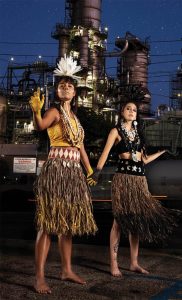
Oil & Gold | Archival Pigment Photograph | 2021 | ©Cara Romero, Courtesy of Cara Romero Gallery
“Women take on a central role in my figurative work. It is something I love and really wanted to explore as an artist,” she says. “I come from a community where there is a lot of gender equity; for example, my grandmother was the chairwoman of our tribe, and there are a lot of strong women on both sides of my family.
“When I left my community and ended up in mainstream America, I realized how unique my community was — and I could see that by contrast. I was taught to be strong, not submissive. If that is seen in my work, that’s part of my autobiography coming through.”
Sand & Stone, an archival pigment print, sees a woman’s clasped hands emerging from the earth’s rough surface. The hands are striking; more striking is the woman’s face, which gazes unblinkingly at the observer.
She is still but vigorous. She is the guardian of many secrets and the keeper of a vibrant heart that lies below deep layers of a life. She is a part of much that came before and of a future in formation. She is serious. And she is unafraid.
She is Cara Romero.
No Comments