


29 Oct The House That Art Built
Byron and Keely Lewis had outgrown their 1930s Craftsman home, where they’d lived happily for 30 years. More precisely, their art collection had outgrown the house, Byron’s office, and the guest house next door — they had even lent art to museum shows. Once they realized they had more than 300 really important pieces of art, they knew it was time to move. Better still, it was time to design a home for their art.
Byron had been collecting things since childhood. He met Keely when he was 19 and attending the University of Texas, and together they began collecting Depression-era glass.
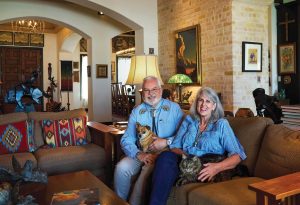
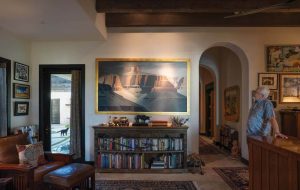
The Lewises in their living room surrounded by paintings and sculpture by their dear friend, the late Ed Mell. To their left is Mell’s bronze Jack Knife; behind them, the oil painting Canyon Sunset; on the brick wall, the monotype Bricklayer; and to their right, Mell’s bronze Hands of the Earth.
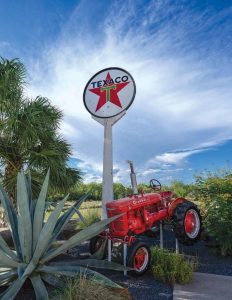
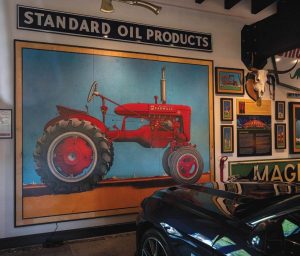
The couple’s eclectic collection spreads outside the home and includes a 1940 porcelain Texaco sign and a Farmall tractor.
Byron also had an aunt who was a self-taught painter. He’d always loved a certain still life of hers, but one day he entered her home, and the painting was missing. She explained the wire on the frame was broken, so the painting was propped behind a door. When he offered to fix it, she said, “Oh, honey, why don’t you just take it?”
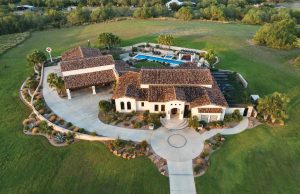
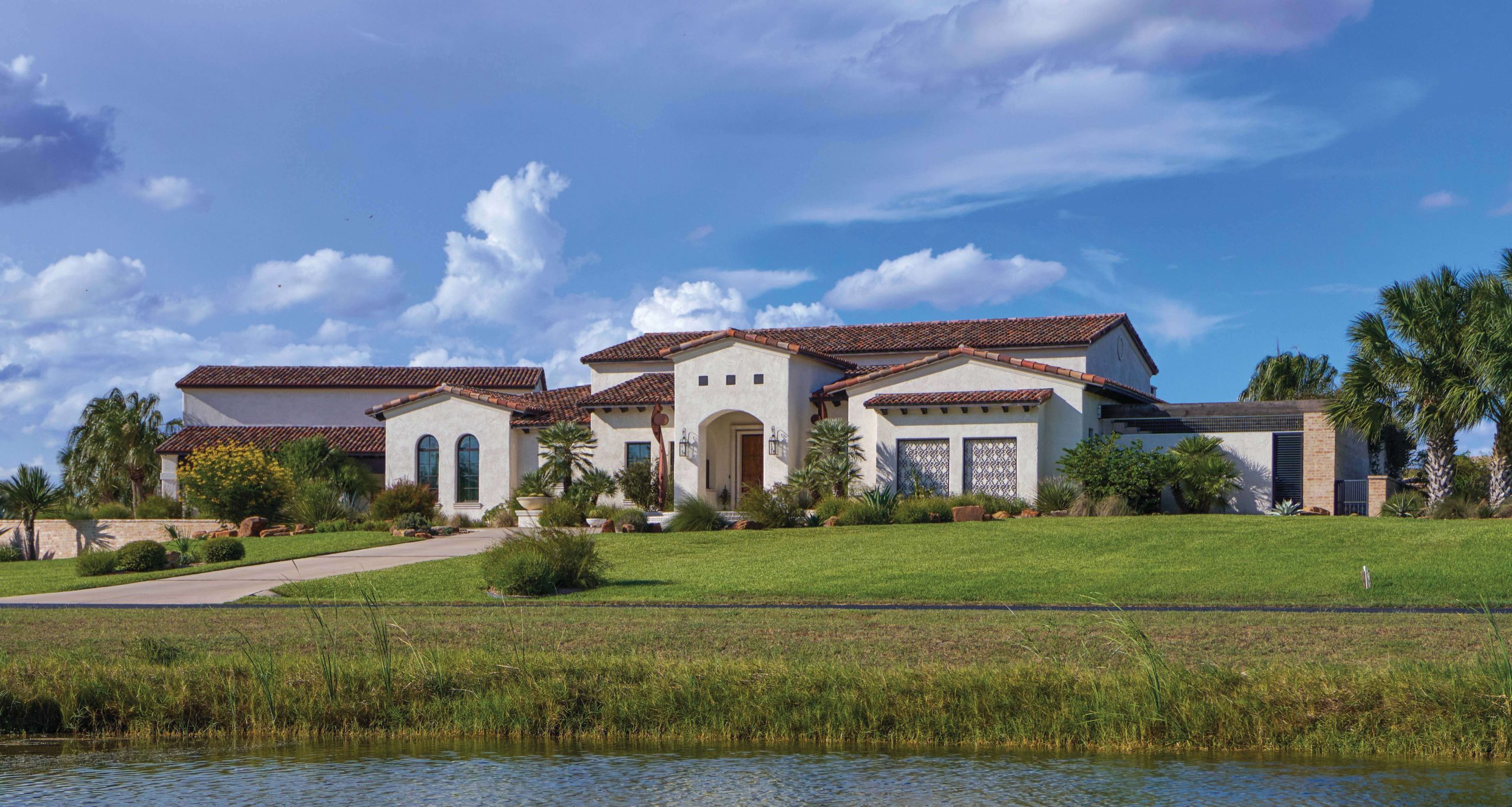
Aerial view of the house, which is tucked into the Rio Grande Valley.
“I was like a dog with a bone,” Byron says of the painting that launched the couple’s collecting in earnest. “After that, Keely and I started searching out original work from local artists.” But when they visited Santa Fe in the early 2000s, they were awestruck. “We bought one of Bill Haskell’s dry-brush watercolors,” Byron says. They met Haskell, who was making ends meet at the time by working at a gallery and painting in his off-hours; they remain friends to this day. “And we bought a Star York sculpture. From that point, we were off and running!”
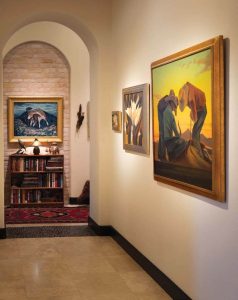
In the west hallway is a Lon Megargee oil, Two Horses. Below is a Dirk van Erp copper lamp. In the middle is an Ed Mell oil, Cactus Lily, and to the right, his oil Dusk Branding.
“Byron had started collecting Craftsman-style furniture and lamps,” Keely recalls. “And we went to an Arts and Crafts convention in California, where we met Eric Firestone from Arizona. He recognized Byron as a collector of beautiful things.” Firestone asked if they’d heard of Ed Mell, and when they said no, he mailed them a book of his work, which they loved. Then Firestone took things a step further.
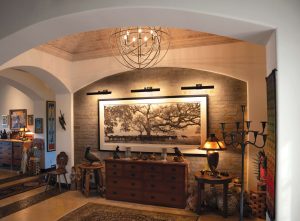
In the foyer, a photo by Jay Dusard, Brangus Heifers Live Oak Valley, is surrounded by bronzes by Stefan Savides, Star Liana York, Kent Ullberg, Mark Rossi, and to the far left, paintings by Angie Haskell, Lon Megargee, Joshua LaRock, and Mark McDowell, and sculptures by Leroy Ortega.
“Two big boxes showed up on our front porch,” Byron says. “I opened them, and there were these remarkably beautiful Ed Mell paintings.” Of course, they kept the paintings, and over the years, added many more.
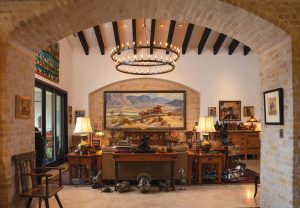
In the living room, the large painting is a Marjorie Reed oil, Stagecoach into the Valley; on the left, a William Haskell oil, Range Rover. To the right is an Angie Haskell acrylic, She Means Business, a Lon Megargee oil, Navajo Woman, and a Joshua LaRock oil, Wrangler. On the floor, Ken Law metal sculptures and John Kearney’s Cat, composed of car bumpers.
At the time, Byron says, the established galleries in Tucson, Scottsdale, and Santa Fe were very expensive and a bit of a closed world. “They had a circle of clients who were much older and wealthier than we were,” he recalls. “We were babies, and Eric had just busted into that world. He was like a bull in a china shop. But there were a lot of collectors who were at an age to start selling their art, and they found Eric, this enthusiastic, precocious young man.” One example of Firestone’s chutzpah: he searched the Tucson phone book for the address of the late artist Douglas Denniston, knocked on the artist’s door, and asked his widow if she had any more of his paintings for sale, which produced a trove of art.
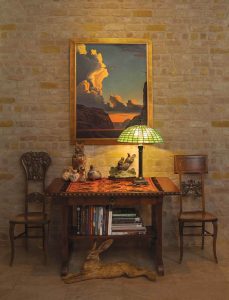
On the living room north wall is an Ed Mell oil, Canyon Sunset; on the floor, a Star Liana York bronze. The table is Stickley Brothers with North Wind chairs and a Goodwin lamp; Kintz Co. art glass lamp.
“Eric started offering us these wonderful things that had never been on the secondary market,” Byron says. “Probably 40 percent of our collection came as a result of Eric knocking on doors.”
Byron prefers to consider their collection as simply fine art rather than putting it into the narrowly defined category of Western art. “Western art,” he says, “can be modern, it can be traditional, it’s so much more than cowboys and Indians.”
In the primary bedroom is an Ed Mell oil, Canyon Storm, plus his bronze, Toro del Yermo.
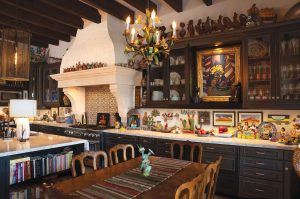
The kitchen cabinets were designed around a Lon Megargee oil, Still Life. On the table is a bronze by Paul Rhymer, Hummingbird.
One of the most rewarding aspects of their dedicated collecting has been the friendships they’ve made with artists. For many years, Ed Mell and his wife were among the couple’s closest friends.
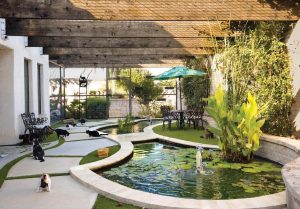
When the time came to build a lasting home for themselves and their large collection, the Lewises identified a plot of land on a vast, flat area along a low hillside. An engineer they talked to suggested hiring Hugo and Ceci Salinas of Superboy Architectural Design to do the landscaping and design the couple’s “catio,” the place where their 40 cats and six dogs could hang out. So impressed were they with the Salinases’ work that they asked them to do more, like help with the exterior. Then the interior. Then everything.
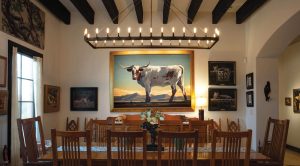
In the center of the dining room is an Ed Mell oil, Southern Arizona Longhorn. On the left is a Berry Fritz oil, Game Over. To the right, two charcoal-and-graphite drawings by Mary Ross Buckholtz, and on the table, an Ed Mell bronze. On the sideboard, a Paul Rhymer bronze.
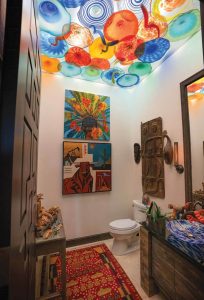
In the hallway bathroom, the ceiling is Mexican blown glass bowls, and on the wall are Sandra Urie’s oil, Valley Date Palm, and Angie Haskell’s acrylic, Southwest Road Trip.
“We’re more modern designers,” Ceci says. “They wanted a mix of Spanish Colonial and Mediterranean: Keely is more modern, Byron is more traditional. So the design had to reflect the marriage of these styles.”
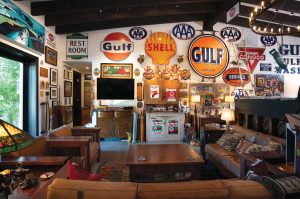
The garage gallery has a collection of ‘30s to ‘50s gas station signs, a Camillo Pardo painting of Byron’s Ford GT, and a Mark McDowell pencil on birch, Wyandott Mar Vista.
Since Ceci and Hugo are also art lovers, the next step was exciting. “They invited us to see the art collection, and we were amazed by how huge it is,” says Ceci. “So the main thing was to incorporate all the paintings in a way to do justice to the art.” The couple sent Ceci and Hugo a list with photos and dimensions of each painting. “It was very detailed,” Ceci recalls, “but we were happy, because that’s how you present an art exhibition in a museum.”
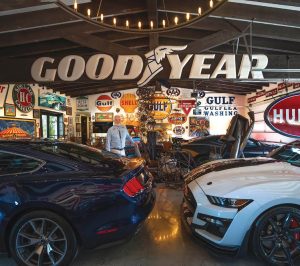
Also in the garage gallery are porcelain service station signs, another McDowell pencil on wood, and Byron’s car collection.
A koi pond runs through the wire-enclosed “catio,” where 34 of the couple’s 40-some cats live, along with several sculptures.
Hugo and Ceci not only designed the house; Hugo also ran the construction. “And then we did all the lighting for each painting,” Hugo adds.
“What drove the designs were our favorite paintings,” says Byron, acknowledging that sometimes a wall had to be moved to accommodate a large painting, which required more changes. But Ceci and Hugo were unflappable. “When I wake up, there are hand-hewn beams above us and morning light washes over Ed Mell’s Canyon Storm; it’s spiritual. I wake up and say, ‘I can’t believe we’re living here.’”
In the garage gallery are more wood works by McDowell, including a life-size portrait of the Farmall tractor.
“It’s been 10 years,” Keely says. “But Byron’s like the raven that sees the shiny, beautiful thing. If he loves a painting or a sculpture, he’s going to get it. I’m the one who’ll ask, ‘Where’s that going to go?’ We’re all out of space, but that doesn’t deter us. I think now our collecting is more driven by wanting to support emerging artists. We can’t help ourselves.”
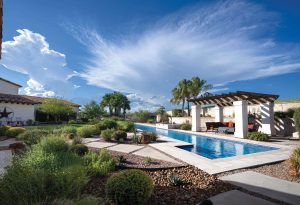
The pool area is the setting for sculptures by Mark Rossi, Star Liana York, Dick Hyslin, and Brian Wedgworth.
No Comments