


29 Oct Artist Spotlights: The Elegance of Form: Silversmith Kim Harrell Carries the Bauhaus West
Kim Harrell’s aesthetic can be articulated in three words: less is more. It’s a philosophy she embraced during the 14 years she spent living in London. She first looked for work where she could use her sociology degree from Colorado College. Then, she stumbled upon a bead shop. The bead shop led to making beaded jewelry, which led to more complicated jewelry, which, naturally, led to art school.
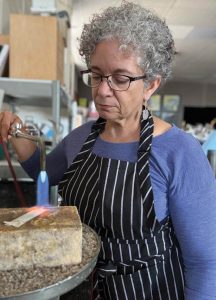
Harrell studied at London Guildhall University (now London Metropolitan University), where her traditional training leaned heavily on Bauhaus design. It still influences everything she makes. “Form follows function,” she says, repeating the movement’s credo and the root of her “less is more” approach to silversmithing, in which simplicity is beauty and decoration is found in subtle texture.
While in school, she worked for established silversmiths selling their work in Camden Market and Covent Garden. This, it turns out, was a great way to learn the business side of her chosen art. When she graduated, she was able to dive into working and selling right away.
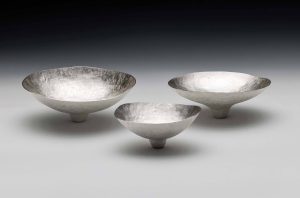
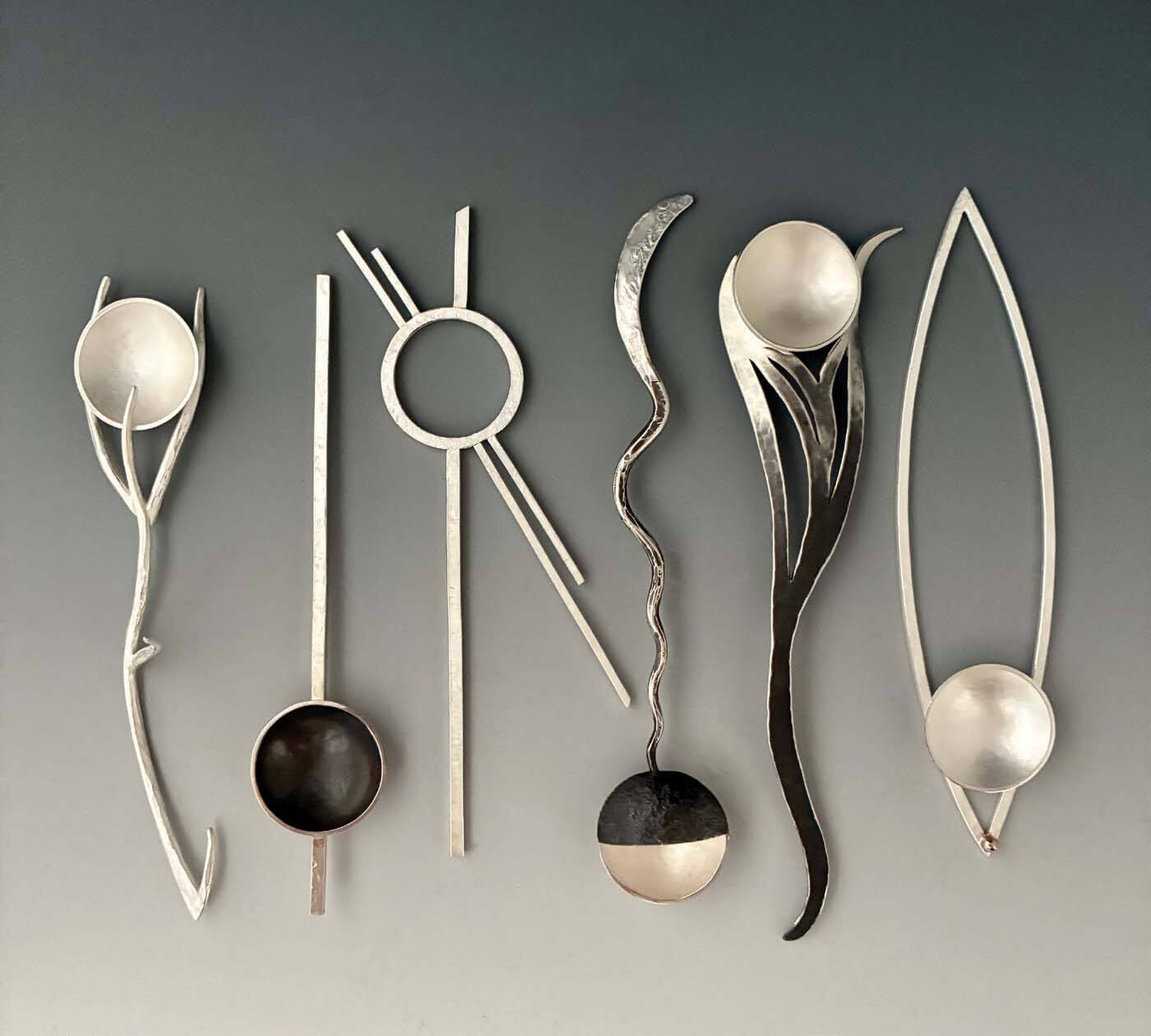
The Muses | Silver Vessels | 2.5 x 4 inches to 2.5 x 6 inches in diameter
Photo: Wes Magyar
A native of Denver, Colorado, Harrell learned the vocabulary of her trade in England. A silversmith and a goldsmith aren’t defined by metal but by object, she says. Goldsmiths make jewelry; silversmiths make pretty much everything else, from teapots to candelabras. Harrell built her early reputation on the latter, working primarily as a silversmith. But when she and her husband and young daughters moved home to the US, she had to relearn American lingo — and not just for her work. “When I came back to Denver, with three girls under five, all my baby terms were British. All my jewelry terms were British,” she says with a laugh. “It was a trip.”
But she discovered another issue that ran deeper than words. “I would call myself a designer-maker. This was in 2003. In Europe, designer-maker was a common term, and in England specifically, everybody knew what it meant: a person who went to art school and studied a specific craft or applied art. So jewelry and ceramics, they called applied arts instead of craft. Craft is more like what we Americans would call folk art,” she says, adding, “Craft was a dirty word in England, but here, the definitions totally flipped.”
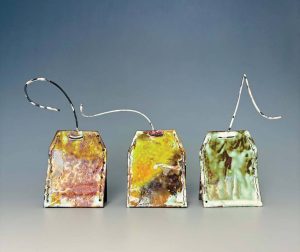
Enameled Teabags | Copper and Enamel | 2 x 1.75 x 0.75 inches
In America, she found, the term “silversmith” conjures images of Native American traditional and trading-post jewelry. So Harrell adapted her language without abandoning her identity: “I’m a silversmith and goldsmith,” she says, then explains the difference, but mostly as a way of signaling that what she makes is not beaded costume jewelry but handbuilt, custom work.
Hand-fabricated, by the way, is the operative term. Every piece that leaves her studio is shaped by hand — hammered, textured, formed with hand tools — never cast or machine-formed. Working in this manner is not only joyful but also led to discovering her signature style. Decades ago, forging a piece of silver against a scarred steel block, Harrell flipped the metal over and found the block’s grooves embossed on the metal. “I was like, ‘What is this?’” she recalls. Her next thought: “Actually, I kinda love it.” That same instinct led her to embrace overlapping seams, a signature design element that has come to define her work. Not only elegant, it is her unique way to solve an age-old problem: how to join a wide band of metal edge to edge.
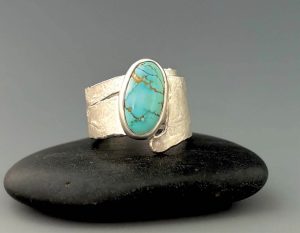
Nordic Sculptural Ring | Silver and Turquoise | 0.6 x 0.7 inches diameter
Harrell’s materials carry their own logic. She favors silver’s cool brightness over gold’s density. Turquoise recurs throughout her work, alongside Wyoming black jade, petrified wood, and moonstone, chosen for color and presence rather than provenance or price. Diamonds appear sparingly, often as rose cuts — a vintage, flatter cut with fewer facets than the more common brilliant cut — used to accent a piece rather than dominate it. And this is perhaps the best way to sum up the distinction between goldsmith and jeweler: rings that showcase a diamond held aloft on prongs, says Harrell, are made by a jeweler. “There’s no artistry.”
It may sound like splitting hairs, but that distinction matters to Harrell, who was invited by Art Students League of Denver to establish its first jewelry program in 2014 — not because the city lacked jewelry schools, but because her approach was that of an artist. Further recognition: her silver spoons are held in the permanent collection of The Kirkland at the Denver Art Museum, an institution she calls “my home away from home” for its trove of Bauhaus art and objects.
Now in a season of transition, Harrell has been experimenting with liquid white enamel on copper, still asking the question that has driven her for 30 years: what can these hands make next? What hasn’t changed is her sense of purpose. “Collectors who buy my work are not just paying for material and time,” she says. “They’re paying for the idea, the inception, the creativity.” And collectors have come to think of her work differently, too. Instead of being another pair of earrings or bowl to dust, Harrell’s creations mark something — a marriage, a promotion, a grief. “These things are not just baubles,” she says. “They have meaning.” To learn more, visit khsilversmith.com.
No Comments