




29 Oct Artist Spotlights: The Elegance of Form: Heath Ceramics: Keeping Craft in Conversation
When Cathy Bailey and Robin Petravic bought Heath Ceramics in 2003, the company Edith and Brian Heath founded in 1948 had shrunk to fewer than 30 employees. Those employees were still making dinnerware in the Sausalito factory the company has occupied since 1959. More than two decades later, Heath has grown into a touchstone of California modern design, with an architectural tile factory, a clay studio, and showrooms from San Francisco to Austin. Bailey and Petravic are now stepping back into roles as co-chairs and brand stewards. Here, they talk about Edith’s legacy, the art of restraint, and setting Heath up for the next generation.
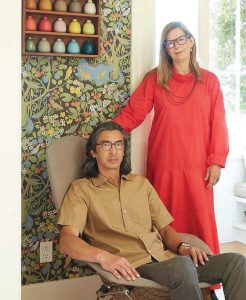
Heath Ceramics owners Robin Petravic and Cathy Bailey.
Q: What drew you to Heath?
The strong connection between design and making — you could see the whole process under one roof. In the US, that was often lost as companies scaled up and sent manufacturing elsewhere. We were also deeply inspired by Edith’s legacy: work rooted in material, function, restraint, and a distinctly Californian way of thinking. We didn’t want to preserve Heath as a historical artifact; we wanted to give it a future.
Q: How would you describe the signature Heath style?
Edith was very interested in restraint. Her objects were functional and beautiful but never decorative for their own sake. She paid enormous attention to proportion, touch, weight, and the relationship between clay and glaze. We still use the clay body she developed from local materials. Its warm, fine grain becomes part of the visual language, even under glaze. We develop all our own glazes, and we treat glaze as a material with its own behavior: it moves, pools, breaks, and reveals the clay. The wiped edge, which exposes natural clay at the rim, has been an unmistakable Heath detail for decades. And we celebrate the variation of handmade work. It reminds you that people made the object.
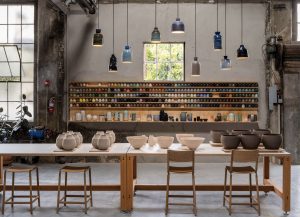
Opened to the public in 2023, the Heath Clay Studio and Gallery in the Boiler Room welcomes visitors and ceramic enthusiasts. Photo: Kelsey McClellan
Q: What new items have you added since 2003?
The Large Mug was our first new design. Since then, we’ve added dinnerware forms, glazes, serving pieces, tile, flatware, and objects for the home. We always anchor new work in the Heath archive. The 2026 Annual Edition, for example, revisits Edith’s Landscape glazing technique from the 1970s. And the Heath Clay Studio gives us room to experiment outside our core production lines. Everything there is hand-thrown, often in limited or one-of-a-kind runs.
Q: I notice you now offer tiles. Are they bespoke or standard?
Mostly made to order. Our Classic Field collection alone includes 21 shapes and sizes, more than 100 glazes, and 36 patterns. We also offer Dimensional, Dual Glaze, Arc, and Mural collections. Each project is made specifically in our San Francisco tile factory. The natural variation in size, surface, and glaze gives an installation a depth that uniform industrial tile can’t achieve. Some projects are deeply collaborative. For the Norton Simon Museum’s facade restoration, our team recreated the tile Edith originally developed for the building. That work earned her the 1971 AIA Industrial Arts Medal, and she was the first non-architect to receive it.
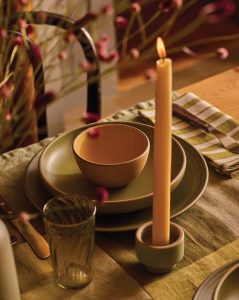
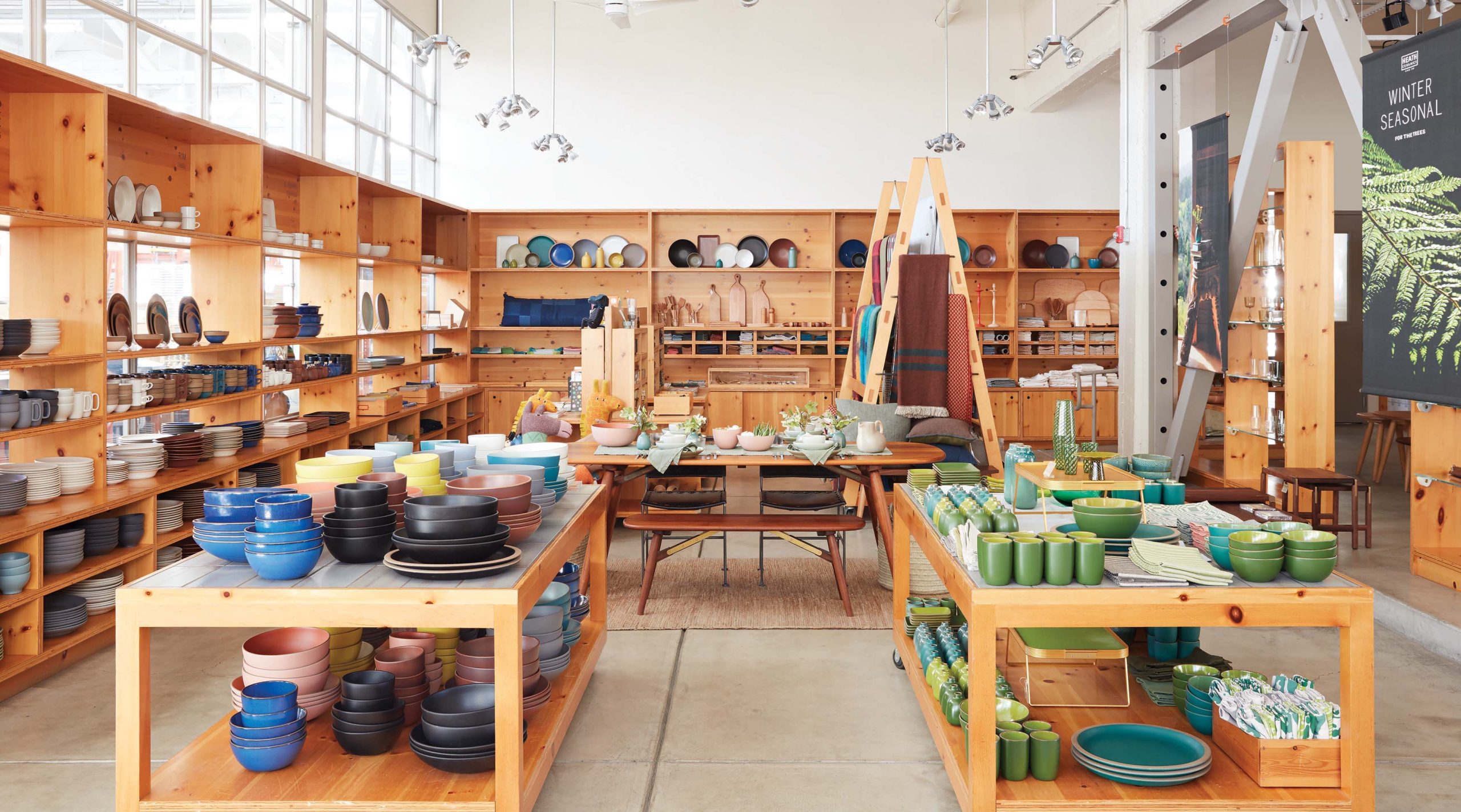
The earthy, warm tones of Heath’s 2026 winter seasonal offering sets the perfect mood for entertaining.
Q: Why expand into lighting and other goods?
We think of Heath as a design company anchored in ceramics, but we’re interested in the broader landscape of everyday life: how we eat, gather, and light a room. The Clay Studio experimented with ceramic lighting for years. Rather than making clay behave like another material, we asked what its weight, opacity, and surface could bring to lighting. We also carry textiles, glassware, and furniture from makers who share our values.
Q: How did the Herman Miller collaboration come about?
Both companies believe deeply in the relationship between design and manufacturing. The resulting Gathered Collection pairs historic and new work. The Studio Mug is an Edith Heath design from the 1940s, while the Coupe Dinner Bowl is a new profile inspired by the archive. Every piece was made in Sausalito from our California clay and was formed, trimmed, glazed, and finished by hand.
Q: What role do the seasonal collections play?
Our core collection is intentionally stable, so people can build on it year after year. The summer and winter collections give our designers freedom to explore a new glaze, form, color, or collaboration. Last fall, I spent time in Norway, walking through a landscape dusted with the first October snow. The clouds moved faster, and the light hit them more dramatically. The greens were set off by a yellow unlike the fall grasses of Northern California. I painted watercolors there and carried that feeling into our Winter Seasonal Collection.
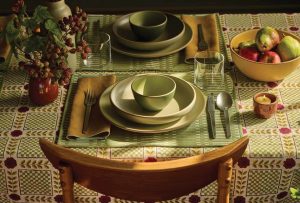
Heath creates seasonal designs made to mix and match, as shown here with the winter series. Photos: Nicola Parisi
Q: Tell me about your spaces and classes.
They’re places to learn, meet, make, and engage with the work, not just places to shop. The 1959 Sausalito factory still produces all our dinnerware, and we offer tours there. In San Francisco, the Heath Collective brings together our tile factory, showroom, Clay Studio, gallery, and offices. There we offer factory tours, hands-on making and glazing workshops, artist conversations, and events with chefs and designers. Our Ferry Building, Los Angeles, and Austin spaces let us take part in other communities.
Q: Is everything made in-house?
All Heath dinnerware and tile is made in our two Bay Area factories. When you hold a plate, you’re seeing the work of designers, mold makers, jiggerers, glazers, kiln operators, material scientists, and many others. Keeping design and production close means we solve problems together rather than passing them down a long chain of suppliers.
Q: What personal projects are you working on?
We spent several years designing and building a retreat in West Marin for workshops and creative gatherings. We recently sold it so we could start again on Lopez Island in Washington with a similar vision. Cathy also designs and makes beads and buttons in Heath clay.
Q: What does the next chapter look like?
Stewardship. We’ve stepped away from the day-to-day, and in 2026 Heath transitioned to purpose trust ownership, so its purpose can guide the company beyond any one owner or generation. Edith and Brian built Heath through complementary strengths, and Heath is strongest when creative and operational thinking are in conversation. To learn more, visit heathceramics.com.
No Comments