



29 Oct Perspective: Emerson Woelffer (1914–2003)
For Emerson Woelffer, the Great Depression was a good thing in one important, unexpected way. As a teenager in Chicago in 1931, Woelffer quit high school to earn money for his family by driving trucks. He somehow ended up making liquor deliveries for the Capone mob, which took him to the Arts Club of Chicago. There, he had his first encounter with African art. It became a major influence in Woelffer’s work, as it was for many modernists in Europe and the United States, including his future peers.
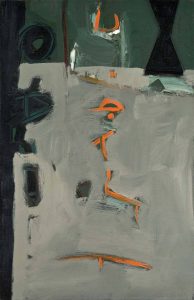
Winterscape | Oil on Canvas | 34.125 x 22 inches | 1955 | Courtesy of the Norton Simon Museum, Gift of Mr. and Mrs. Harold P. Ullman
For such artists, African, Oceanic, and other Indigenous art represented a level of authenticity and spontaneous expression to which they aspired. They saw earlier cultures as continuing an unbroken connection with nature that had been severed in the Western world through the Industrial Revolution, world wars, and modern life.
“These artists were looking back in time to reconnect with the natural order, to get back to the source,” says Denver-based collector Rob Lewis, an advisory board member for the Petrie Institute of Western American Art at the Denver Art Museum. At the same time, their work was a reflection of the times in which they lived. As Ed Ruscha, a California-based conceptual and pop artist and a student of Woelffer’s in 1960, puts it, “His paintings included simple elements that are indicative of the noise of modern life in all its complexities.”
Through improvisation, Woelffer and other artists attempted to connect with their creative source and tap into the unconscious to bypass the rational mind and traditional artistic structures. As it happened, growing up in Chicago put Woelffer in the perfect time and place for encounters with extraordinary feats of improvisation — in music. He frequented jazz clubs where unscripted flow was the hot trend. He had many musician friends and was a jazz drummer himself.
Modern art came to Woelffer’s attention in the mid-1930s while he was a student at the Art Institute of Chicago, where he paid his way by working as a janitor at the school. While studying drawing, anatomy, still life, portraiture, printmaking, and sculpture, and absorbing highlights from centuries of art history, he earned money for studio materials by taking odd jobs at the avant-garde Katharine Kuh Gallery. He was electrified by what he saw there. He began attending exhibitions and reading art journals, following such movements as Surrealism, Cubism, German Expressionism, and the Paris art scene.
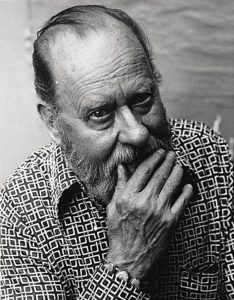
Portrait of Emerson Woelffer, courtesy of Peyton Wright Gallery
Robert Motherwell later wrote that Woelffer was “as literate about modern art as any American whom I had encountered.” Over the years, Woelffer paired this expansive knowledge with a distinctive visual voice and artistic daring that made him both a significant postwar American artist and a highly respected teacher.
Woelffer is often described as an Abstract Expressionist, alongside such painters as Jackson Pollock and Mark Rothko. But to place him in any one category is too limiting, says Francis Mill, co-owner of Hackett Mill Gallery in San Francisco, which has handled Woelffer’s art for many years. “We need to break the conventional boundaries that define him.”
Art historian and museum director Gerald Nordland, in a catalog essay for a 2003 solo exhibition of Woelffer’s work shortly after his passing, wrote that although the artist admired some of what was produced in various areas of modernism, he “rejected most of it as empty exercises.” Rather, he was “searching for an opening that served his need to understand the modern mind. He felt it necessary to work directly from inner impulse, avoiding references to nature and making a wholly new thing.”
Yet Woelffer was also in frequent conversation with brilliant creative minds from interdisciplinary fields. In 1942, he was invited to teach at the Institute of Design in Chicago, an experimental school of art and design modeled on the Bauhaus movement in Germany. His teaching rotated between painting, sculpture, photography, and design. He was as stimulated as his students were by the environment and his fellow instructors, among them the acclaimed architect and inventor Buckminster Fuller.
Woelffer also continued playing drums and appreciating jazz. At one of many social gatherings at his Chicago studio, where musician friends often brought their instruments, he met Dina Anderson, a student of photography at the Institute of Design. They married in 1946 and over the years filled their home with books, records, and African, Oceanic, and Native American art.
In 1949, Fuller invited the artist and his wife to spend the summer teaching at Black Mountain College, an experimental art school near Asheville, North Carolina, with a strong interdisciplinary focus. By then, Woelffer had begun to gain national attention. His work was included in exhibitions at the San Francisco Museum of Art and the Whitney Museum of American Art in New York City, and he had his first solo gallery show in New York.
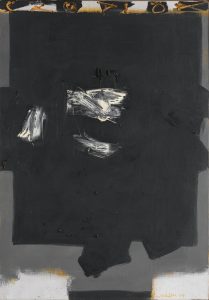
Black and White | Oil on Canvas | 39.5 x 27.75 inches | 1959 | Courtesy of the Norton Simon Museum, Gift of Mr. and Mrs. Paul Kantor
When the Black Mountain summer session ended, Emerson and Dina traveled to New York, visiting galleries and museums and meeting the artists Willem de Kooning and Barnett Newman. Jackson Pollock tried to convince the couple to stay in the city and Woelffer to seek permanent gallery representation there, but they chose not to. Mill believes the decision likely contributed to Woelffer being more marginalized by critics and less well known than if they had stayed.
Instead, they spent the next six months on Mexico’s Yucatán Peninsula, where Woelffer painted daily and he and Dina visited Maya sites, pursuing their shared interest in past cultures that lived close to the earth. That interest expanded to Native art and cultures of the Southwest when Woelffer was invited to teach at the Colorado Springs Fine Arts Center in 1950.
In Colorado, his use of improvisational, automatist techniques — aimed at getting the mind completely out of the way — included brushes with four-foot-long handles and large canvases laid out on the studio floor. “He was trying to mine the unconscious,” says Lewis, who believes the artist’s palette, geometry, and imagery were influenced on a deep level by the landscape of the American West. Mill considers the painting Colorado (1954) a “watershed moment for how he worked. It’s layered, there’s no hierarchy of figure and ground. It’s in more contemplative earth tones.”
Those somber hues and an even more pared-down approach continued when the Woelffers spent 18 months on an island in the Bay of Naples after touring France, Spain, and mainland Italy. “Woelffer always said that he worked best when he was alone, away from artists and galleries,” Nordland wrote.
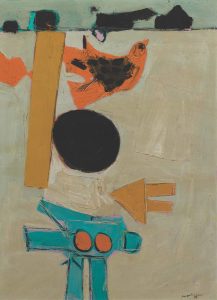
Birds and Black Sun | Oil on Canvas | 40 x 30 inches | 1956 | Courtesy of the Robert G. Lewis collection
When the couple returned to America in 1959, Mitchell Wilder, the man who had invited Woelffer to Colorado Springs, was by then director of the Chouinard Art Institute in Los Angeles. He recruited Woelffer to head the school’s arts department, and Southern California remained the artist’s home for the rest of his life. Along with painting and teaching, he enjoyed a long association with the Tamarind Lithography Workshop in LA, established in 1960 by June Wayne, an old friend from Chicago.
Teaching, at Chouinard and later at Otis Art Institute in LA, became an increasingly significant part of Woelffer’s artistic legacy. Among his most well-known students were Janet Lippincott at the Colorado Springs Fine Arts Center, and Ed Ruscha, Larry Bell, and Joe Goode in LA. Lewis notes that Lippincott described Woelffer as “tremendously supportive of her and other women’s art at a time when women were often discouraged from entering the field.” He was known as an engaging instructor, often teaching with a cigarette in one hand and a bottle of Coca-Cola in the other. He shared with students not only his artistic knowledge but his enthusiasm for jazz and primitive art.
Ruscha remembers Woelffer inviting students to his home to listen to records and experience his collection of African sculpture. Teacher and students hung out together at jazz clubs, met for lunch in Chinatown or at Mexican restaurants, and attended art openings. “He would tell us, ‘You should go see the Renaissance show at the County Museum [Los Angeles County Museum of Art],’” Ruscha recalls. “It was really a nourishing experience.” Just as importantly, Woelffer “didn’t pontificate. He would explain in easy-to-understand terms.”
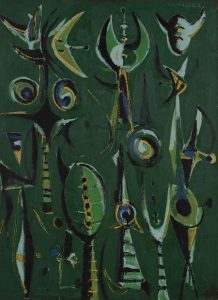
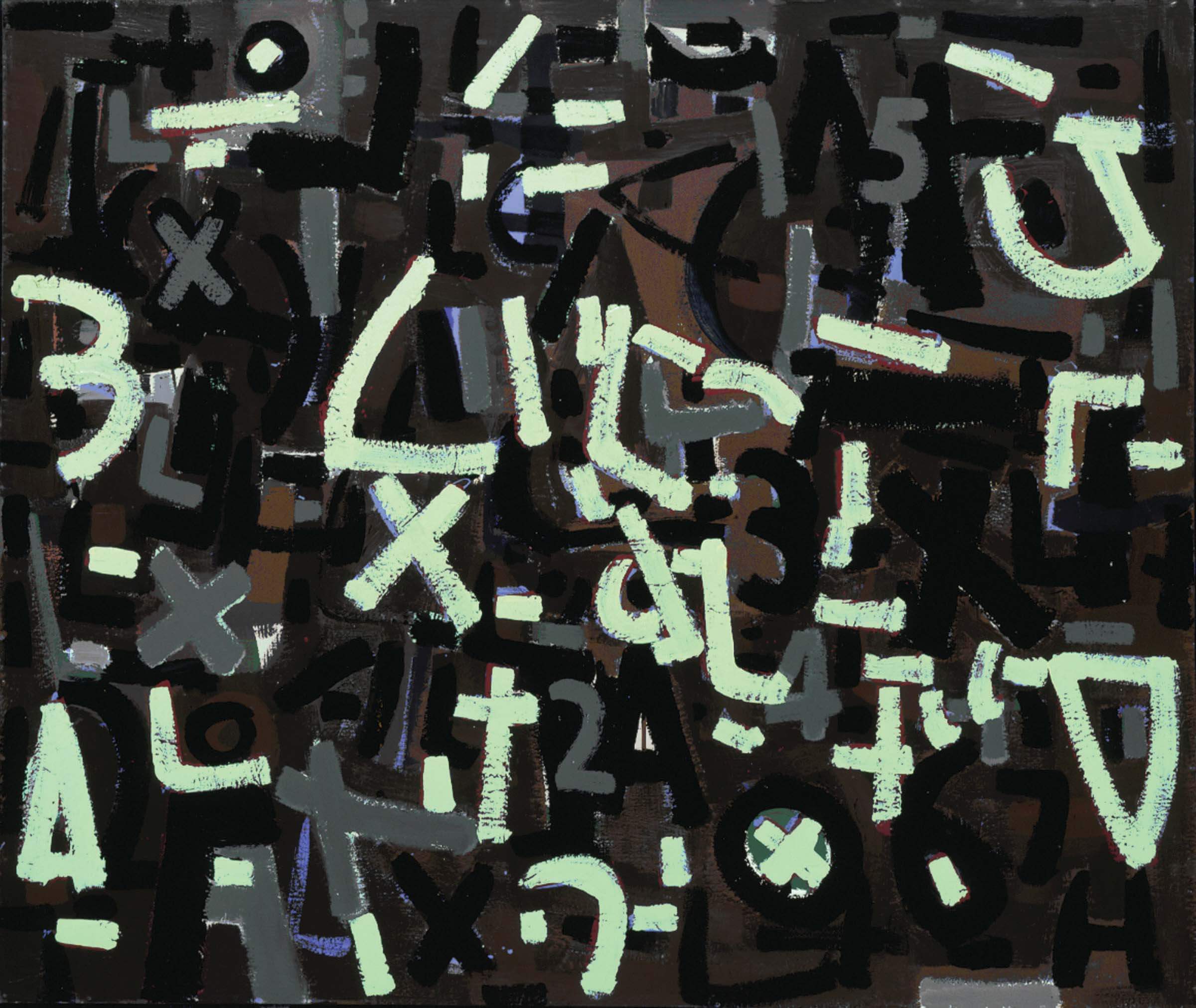
Inner Circle | Oil on Canvas | 47 x 35 inches | 1949 | Courtesy of the Norton Simon Museum, Gift of Casey Wasserman
Mill sees Woelffer’s work as continuing to teach both artists and viewers how to perceive not only the art itself but also the process behind it. In contrast with today’s culture, which celebrates the shortest distance between two points, the gallerist notes that for Woelffer there were “no shortcuts. His art was filled with dead ends, looking, experimenting. There was never one linear direction. He painted with the risk of not knowing where it would end up and he encouraged that with students.”
Ruscha agrees. “His work didn’t look like other people’s art, it looked like Emerson Woelffer’s art,” he says. “It had a clarity to it, and also some newfound element that would show up and that was always surprising and instructional for us as young artists. I can’t think of anybody that didn’t get something deep from him.”
No Comments