



30 Dec In the Studio: Prairie Skyscraper Atelier
Grain elevators have been landmarks of the West since the heyday of their construction in the 1920s and ’30s. With their tall, shouldered silhouettes and industrial cylindrical shapes, these architectural icons have long acted as beacons signaling from afar the location of the next settlement for trail-weary travelers.
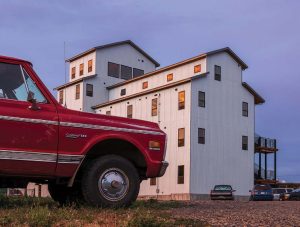
But these “prairie skyscrapers,” once symbols of a frontier town’s prosperity, are being torn down not only because they are unstable but because the value of the land beneath them has increased exponentially. As a cruel twist, the aged and patinaed lumberis highly sought after, as reclaimed rustic accents lend new structures instant authenticity. At one time, as many as 30,000 of these distinctive silhouettes dotted America’s rural landscape; fewer than a third remain today.
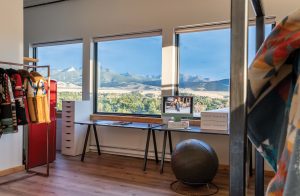
The first person to commit to an apartment, designer Lindsey Thornburg also took the space at the top of the historic grain elevator for her studio. A light-filled aerie, the studio offers sweeping views of the Crazy Mountains and the Absaroka-Beartooth Wilderness. Her desk and custom racks filled with recent designs are from LaMar Metalwork.
Third-generation Montanan Lindsey Thornburg had been scanning online rentals in south-central Montana for several years when an intriguing new listing in Livingston surfaced. The 100-year-old Yellowstone Granary had been saved from demolition by a group of local architects and contractors who stepped in to renovate the structure and create apartments in a region hard-pressed for affordable housing. The challenges of rehabilitating a building whose center rests on stacked timbers with overlapping corners and is comprised of grain cribs and conveyor systems were significant. Jordan Zignego, assistant professor of architecture and director of Montana State University’s Community Design Center, explains, “It would have been far less expensive to tear down the structure and build something new, but we wanted to honor this 100-year-old landmark.”

Thornburg, wearing her iconic Tumalo Ridge Shearling Duster, enjoys a “spacious mental clarity” that she couldn’t get in New York. “It allows me to move more slowly and look at things from a less complicated mind. My focus is much clearer.” Photo: T Lamar
Thornburg was the first to commit to renting. “I fell in love with the project,” she explains. “It’s like living in a piece of history. The walls are two-by-fours stacked atop each other, and because it was an elevator, the [cascading] grain eroded the walls away. So, it has this depth, like carvings. The walls have history and art within them. And I was so aligned with what the owners were doing; they were so passionate about the history and about bringing this structure back to life.”
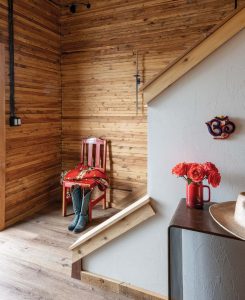
For the fashion designer, moving into the refurbished silo was a return home. She grew up in the Pacific Northwest and Colorado, and attended college in Santa Barbara and design school in Los Angeles before moving to New York City, where she began crafting and hand-selling her clothing designs directly to the public. But Montana has always been her constant — the place her relatives lived and worked, the home of her summer memories, and an unending source of inspiration for her designs and the Western aesthetic they represent. She had also long maintained a concept store/art installation in nearby Paradise Valley. And while each of her garments is handmade in New York City’s Chinatown, her distinctive cloaks and coats are all about her connection to the West.
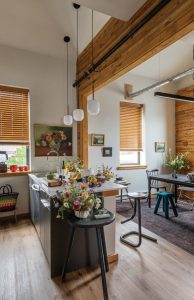
In the kitchen, midcentury-modern stools by Hugh Hamilton & Philip Salmon are combined with vintage stools found at Kithship in Livingston, Montana. The still life painting was purchased at Architect’s Wife in Bozeman.
Known for her capsule collection of timeless and easy-wearing dresses, it is, however, Thornburg’s outerwear that speaks most evocatively to her sense of Western place. She has been formally collaborating with Pendleton Woolen Mills since 2011, crafting wearable art from vintage blankets woven by the iconic company. Her signature cloaks — as likely to be seen on the streets of New York and Milan as on the set of “Yellowstone” — are made from traditional Native American-inspired Pendleton patterns, realigned into strikingly beautiful garments built to last a lifetime. The co-branded collection, Pendleton by Lindsey Thornburg, is available in specialty boutiques, online, and at Pendleton’s Home Store in Portland, Oregon.
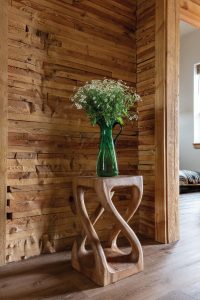
The deep grooves and patterns in walls made from stacked two-by-fours were created by tons of cascading grain; they lend warmth and patina to the space.
Thornburg’s apartment is spread over two levels; its spaces infused with warmth, texture, and a palpable sense of history from the wood cribbing, some sections deeply scoured from the passage of grain along the walls. Exposed pipes along the ceilings create a raw contrast to the expansive views. She “commutes” to her office/atelier at the top of the grain elevator, a light-filled aerie. The large, open space has windows on three sides, with sweeping views over the town and railyard, to the Crazy Mountains and the peaks of the Absaroka-Beartooth Wilderness — providing endless inspiration. The studio is serene and minimally furnished, in deference to the drama provided by the views, as well as to the practical necessities of a clothing atelier, where one needs room to move. To that end, colorful garments on custom-made racks can be easily rolled from one side to another. Her desk sits directly in front of the window.

Thornburg juxtaposes unexpected elements from different eras to striking effect, like a lamp with a fringed shade made by her aunt, Jenny Thornburg, a blue paperclip stool purchased at Clic Gallery in New York City, and bear skull artwork by her photographer friend, Christopher Campbell.
Thornburg’s approach to interior design in both spaces has been one of restraint. She prefers to build layers over time to fully express her Montana persona. From a patinaed copper vanity made by Bozeman artisan T. Lamar to found stools to a rodeo clown painting by C. M. Okerwall and bear skull artwork by photographer Christopher Campbell, each item is imbued with meaning. A modern aesthetic mixes comfortably with vintage, handcrafted, and found items Thornburg combines for a striking effect. An early, rare Pendleton blanket rests atop her bed, while 1970s modernist “paperclip” stools from Hugh Hamilton & Philip Salmon tuck under the kitchen counter, and a vintage chair is paired with a bent metal table from LaMar Metalwork.
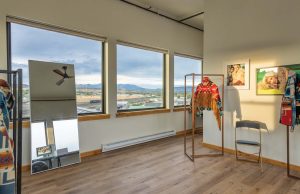
Thornburg’s designs are directly inspired by the land, lifestyle, and history of the West just outside her windows.
The artist juxtaposes unexpected elements; she’ll place a lamp with fringed shade made by her aunt, Jenny Thornburg, with a blue paperclip stool purchased at Clic gallery in New York. “My aesthetic is like Parisian flea market meets psychedelic Western,” she says with a laugh. “Oddly, they all play into each other very well.”
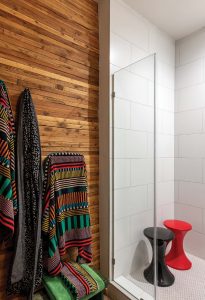
Modern meets rustic in the bathroom. The shower stools were purchased at the SFMOMA store in New York.
Having a base in her spiritual home state has proven crucial to Thornburg’s work. Montana lies at the heart of her firm’s branding and marketing, both of which feature strong Indigenous women and celebrate the extraordinary landscapes of the American West. More crucially, she says, being in Montana affords her a “spacious mental clarity” that she doesn’t experience in New York. “It allows me to move more slowly and look at things from a less complicated mind.”

In the bedroom, minimal furnishings — a vintage Pendleton blanket, by artist George Hunt Jr, an Electric Love feather sculpture, and a Flos light atop a vintage stool — accentuate the rustic walls.
In this sense, Thornburg’s designs, transformed into wearable items, are intended to transcend their use. Each piece, she says, is “art that tells a story.”
Contributing Editor Chase Reynolds Ewald released her seventh book with Montana photographer Audrey Hall, Modern West continues their study of Western architecture and design in a suite of titles that includes American Rustic and Cabin Style. Their multi-award-winning book Bison: Portrait of an Icon pays tribute to the wild lands and wildlife of the West.
Photographer Audrey Hall’s work features commercial, documentary, and editorial projects that have appeared in a variety of media across the globe.
No Comments