

30 Dec Collector’s Notebook: Preserving a Fading Legacy
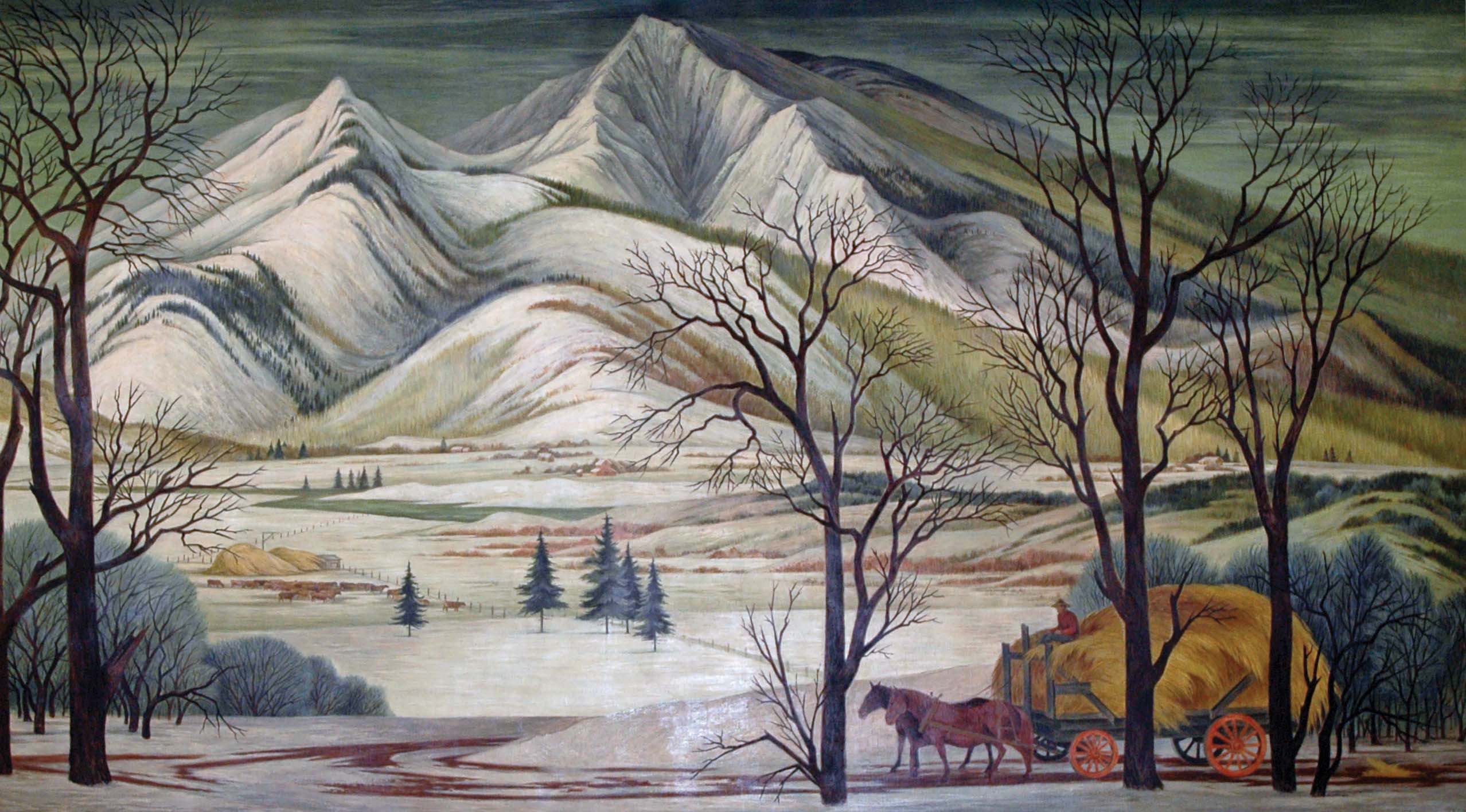
Recently, I received an email with the subject line: “Saving my mom’s WPA mural….” In it, Jenne Currie, the daughter of Ethyl Magafan and niece of Ethyl’s twin sister, Jenne, wrote that the government is fast-tracking the sale of the Wilbur J. Cohen Federal Building in Washington, D.C. Described by experts as the “Sistine Chapel of the New Deal,” it features murals and bas-relief sculptures that were commissioned by the federal government during the Great Depression; her mother and aunt’s mural is among them.
Designed to serve as the headquarters of the newly established Social Security Administration, the 85-year-old Cohen Building features Classicism-style architecture with Egyptian Revival and Art Deco influences. But for all its grandeur, its 1.2 million square feet of office space was never occupied by the Social Security Administration, and its long-term tenant, Voice of America, couldn’t afford to maintain the massive structure, which includes some 1,800 square feet of public art.
Currie writes, “It is believed that since the building is so large and in poor condition, any new owner would be hard-pressed to have the funds to restore it. It could easily be demolished.” If that happens, those stunning murals painted as frescoes on the walls by the Magafan sisters, as well as murals by Ben Shahn, Phillip Guston, and Seymore Fogel, would also be destroyed because there is no feasible way to remove them.
Enter Mary Okin and the Living New Deal (LND), a small nonprofit with a national presence. The LND has spent the last two decades painstakingly documenting and mapping New Deal projects across the country and making that information available to the public on their website livingnewdeal.org.
“We’ve become a kind of encyclopedia of the New Deal,” says Okin of the more than 19,000 New Deal public works sites they have identified nationally. “We have volunteers all across the country who look for New Deal sites in their communities. And not just federal agency headquarters in Washington, D.C., or post offices and schools with important artworks. We document sidewalks, bridges, and sewer systems built through New Deal programs in urban centers and small rural towns alike. Our goal is to teach people about the New Deal’s forgotten impacts on the U.S. built environment.”
As the aging generation that grew up during the New Deal passes away, Okin worries that people don’t realize how much was created under its auspices. There’s a good reason for this: New Deal public works were never fully documented or mapped. It’s estimated that more than 200,000 works of art alone were created in the 1930s; to go back and document everything is daunting, albeit vital. “Understanding the New Deal’s impact on American society and that moment in time when the government really worked for the people,” Okin believes, “is a model for present and future public policy and good government.”
In 21st-century hindsight, we may find fault with New Deal policies, but without question, the New Deal changed the course of our country and strengthened America’s position in the art world. “The American government became the world’s leading supporter of contemporary art during this decade, at a time when Europe was devolving into another world war, and many countries were persecuting or suppressing artists, some of whom fled to our shores,” Okin says. “For the first time in American history, the government funded both established and up-and-coming artists alike. FDR’s administration viewed visual, performing, literary, and other artists as essential workers. It was really extraordinary.”
Most people know the term “WPA art,” but it refers to just one of several New Deal art programs meant to provide jobs for artists and bring art, theater, music, literature, and more to the American people. After the success of the pilot program, the Public Works of Art Project (PWAP), which operated from 1933 to 1934 and provided weekly salaries to artists for creating murals, easel paintings, and sculptures, the federal government started the Treasury Department’s Section of Fine Art in 1934, which ran until 1943. This program awarded commissions to artists for new federal buildings through juried competitions, including funding for the Cohen Building.
There was also the Treasury Relief Art Project (TRAP), from 1935 to 1938, and the Works Progress Administration, Federal Art Project (WPA/FAP), from 1935 to 1943, which was the largest arts program and employed artists based on need, resulting in thousands of works of art. Additionally, other federal agencies like the National Park Service also hired artists. Though popular, the New Deal program ended in 1943 without a plan for managing the enormous amount of art produced. In 1949, a new federal agency, the US General Services Administration (GSA), was established to oversee federal property. It became the custodian of the New Deal and other federally owned architecture and art. By then, however, data on New Deal art and its locations was scattered or unavailable.
“There have been many losses because records of these accomplishments were left haphazardly in various places at the end of the projects,” Okin explains. “The government was primarily interested in putting people to work and didn’t treat New Deal work as part of an important art collection requiring resources for management and upkeep.”
Laws do exist to protect New Deal art and architecture. The Cohen Building, for instance, is listed on the National Register of Historic Places and is safeguarded by the National Historic Preservation Act (NHPA), which requires a formal review process involving relevant federal agencies, preservationists, and outside groups and stakeholders, such as the children of the artists or organizations like the Living New Deal. These groups can advocate for the inclusion of historic preservation covenants in any sale agreement transferring ownership to private parties. “That process of review has to happen,” Okin says, “but it does not guarantee historic preservation, which was kind of a shock to me. The law implies a sense of decency among leaders of the government to not sell off national treasures, but it doesn’t mandate preservation.”
To raise awareness of the impending threats to the Cohen Building, the Living New Deal staff started a Change.org petition (see sidebar) that asks the GSA and Congress to save the building or mandate that a buyer save its art. “But really,” Okin says, “the best mechanism for change is public concern, citizens coming together and saying, ‘This building is precious; it’s our national heritage, we want it to be saved.’”
Okin and her organization have warmed up to the idea that selling the Cohen building might not be the worst option, especially if a civic-minded real estate developer can help with historic preservation. “They might be better caretakers of a former federal building,” says Okin, “including providing access to the works of art.” Several ideas have been floated for renovating the Cohen Building, such as transforming it into a university campus or a mixed-use space managed by the Smithsonian or the Library of Congress, with living spaces, grocery, pharmacy, and shops on the main floor.
But that brings us back to the original question: Why is saving New Deal art and architecture so important when there are other things that need to be tended to? Here Okin cites research that suggests art strengthens democracies by exposing people to other ideas and points of view. “You recognize another person’s humanity,” she says. “And that opens up your heart and taps into your empathy, even if you disagree strongly.”
Case in point, Okin recalls seeing a young couple at a museum in Sacramento where a show of New Deal paintings were on display. ”The girlfriend had clearly dragged him to the museum on a date; he looked somewhat bored and miserable. But as he turned a corner, he had this ‘wow’ experience standing in front of a painting of a welder. He said, ‘Oh my God, that looks like my dad.’” Okin recalls. “The art spoke to him. It was a painting of a working-class person, sort of like he was. I think that’s the case for a lot of New Deal art: It’s not created for an elite audience of critics and collectors but for ordinary citizens. That’s a powerful inheritance from the New Deal and a lesson in the strength of paying attention to the lives of humble workers and rural communities.”
Sidebar:
For more information about saving Wilbur J. Cohen Building and other New Deal art and architecture, check out these resources:
- Visit livingnewdeal.org for a current map of New Deal projects across the country.
- Think you’ve located New Deal art that should be documented? Please contact the Office of the Inspector General for the GSA, gsaig.gov/wpa-artwork-gallery.
- To add your voice to those wanting to save WPA art and the Cohen Building, please go to Change.org.
Curator and writer Rose Fredrick shares her extensive knowledge about the inner workings of the art market on her blog, The Incurable Optimist, at rosefredrick.com.
No Comments