





30 Dec Rendering: Design Integrity
California AIA’s 2022 Maybeck Award for outstanding achievement in a body of work in architectural design went to Anne Fougeron, founder of Fougeron Architecture. Of the San Francisco-based firm, the jury stated, “Anne Fougeron is an incredibly impressive architect whose work consistently challenges the profession’s thinking about the role of architecture in our society. Her belief in architecture’s ability to change lives and that everyone deserves access to design’s transformative potential results in thoughtful, unique, and refined solutions.”
Dusk on the north-facing glass facade of Fall House.
The road to recognition, Fougeron admits, has at times been bumpy. But one thing is certain: Anne Fougeron creates daring, inventive designs that are both beautiful and playful, while still being practical.
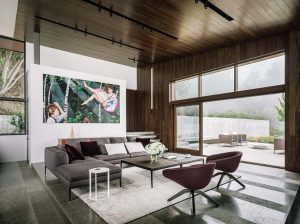
The living room extends beyond its walls onto a serene patio. Furniture by B&B Italia Michel sectional sofa and coffee table.
Fougeron grew up in Europe and was exposed to some of the world’s most awe-inspiring architectural feats. In Paris, buildings that have lasted hundreds of years are, in her opinion, the true measure of sustainability. She attended Wellesley College, where she majored in art history. But she also took a few architecture courses at nearby MIT, where a professor recognized her talent and convinced her to enter UC Berkeley’s Architecture program.
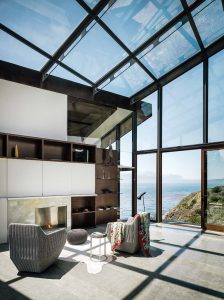
Dramatic library with eco smart fireplace and Ligne Roset ‘Facet” armchair and B&B Italia Frank small table.
She graduated from Berkeley and opened Fougeron Architecture in the Bay area in 1985. “It was a bit like jumping off a cliff,” she recalls. “But when you find something that interests you, that appeals to you on a pretty primordial level, you know the fit is right. But I really had no idea how complicated the field was, or what it meant to be an architect.”

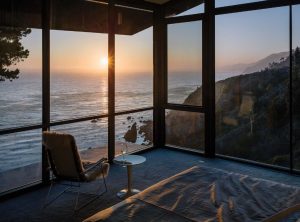
View from the primary bedroom in Fall House looking north along the Big Sur coastline.
Those were days when it was still daunting for a woman to start her own firm. The world of architecture continues to be male-dominated, but it was even more so in the ’80s. Asked about the challenges, Fougeron laughs. “Do you have a week?” she says and adds, “ I got to do a lot of bathroom and kitchen remodels. A lot.”
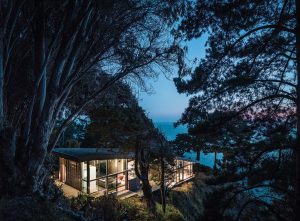
Aerial view of Fall House.
One day, she confided her frustration to a grad school friend. “I’ve got to find an idea in here,” she told him. “It’s going to drive me nuts figuring out how to put tile on the floor. And I told him, the thing I’m always trying to do in these jobs is break the box, which is something Frank Lloyd Wright talked about. You get these weirdo Victorians with very small rooms, and I was trying to open them up to the outdoors or to the rest of the house.”
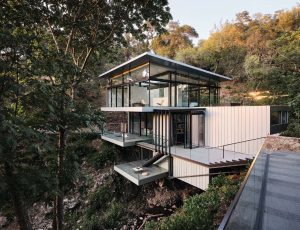
Suspension House view of the west facade from the walkway.
Now that she’s long past the make-work stage of remodeling bathrooms, the concept of breaking the box remains fundamental to Fougeron’s design philosophy. Still, she notes, development, construction, and engineering remain the world of men. “The resistance you meet is from people who have no idea they’re being male chauvinist pigs,” she says. “A professor of mine said, ‘The problem with being a woman architect is, if something goes wrong, they’ll say, ‘Well, you hired a woman architect.’ No one would ever say that about a guy.”
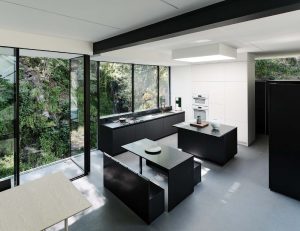
With a view of the natural waterfall, Suspension House’s kitchen by Poliform features a cooktop and refrigerator by Gaggenau, an integrated dishwasher by Miele, and a sink by Kohler.
Fougeron had a daughter in 1989, and was teaching part-time at Berkeley when she suddenly ran out of work. Her father was ill, so she closed up shop and went back to France, where she worked for a time in what she describes as a pretty miserable office. In 1994, she split from her husband and returned to San Francisco with her daughter.
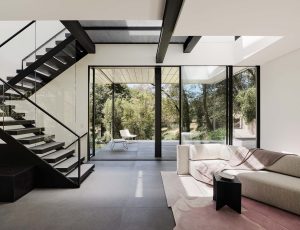
Suspension House sofa by Christopher Delcourt.
“I had to make a living,” she says. “There was no more sitting around hoping that money would roll in. So, that motivated me to think differently about running the office. I don’t know if aggressive is the right word, but certainly I was more engaged. But still it was hard to get larger-scale work. It was hard to break into that market — it’s still hard. I think you just have to grind at it. You have to move the needle. Nobody’s going to move it for you. It’s better now, but there still aren’t that many female architects at the upper level, and very few women architects have their own firms unless they are associated with a male architect. I call it the Remington Steele thing: you have the façade of the guy.”
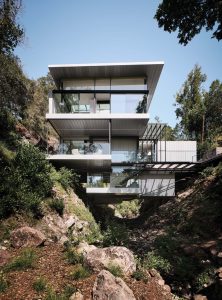
View of Suspension House west facade with creek running below.
On her return from France in 1994, one firm offered a place for her, which was tempting, but they never came to a decision. “And then all of a sudden, I started getting jobs,” she says. “Keeping it going was rough, but I liked what I did. I like to design and I was able to keep that going.”
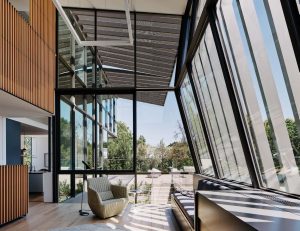
Wavelet home’s two-story library bathed in light with Ligne Roset ‘facet’ armchair.
One meaningful project was designing a building for Planned Parenthood, but at the moment, most of Fougeron Architecture’s work is single-family homes. She does hope to do more designs that transform work experiences as well as high-quality living spaces for people who can’t afford expensive homes.
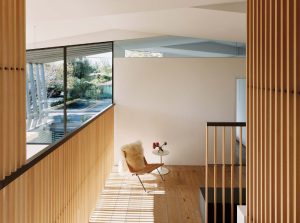
Staircase landing for primary bedroom in Wavelet home.
Light, she says, is a crucial element, and it’s the subject of the firm’s latest monograph, Framing Light, published by Oscar Riera Ojeda Publishers. “We always feel the more light you bring into a space, the more transformative it is,” Fougeron says.
Of transformation, she often refers to a favorite Wallace Stevens poem, Anecdote of the Jar. “Basically he says, you put a man-made object into a landscape, in this case a jar, and it is both transformative for the object, but it’s also transformative for nature. Sometimes it’s a dialogue and sometimes it’s opposition, right? But it’s that dialogue and friction between the two that creates very interesting ideas.”
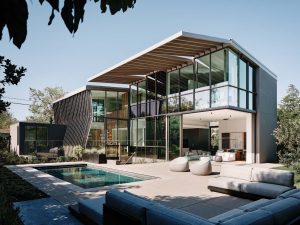
At the back of the Wavelet home, a cantilevered roof sun shade adds a dramatic design element. Outdoor furniture by Restoration Hardware and Paola Lenti.
One of her better-known designs, Suspension House, is a light-filled house cascading down the slope of a clifftop property in Big Sur. The serenity of the house is in contrast to the wind and savage ocean below.
Another unforgettable design is Wavelet, which replaced a boring and decaying Eichler-period ranch-style house in Los Altos. And though there were many restrictions to deal with, Fougeron managed to create something surprising and memorable. The heart of the house is a two-story library. And she solved the clients’ desire for lots of glass with a slanted overhang on one end and a curtain wall on the other, which mediates harsh sunlight without robbing the interior of light.
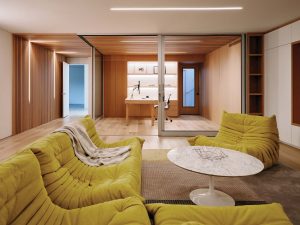
Wavelet’s home office and family room feature a Togo sofa by Ligne Roset and a table by Eero Saarinen.
Of course, none of these projects could be accomplished without a team. The firm calls in consultants (on one project, there were 12). But since Covid, Fougeron has resisted returning to the pre-pandemic staff size of 15. Now she has just six people working remotely.
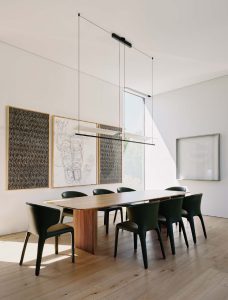
Wavelet’s dining room with a Cassina table and chairs from Design Within Reach.
“She’s the thinker behind it,” says Todd Aranaz, a project architect. “I help execute it all and participate in it to some degree, but she’s the brains behind the whole institution that we have here.”
These days Fougeron has won too many awards to list. Whenever a house is completed, all the design magazines feature it. Beyond design, Fougeron frequently gives talks to encourage young architects. “I want to pass the baton,” she says. ”At some point, other people have to grab the baton. You can’t run that fast anymore and continue the race.”
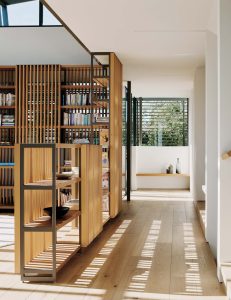
Looking towards the entry of the Wavelet house past the library with custom wood and steel shelves.
Though not just yet. Fourgeron has lost none of her fire, originality, or her sense of humor. Watch for more of her inventive responses to dramatic natural landscape and to surprising reinventions of narrow city lots.
Laurel Delp is a frequent contributor to Western Art & Architecture and other magazines and websites, including Town & Country, Departures, Sunset, and A Rare World.
Born and raised in London, Joe Fletcher’s photographs have appeared in such publications as Wallpaper and Architectural Digest.
No Comments