


30 Dec With an Open Heart
It was very wild, very brushy,” Don Stinson says of the land in Austin, Texas, where he and his wife Barbara built their home and his studio in 2025. “You almost had to crawl into it — on your hands and knees. But we could see there were a lot of beautiful live oaks and old cedars, along with interesting topography, including a couple of little grottos going down to water at the base of a 40-foot cliff at the back of the property.”
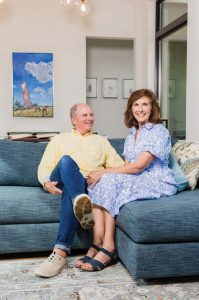
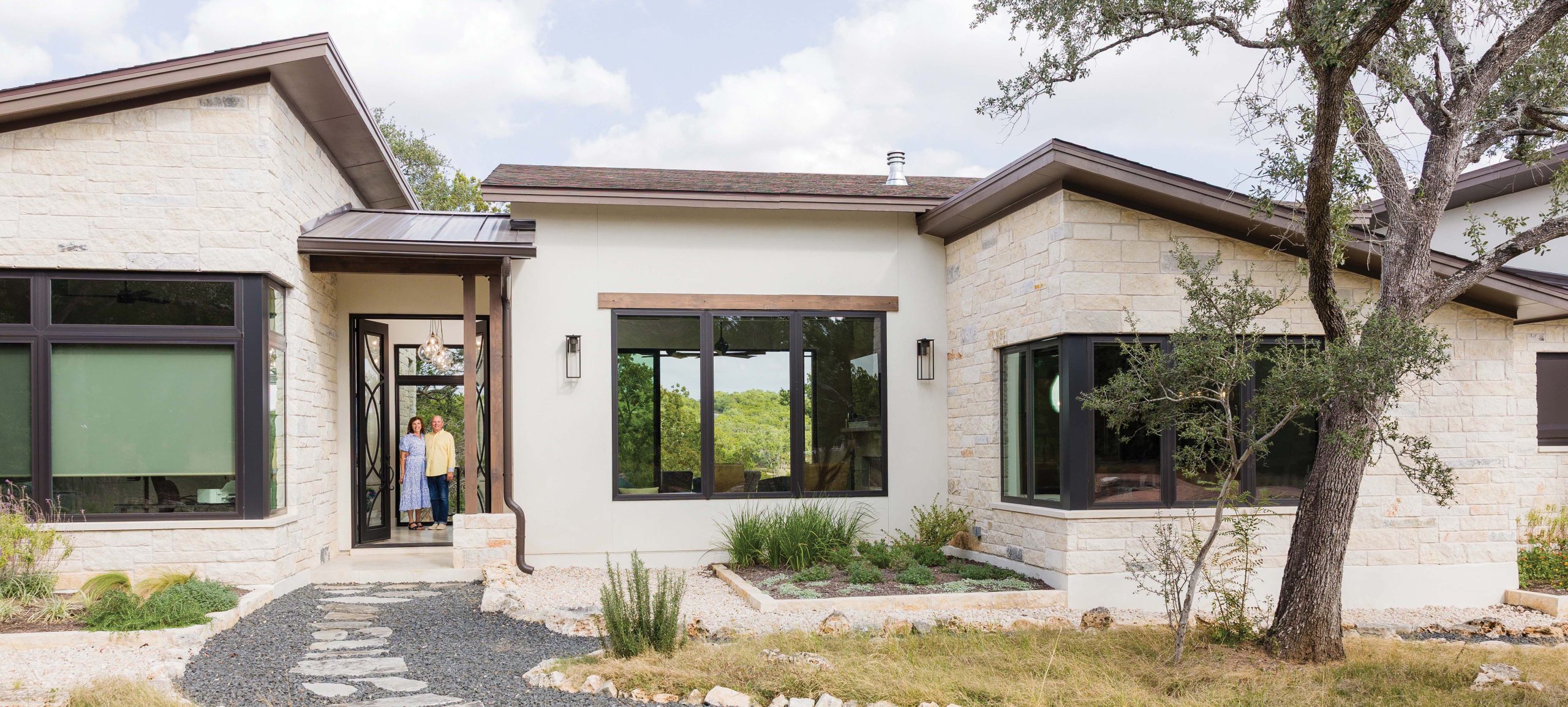
Don and Barbara Stinson at home in Austin, TX. Designed by John Hathaway, their home is open and airy, with ample wall space for art.
For a landscape painter, the old real estate adage — location, location, location — also rings true. But this particular piece of land holds even more significance: Barbara’s father developed ranches around Austin and reserved these 5.5 acres, planning to build one day, but never did. Meanwhile, Barbara and Don were busy raising a family in Colorado and pursuing their careers. As a result, the land sat untouched, becoming increasingly wild, until one day the stars aligned: The Stinsons’ last child left the nest and Barbara’s job in the Midwest concluded. Suddenly, building on that beautiful, rugged land seemed plausible.
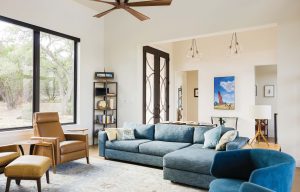
The couple collaborated with John Hathaway at Vanguard Studio to design their home, ensuring it blended seamlessly into the landscape while providing Don with a studio angled toward that warm, steady northern light favored by artists. And those old live oaks and cedars? “We built around the existing trees,” Don says. “And we positioned the house so that the kitchen and great room spanning the distance between my studio at one end and Barbara’s office on the other end has windows on both sides.” Even better, and to their great surprise and relief, Michael Demarco led the team at LTB Design + Build to not only complete construction on time, but to come in under budget.
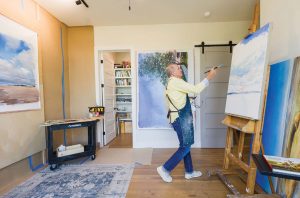
Don in his studio, blocking in a new painting.

Don works in oils and watercolors, and his studio is filled with watercolor sketches painted on the road.
The idea of treading lightly on the land is evident in their wild, xeric landscaping. “It gets pretty interesting when it rains,” Stinson says. “All kinds of things happen. Really beautiful grasses and cacti come to life. It’s an aggressive growing climate here compared to the mountains.” And, of course, as long-time residents in the West, they are cognizant of water issues, which are compounded by the pressures of housing development, industry growth, ranching, and agricultural needs. “There are all these wonderful cold springs that bubble up, filling the lakes with cool, clear water from deep underground aquifers. And we have the Tesla factory and data centers, so the economy here is dynamic, and water is a precious resource. So, politically, how that gets allocated is really intense.”
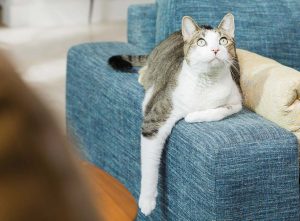
Tabby cat Tiffany holds court on one of her favorite perches.
That tension over land use is a topic Stinson has long explored in his work. Like the painting Green River Ridge, a reimagining of the place where Thomas Moran stepped off the train on his first trip out West to paint the newly explored lands. “I guess it all started for me with an awareness of how places are marketed, how vacations are sold, and how settings in movies and cities are visually promoted,” Stinson says. “And then, how do you make that really powerful visual language accountable? If you’re a painter and have studied the history of painting, you know this 400-year-old tool is highly developed. So, I find it intriguing that Moran painted the Tollgate Rock but knowingly omitted the mode of transportation that took him there. He painted the landscape as it was 40 years earlier, before trains. So, I thought, what if we just admitted that our presence here can both ruin and save this place, depending on how we act? That’s a dramatic concept that makes for good art.”
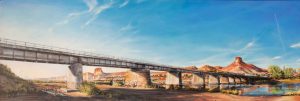
Green River Ridge | Oil on Linen | 20 x 60 inches
His painting, Lone Star and Pool, Lobo, Texas, featured in the exhibition New Visions: The Western Landscape, at the Amon Carter Museum of American Art, is one that emerged after many family vacations with the kids, driving through Colorado and New Mexico on their way to visit family in Texas. “That abandoned swimming pool is located in Lobo, Texas, near Marfa,” he explains. “We used to go there often in the late 1990s and early 2000s when we’d take the kids on art safaris around Marfa and Big Bend. Back then, we could take a rowboat across the Rio Grande, eat Mexican food in the little village of Elena and row back. But everything changed after 9/11. You can’t do that anymore.”
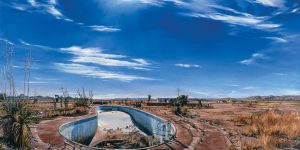
Lone Star and Pool, Lobo, Texas | Oil on Wood Panel | 36 x 72 inches
Before moving to Austin, the Stinsons lived in Iowa for three years, where Barbara led an international food and agriculture organization. Don, however, never fully felt connected to that landscape, with the exception of the coldest days of the year, when the moisture in the air crystallizes, creating an effect known as sun dogs. Otherwise, he relied on frequent trips to his studio in the Colorado foothills, where he could work on paintings for galleries and exhibitions. Those road trips across Nebraska and the Colorado grasslands were not empty hours behind the wheel; they sparked questions that influenced new paintings. Shuttered motels, dilapidated restaurants, and abandoned gas stations left him wondering why anyone would have wanted to stop in these windswept places. “Was this place a stop of last resort, a last chance for gas? Was there a local economy somehow hidden from the road that had been served? And what changed? Where did the people go?”
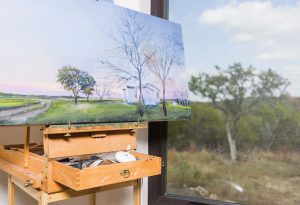
View from Don’s studio and view across the rugged landscape out his window.
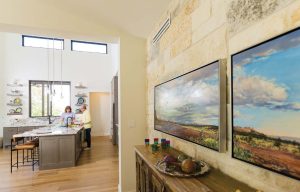
Don and Barbara preparing lunch. His diptych New Speculative Realities along the Colorado Plateau adorns the rock wall in the dining room between his studio and her office.
And while his roadside paintings engender nostalgia for many patrons of his work, that’s not what moves him. “For me, it’s about this kind of open-hearted looking. Because often things appear pretty rough, but you can see that maybe someone had a great life there, that it was a thriving place. I think that’s just a natural part of our life cycle,” he says and adds, “It’s the same with energy landscapes, because now with wind turbines and solar farms there’s a radical shift. So, how to paint those kinds of shifts? How to tell that story? I want to show enough of what was once there and how things were used, but also how a place is coming back to life. Everybody loves the open road, but hardly anybody loves old pump jacks, right? So, how do you convey all those things, and convey how complex it really is? To me, that’s a fun painting problem.”
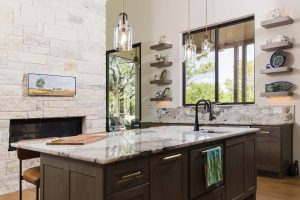
Open, light-filled kitchen with floating shelves, fireplace, and, of course, art.
Since settling into life in Austin, Stinson still drives to his Colorado studio, only now the road takes him through New Mexico where, with the help of artist friends Randall and Mary Wilson in Corrales, he’s discovered bands of wild horses. “I think of those horses as cultural relics,” he says. “And I wonder, what’s the difference between an abandoned gas station and an abandoned horse? It’s living tradition. As an artist, being part of a living tradition makes for engaging paintings. And people are compelled by the idea of wild horses, but they present difficult management in many areas. It’s a fraught issue. And how we treat these wild horses says a lot about us because they really are relics of our culture, relics of conquest.”
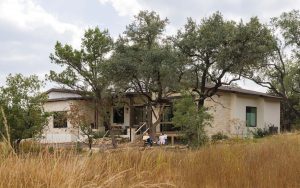
Don and Barbara enjoy a laid-back afternoon in Austin.
Since the start of his career in art, Stinson has heard people say “painting is dead.” And yet, it keeps going, artists keep exploring and finding new ways to show us our world as it is today. “I think the drama of the time that you live in, and just being fully present, is where the art is,” he says. “It’s about trying to express some part of the tension in the landscape in an openhearted way. If you help people see this tension, it’s inherently dramatic and interesting. I’m always looking for the story that the landscape tells rather than trying to resolve something. Allow for the mystery; that is where the art lives.”
No Comments