



03 Sep A STUDY IN CONTRASTS
There is more than meets the eye in the layered paintings, prints, and murals of celebrated Chicano artist Tony Ortega. Pieces by this artist reflect a mythmaker and man of many roles, talents, and cultural traditions (Mexican, American, and the distinctive cultures of the American Southwest).
After earning undergrad and graduate degrees in fine arts, a bachelor’s in commercial Spanish, and a certificate in Latin American Studies, Ortega is now an educator himself. The professor of painting, drawing, and art history at Regis University in Denver is husband to one artist, (Sylvia Montero), and father to another, (Cipriano Ortega).
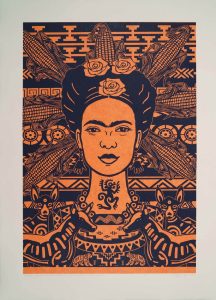
Frida con su Corona de Elotes en Anaranjado | Woodblock Print on Kozo Paper with Chine-Collé on White Paper | 36 x 29 inches
rtega pulls refreshment from an interior spring fed by his training, mentoring, and experience. His foundational art history courses include Chicanismo/Chicanarte and the New Mexico santo tradition. In this way, Ortega teaches what he lives and creates in art what he experiences materially and spiritually.
Chicanismo refers to a movement and cultural philosophy of Mexican Americans whose roots are intertwined with the foundations of this nation. The santo art form, sometimes seen as regional or national folk art, takes its dimensional and devotional expression — including carved wooden figures or paintings on wooden tablets (retablos) — from Roman Catholic saints (santos).
In his youth, Ortega embarked on a pilgrimage of identity. He studied in Mexico for several semesters, a period during which he discovered how profoundly he was connected to Mexican culture. “But I also realized how much I am shaped by being American,” he says.
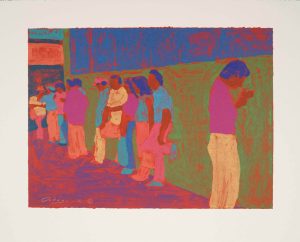
La Parada de Verde | Monotype on Kozo Paper Chine-Collé on to Arches Cover | 22 x 30 inches
During his travels in Mexico, he collected folk art, including sculptures of fantastical creatures called alebrijes, ceramic works from Oaxaca and Michoacan, and art of an indigenous people of Mexico known as the Wixarika, or Huichol.
“The use of saturated colors, simplified forms, and symbolic imagery had a profound influence on my visual language,” Ortega says. Later, while studying art history, Ortega identified connections between those traditions and the work of Post-Impressionists, the Fauves, artists dubbed ‘wild beasts’ for their emphases on emotion and the expressive nature of raw color, pre-Columbian art, and other Modern artists.
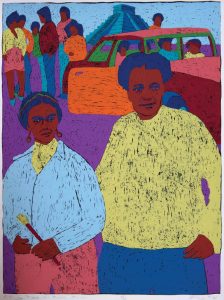
Frida y Diego nos muestran a México | Serigraph | 37.25 x 28.125 inches
Nepantla is the term that Ortega applies to that mix of religious, cultural, and artistic expression that is at once both figurative and symbolic. “It is the in-between space where cultures, histories, and identities intersect,” says Ortega. “Much of my practice is about living between two worlds and bringing different histories together.”
If you, like the 19th-century novelist Stendhal, become faint in the face of intense beauty, please prepare yourself for a discussion of “Juan Diego at Tepeyac,” a hand-colored silkscreen that bears Ortega’s signature bold outlines, startling color, overt symbolism and — in this case — a strongly devotional aspect, typifying the intersection Ortega describes.
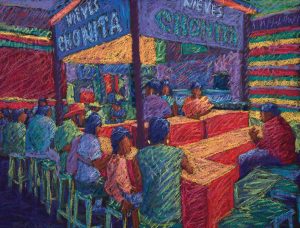
Nieve Chonita | Pastel on Paper | 19.5 x 25.5 inches
The work’s two central figures are both protagonists. They are, in fact, protagonists surrounded by protagonists. The 16th-century encounter between Juan Diego, the now-canonized indigenous Mexican visionary, and a Marian apparition (Our Lady of Guadalupe) is made contemporary in Juan Diego’s graphic T-shirt and tattooed bicep bearing the image of a female Mayan deity. It is evocative of an historic event yet is timeless in its emblematic appeal. And a butterfly, bee, and hummingbird are derivative of the symbols used by Frida Kahlo, just as the roses in the picture refer to the Guadalupe miracle.
“The symbolism intentionally creates a bridge between these two powerful traditions,” Ortega explains. It is an apt reference. The figure of the Blessed Mother is a potent, and even everlasting vision of womanly perfection, while the homage to Kahlo is a stirring celebration of deeply rooted cultural inheritances.
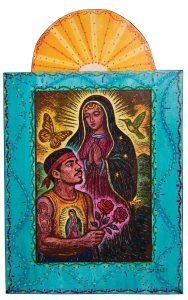
Juan Diego at Tepeyac | Hand-Colored | Silkscreen on Panel | 18 x 11 inches P. 154
The original print is elliptical in its statement about Kahlo. But Ortega’s monumental silkscreen created in 1991, Frida y Diego nos Muestran a México is not.
In the latter work, Ortega’s engagement with Kahlo is fully realized. It is included in Tate Modern’s exhibit, “Frida: The Making of an Icon,” which opened in London on June 25 and is slated to run through January 3, 2027.
The brilliantly colored Frida y Diego places Kahlo and her equally storied partner Diego Rivera in the foreground as a lowrider and Chicano youth occupy the middle distance beneath the silhouette of an ancient Mexican pyramid.
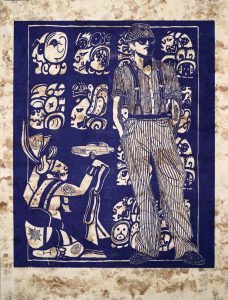
Bonampak Cholo | Woodblock Print | 36 x 29 inches
“The work bridges modern Mexico, indigenous history, and contemporary Chicano identity in a single, exuberant vision,” says Ortega.
It is notable that Ortega finds his two decades of classroom and community outreach integral to securing an active studio. “Teaching and public engagement are important parts of my artistic practice,” he says.
Ortega is modest and quiet. His artwork? Confident and flamboyant. Which is the truer reflection of the man? The question is flawed; Ortega’s is not a case of either-or but of both-and.
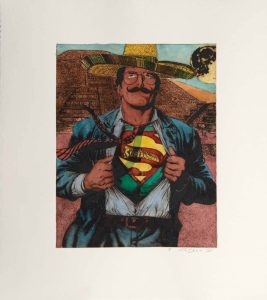
Super Hombre con Sombrero | Hand Colored Etching | 10 x 7.75 inches
Exhibit A: La Familia at Crema. Exhibit B: Lágrimas de luz. Yet even an alphabet’s worth of examples would be insufficient to contain all that might be said or seen tied to woodblock prints such as Bonampak Cholo or pastels such as Nieve Chonita.
A solo exhibit of Ortega’s work opens with a reception November 13 from 5 p.m. to 8 p.m. at the William Havu Gallery in Denver. The event, to run through January 9, 2027, is the latest showcase by a gallery that has represented the acclaimed local artist for 43 years.
Ortega, whose work is contained in the permanent collections of such institutions as the Denver Art Museum, Los Angeles County Museum of Art, and Museo del Barrio in New York City, issues from a line of what he calls “makers.”
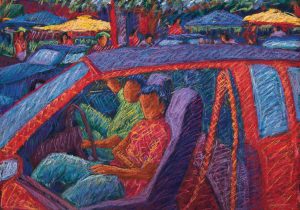
Monte Carlo Vatos | Pastel on Paper | 20 x 28 inches
The term is broad, for it speaks of such figures as his maternal grandmother, who made alterations in clothing, crocheted objects, and patched quilts with pieces of old shirts. An uncle who stayed with the young Ortega and his grandmother one summer in the village of Pecos, New Mexico, and did handiwork, mostly carpentry, around the house. These and other models awakened in Ortega an understanding about adulthood. “I thought, ‘This is what you do when you grow up: you make things,’” he says.
For the child who was father to the man, as the poet said, there was more than one epiphany. Ortega considered his given name and its frequent occurrence among male members of the extended family. “I thought, ‘Why is Antonio a popular name within the family?’ My grandmother had a small altar on her dresser with a crucifix and a statue of Mary and I would see those images.
“One day, I noticed the church was named ‘San Antonio’ and I put it together that [St. Anthony of Padua] was the patron saint of our village.”
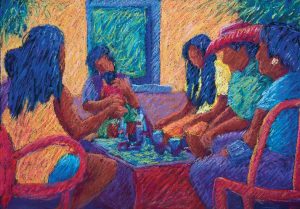
La Famila at Crema | Pastel on Paper | 15 x 22 inches
And thus — Antonio, Ortega’s formal given name.
Such confluences of experience, understanding, and recollection informed Ortega’s vernal mind just as it now informs his mature one. His use of juxtaposition to shake viewers into wakefulness is notable in such works as Las Fresas y La Tormenta (The Strawberries and the Storm). There is more than a touch of Edward Hopper and Robert Henri — the founder of the Ashcan School of American realism — in Ortega’s depiction of everyday scenes in which there are almost no everyday people.
For each of the artist’s figures is unique and yet universal; that is, the images are of distinct individuals shaped by a collective human experience. To wit, Monte Carlo Vatos, a pastel showing two guys with two feelings — pride and joy — as they lounge in a lowrider Chevrolet.
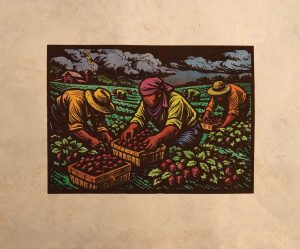
Las Fresas y La Tormenta | Watercolor and Silkscreen on Papel Amate, (Mexican Bark Paper) | 8 x 11 inches
Ortega’s discipline in his field paired with his artist’s eye has given rise to an assured playfulness with popular icons. For example, transforming Clark Kent into a brown-skinned, bespectacled, and mustachioed figure is Super Hombre.
Blending, contrasting, mixing, and unmatching, Ortega engages in what he terms “cultural hybridity.” At a time when America marks its 250th year as a single nation buoyed by a variety of people, Ortega’s iconography metaphorically strikes the storied Liberty Bell — inscribed “Proclaim liberty throughout all the land unto all the inhabitants thereof” — and it rings true.
No Comments