


03 Sep Chasing Querencia
The summer after high school, lifelong New Mexican Eric Romero and a few friends were backpacking in Spain. It was during what he calls his bohemian period, and they were “crazy and irresponsible and completely broke after three weeks.” In San Sebastián one day, they got a whiff of something familiar and followed the enchanting smell. “A sense of querencia,” Romero remembers, “drew me up this mountain.” What they found was someone roasting green chiles. The friends didn’t expect it to taste like New Mexican green chile, and in fact, it was horrible, Romero says. “But the smell alone was worth it. That sense of home was a reinvigoration of the soul.”
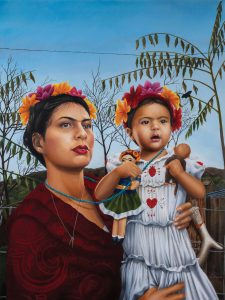
Las Fridas | Oil on Canvas | 40 x 30 inches
Querencia is a layered, complex Spanish term for the deep feeling of belonging to a particular place or certain people, an almost indescribable sense of rightness and peace that surpasses longing or love. For Romero, who grew up on a farm south of Albuquerque, querencia is “where your soul resides and refuses to leave. It’s an exhale, a place where you can close your eyes and feel faith.”
With its age-old land, rich cultural history, and interwoven ethnic threads, New Mexico is Romero’s querencia. It is a limitless source of inspiration for the allegorical figurative paintings in which the artist tells current-day stories in a classical realist style. His most recent body of work, on view at Blue Rain Gallery in Santa Fe through October 8, draws on cultural and religious symbolism and mythology from New Mexico to ancient Greece. It also focuses on people and themes that are especially close to the artist’s heart.
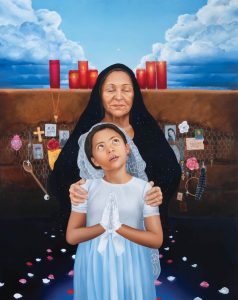
A Thousand Mothers Behind Her | Oil on Canvas | 60 x 48 inches
Romero grew up surrounded by traditional folk art forms, including straw appliqué, retablos and bultos (painted or carved religious imagery), and his grandfather’s leathercraft. There were also a few paintings around the house that his mother had painted, but he didn’t realize they were her work until much later. What he knew was that his mother was always making angels, often crocheted, to give away. She also provided her son, an only child, with art materials and, without pushing, introduced him to art teachers. But as a stubborn boy who resisted any type of authority, he didn’t take the bait.
Instead, Romero fed his love of art by reading Wolverine comics, illustrated by artists from diverse cultures who produced different visual versions of the same characters. “I fell in love with how the artists were able to convey emotion,” he says. He kept his comic obsession under wraps, not sure his parents would approve, but experimented with drawing, exploring what it meant to have a creative side.
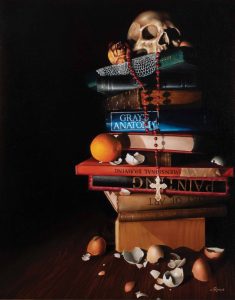
Sabio Pendejo (Wise Fool) | Oil on Canvas | 30 x 24 inches
Equally intriguing to Romero was Wolverine himself, a complicated, superpowered anti-hero facing a personal identity crisis. Young Eric resonated with the character’s confusion as he tried to work out his own cultural identity. He now knows his ancestry is a mix of Indigenous, Spanish, New Mexican Chicano, and a little French, but at the time he lacked that clarity.
Then, in the summer before high school, Romero was required to read books for the first time for school, and the first books that caught his attention were on Greek mythology. These myths and the experience of engaging with other storytelling traditions expanded his world, and he hasn’t stopped reading since. Characters as varied as Voltaire’s Candide, Steinbeck’s migrants, and the Count of Monte Cristo have informed his art and sense of self-understanding.
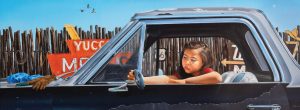
Route of Tomorrow | Oil on Canvas | 28 x 76 inches
Yet as much as he was drawn to art, Romero didn’t consider it a career option. He entered the University of New Mexico to study architecture and business, but stumbled over calculus and computer-aided design (CAD). So he pivoted to art history, taking as many courses as he could from UNM and Central New Mexico Community College. He also doubled down on “researching the bohemian lifestyle,” in other words, “partying, alcohol, travel, living hard.” In hindsight, he was seeking the experiences that would eventually fuel the storytelling in his art.
Then he met Melissa.
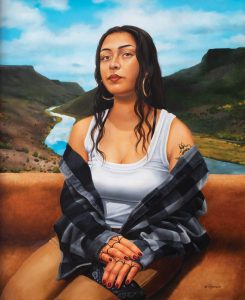
Chola Lisa | Oil on Canvas | 40 x 32 inches
“From the moment I saw her, I knew I was going to marry her. It was one of those things like seeing the sun for the first time,” Romero recalls. He had so much respect for her that he knew he had to change. “I was not house-trained. I was very wild. I said to myself, ‘With this woman, you cannot be a child anymore. You have to grow up.’” Romero approaches his art with that same level of respect. He also now sees that opening himself in vulnerability to another human, and receiving complete support in response, allowed him to become an artist and face whatever public critique that entails.
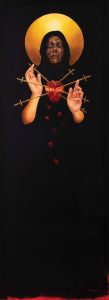
Mater Dolorosa (Our Lady of Sorrows) | Oil on Canvas | 76 x 28 inches
Another experience with Melissa threw open an equally critical door. On a three-month honeymoon in Europe — he sold a ’69 Camaro he’d “cherried-out” to pay for it — Romero spent days on end in art museums, finally experiencing in person the works he had only seen in books. He also sees that opening himself, being vulnerable to another human, and receiving complete support in response, allowed him to become an artist and face whatever public critique that entails.
A self-taught painter, Romero builds meaning into his imagery by incorporating traditional religious symbolism, cultural iconography, glimpses of desert landscape, and personal and collective memory in ways that preserve the past while commenting on present-day social issues and imagining a future that necessarily mixes challenges and hope. He also likes to throw in an occasional inside joke.
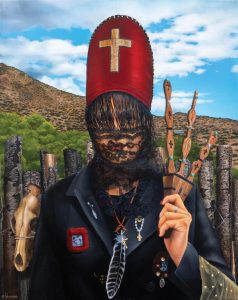
The Prayer of the Dance | Oil on Canvas | 30 x 24 inches
For Ruta del Mañana, he engaged his six-year-old daughter Sol as a model. Sitting in the driver’s seat of a classic car in the process of being restored, she studies her reflection in the side mirror. Behind the car is a traditional New Mexico coyote fence on which hang signs from old Route 66. Aside from its historic significance, the highway has personal meaning for Romero. In Albuquerque it is Central Avenue, where both the artist and his wife were born, where his new studio sits, and close to where the family lives.
His daughter’s pose was inspired by Caravaggio’s Narcissus, in which a young man admires himself in the water’s reflection. In this case, however, Romero imagines the child seeing a reflection of her future self as someone helping preserve Route 66 by telling its story. The moon symbolizes the highway’s nickname, the Mother Road. Geese are flying west. A shop rag and gloves on the hood suggest the work that goes into preserving a culture while moving it forward. And a screwdriver is there for the artist’s father, who often accuses his son of taking his tools to include in paintings. Romero smiles. “It’s true.”
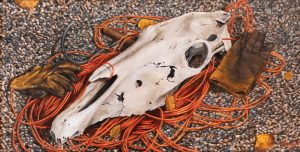
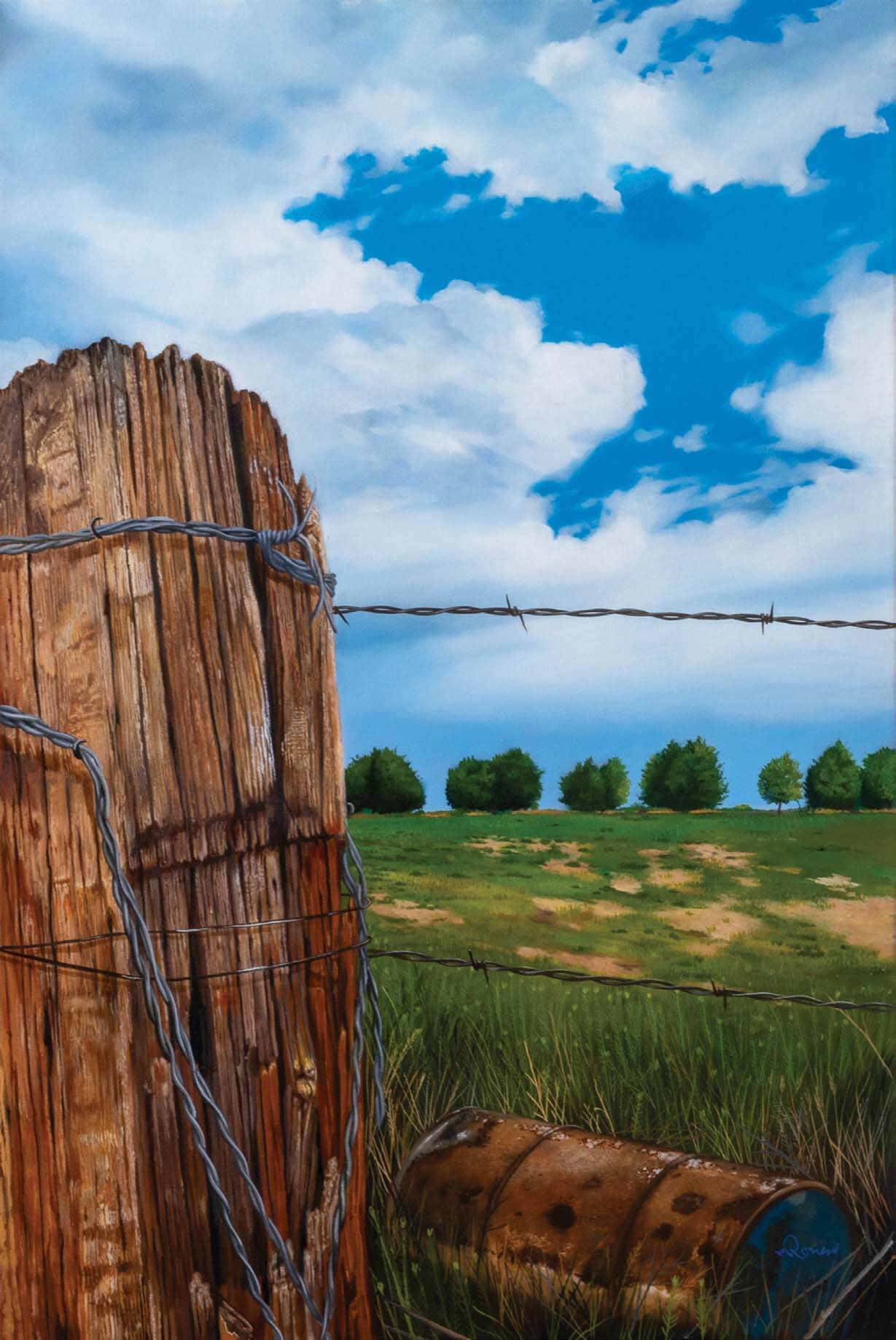
Twine that Binds | Oil on Canvas | 15 x 30 inches
Blue Rain founder and owner Leroy Garcia remarks that there are “very few Chicano artists with Eric Romero’s level of talent. His technical skill is exceptional, but it’s his ability to weave culture, history, and symbolism into every painting that truly sets him apart. Eric’s work honors his heritage while pushing contemporary Southwestern art in an exciting new direction.”
For his part, Romero credits his querencia for providing his work its defining spark: his land and culture, his dad for discipline, his mom for creativity, his wife for support, and his daughter for inspiration. “This is my world.”
No Comments