

03 Sep Collector’s Notebook: Modernism and the New West
Contemporary Western Art is having a moment, particularly the Modern West subgenre, a.k.a. New West. While there are many ways to tell the stories of the American West in art, New West artists share one common thread: they embrace the visual language of Modernism.
Borrowing from movements as diverse as Impressionism, Expressionism, Abstraction, and Pop, New West artists apply modernist ideas to typical Western subjects — wildlife, landscapes, cowboy life, and Native culture. The result is a fresh aesthetic that is attracting a younger generation of collectors and gaining acceptance within many of the Western art world’s most traditional institutions.
The roots of the New West stretch back more than a century to Maynard Dixon [1875–1946] and Georgia O’Keeffe [1887–1986]. Dixon’s gradual embrace of Modernism produced some of his greatest works, in which simplification, geometric design, and expansive space conveyed both the physical landscape and its emotional power. O’Keeffe’s application of a modernist lens to the American Southwest was equally groundbreaking. She proved that an artist could live in the West, paint the West, and still stand among the leading figures of American Modernism.
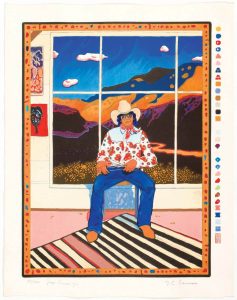
T. C. Cannon (Caddo, Kiowa), Self Portrait in the Studio (1975) | Edition 50/200, 2005-2006, Woodblock on Paper, 25 x 19.5 inches, Gift of Joyce Cannon Yi, Executor of T.C. Cannon Estate, 2011. Courtesy of the IAIA Museum of Contemporary Native Arts, Santa Fe, NM:CD-35. ©T.C. Cannon. Photograph by Jason S. Ordaz
Many other Western artists experimented with modernist ideas during the first half of the twentieth century, but there was no distinct “big bang” that launched the movement. Traditional realism continued to dominate the Western art market, while modernist interpretations remained scattered and largely disconnected.
That changed dramatically in 1962 with the founding of the Institute of American Indian Arts (IAIA) in Santa Fe, New Mexico. The school’s mission was revolutionary: Give young Native artists new tools, new techniques, and permission to challenge traditional expectations of how Native stories could be told.
Visionary Cherokee artist, educator, and advocate, Lloyd Henri “Kiva” New [1916-2002], was the Institute of American Indian Art’s (IAIA) co-founder and early director. New famously observed: “People and cultures, like any living organisms, have to adapt to environmental changes; those that don’t, die. The relationship of the past to the future has been stated in many ways. I like the declaration that ‘the future lies in the future, not in the past.’” His work with the University of Arizona and support from the Rockefeller Foundation created the perfect confluence of ideas, resources, and ambition. In the University’s proposal to the Rockefeller Foundation, the authors emphasized New’s forward-looking perspective: “Indian art of the future will be in new forms, produced in new media, and with new technological methods,” they argued. “Equally important is the need to encourage traditional sources of inspiration while seeking broadened forms of expression.”
As IAIA’s first art director, New lit the fire that soon engulfed the Western art scene. Teachers such as Fritz Scholder, Allan Houser, and Charles Loloma, alongside students including T.C. Cannon, Kevin Red Star, Earl Biss, and others, became some of the defining artists of the emerging movement. Their combined talent, collaboration, and creativity established Native Modernism as a powerful new artistic language. Just as important, they demonstrated that Western subject matter could thrive within contemporary artistic expression. In doing so, they made the Modern West possible, opening the door for future generations of artists to push boundaries without sacrificing their careers.
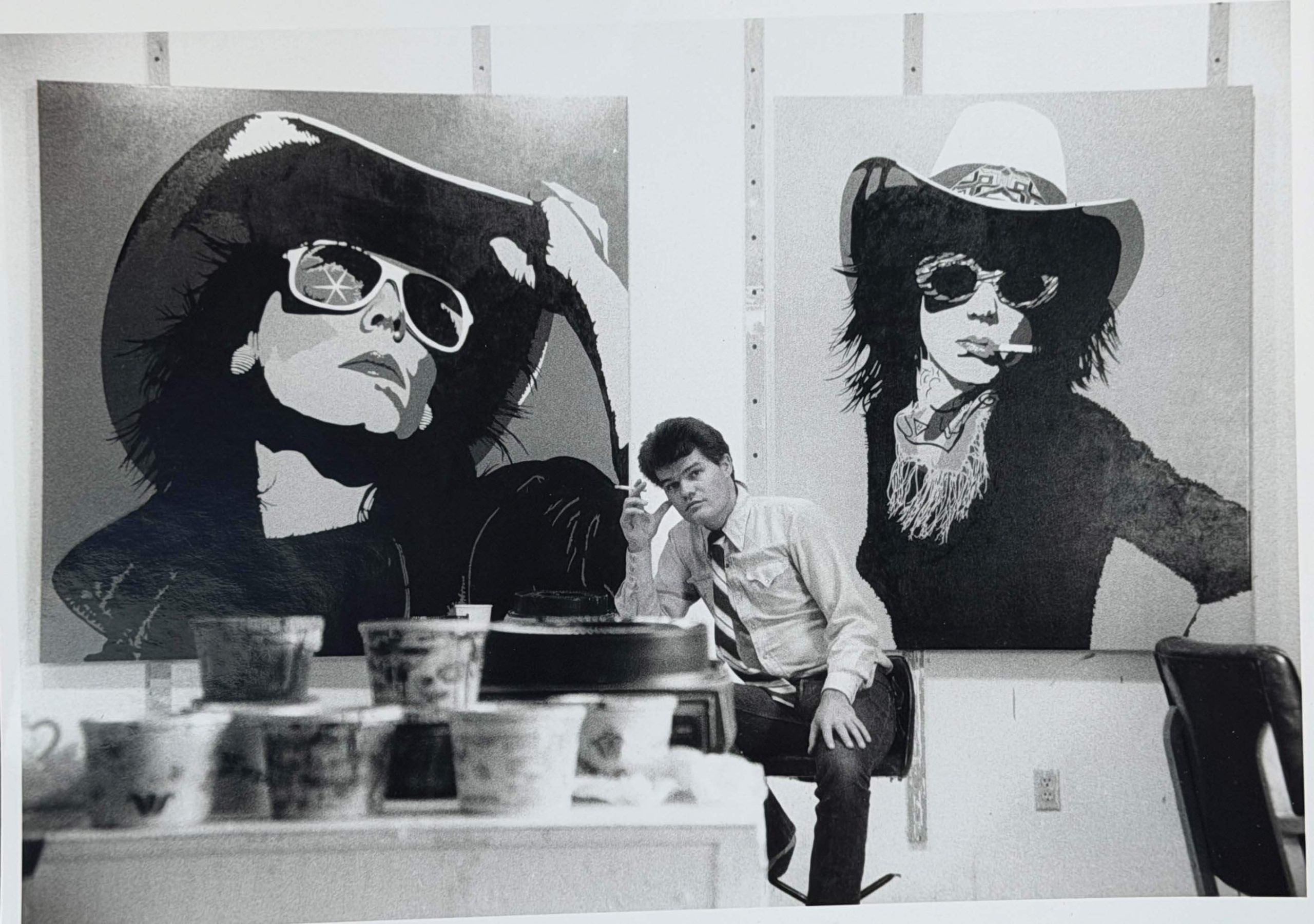
At nearly the same moment, another branch of the movement was taking shape hundreds of miles away. A young Billy Schenck attended a gallery exhibition in Columbus, Ohio, where, in 1965, he encountered Andy Warhol’s Pop Art for the first time. Although his fascination with the American West had started during family road trips and summers spent in Jackson Hole, his artistic direction crystallized in New York City, where cinema and contemporary art collided. When Sergio Leone’s A Fistful of Dollars premiered in 1967, Schenck found his subject matter. Although Leone had used Almeria, Spain, as a double for the American West, his cinematic vision captured Schenk’s imagination. “What Leone did was he turned everything on its ear in that genre,” Schenck recalls. “He added another dimension, one not thought possible before. Nothing changed my world quite like that movie did. It was an earthquake, a tidal wave.”
Schenck fused his lifelong love of the West with Leone’s cinematic expression, Pop Art, and the influence of contemporary artists like John Clem Clarke. Photographing scenes directly from the movie screen, he projected and reinterpreted them into bold Pop compositions featuring unexpected twists. “I was appropriating ideas, techniques, and imagery like everyone else at that time,” Schenck says. “Photographs were used as a point of departure for my work.”
His first solo exhibitions in New York, beginning in 1971, sold out almost immediately. Success soon followed in Europe. Western Pop had arrived.
History has shown that artistic movements require more than visionary artists, they require visionary dealers. The Impressionists found theirs in Paul Durand-Ruel. Pop Art had Leo Castelli. The Modern West found an early champion in Elaine Horwitch.
When Horwitch opened her Scottsdale gallery in 1973, she had no idea she would become one of the Modern West movement’s defining supporters. Over the following decades she assembled an extraordinary roster that included Scholder, Schenck, Houser, Biss, and others. And she exhibited their work alongside nationally recognized contemporary artists such as Robert Rauschenberg, Helen Frankenthaler, Paul Jenkins, and Sam Francis. This freed them from their regional niche and placed Western artists within the broader context of contemporary American art. Like Lloyd Kiva New, Elaine Horwitch became one of the Modern West’s unsung heroes.
By the early 1980s, the foundation had been
laid; modern visual language had found its place within Western storytelling, collectors had begun to embrace it, and a new generation of artists pushed the movement even further. Ed Mell reimagined the desert landscape through geometry and design. John Nieto transformed Western portraiture through fearless color. Dan Namingha expanded Indigenous abstraction, and Donna Howell-Sickles reshaped the visual language of the American cowgirl. Howard Post brought a fresh painterly approach to the contemporary West, distilling cowboy life and ranch culture into expressive compositions that balanced realism with emotion. Together with others, these artists proved there was no single way to tell the story of the American West.
Today, Contemporary Western Art, especially the New West, is experiencing an extraordinary period of growth. New collectors, new galleries, and increasing museum recognition have accelerated the movement’s momentum. In 2022, Seth Hopkins, former executive director of the Booth Western Art Museum, guest curated The New West: The Rise of Contemporary Indigenous and Western Art, at the Steamboat Art Museum. More than simply naming the movement, the exhibition acknowledged something artists had been building for decades, establishing the Modern West as more than a disparate group of artistic rebels.
The stories of the American West have never stood still. Neither should the art that tells them. The New West is not defined by a single style, but by a shared belief that the West remains a living place and, as New believed, every generation deserves to tell its stories in the visual language of its own time.
No Comments