

03 Sep Artist Spotlights: Balancing Act
In Conversation: Caroline Douglas, Where the Magic Happens
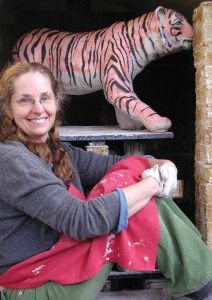
I would have to say, clay chose me. I took a pottery class in high school, and from day one I loved it; it is the medium that made me feel most alive. I started out on the wheel, but at night, after a day of trying to center clay, I had to put my hands on the ground to steady myself. Then I fell in love with sculpture and knew that was the right fit for me. Clay has taught me about patience, resilience, humility, and playfulness. I came to realize that as I changed the clay, it was changing me.
Clay and ceramics have come a long way. Ceramics have occupied a special place between art and fine craft, but that distinction has gradually dissolved.
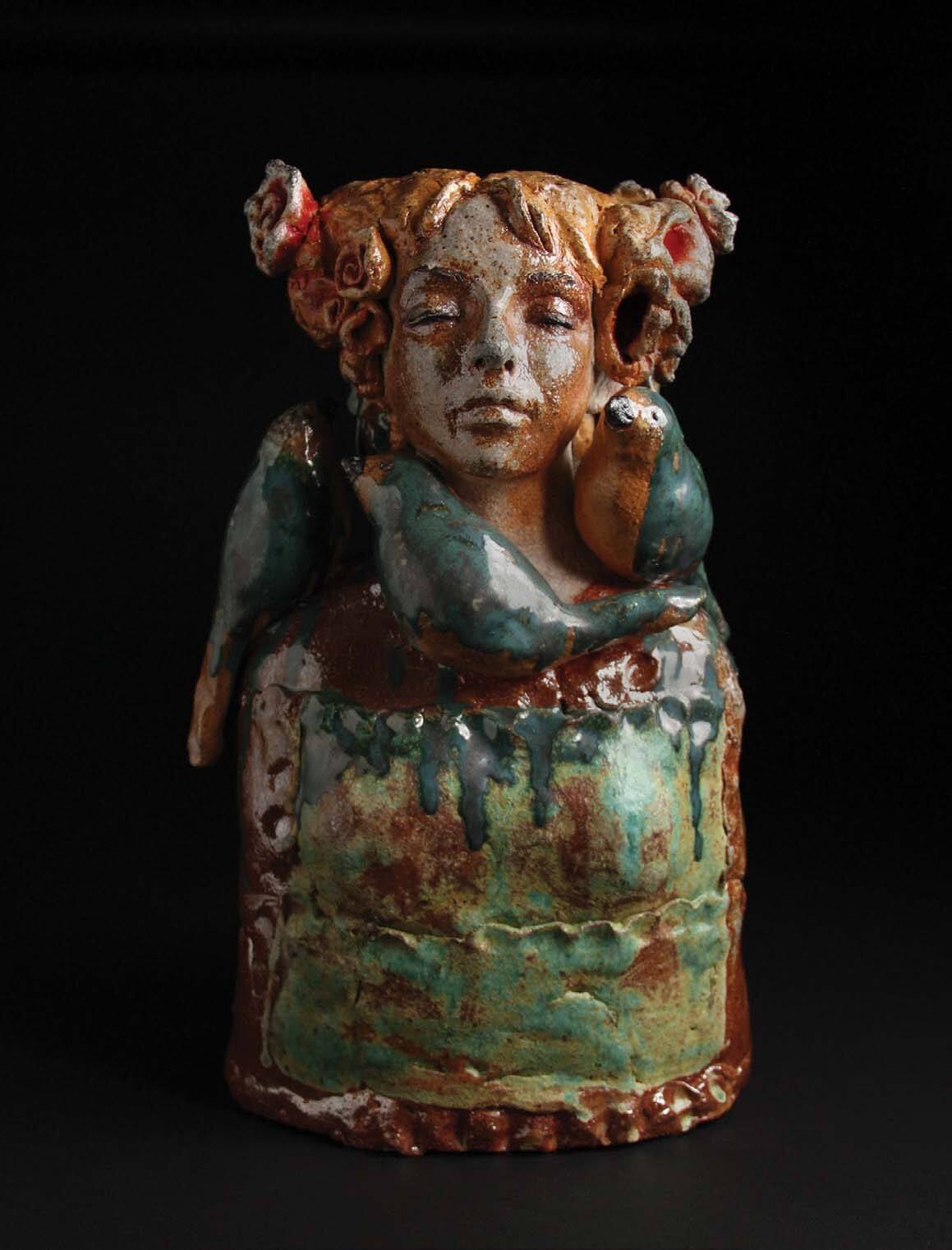
Today, artists are using the human figure in clay to explore identity, memory, vulnerability, and our humanity. We recognize ourselves in figurative art immediately. My figures and animals are rarely portraits of specific beings. They are archetypes; they carry longings, delight, joy. And symbolic objects like birds, donkeys, deer, and bears help tell stories.
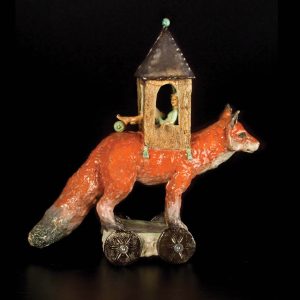
The Fox and the Princess | Salt Fired Stoneware/Porcelain at Cone 10 | 18 x 21 x 11 inches
I have a degree in ceramics and have worked with it for more than 50 years. But after a traumatic brain injury 25 years ago, it became apparent that clay and working with it was helping me reconnect with my body, my hands, and my spirit. My dreams became filled with images of figures and animals that wanted to be made — and there was some urgency to it. Working with clay became the practice through which I found healing, meaning, and ultimately, my voice as an artist.
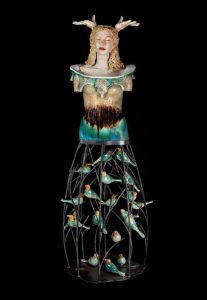
Earth Song-Lark | Salt Fired Stoneware/Porcelain at Cone 10 | 84 x 24 x 25 inches
Clay gave me a reason to get up every day when everything else felt uncertain. It required me to be present one touch, one gesture, one decision at a time. My thinking mind was not operative then, so my hands gently took over. It took physical effort, but I could feel satisfied that I had made one small thing. Then I would have to sleep the rest of the day. This process took about eight years.
The tactile nature of working with the clay helped my brain build connections. Science now tells us that the brain can reorganize itself after injury through neuroplasticity. I can’t say exactly what was happening in my brain; I believe the combination of focused attention, repetitive hand movements, creative problem solving, and the joy of making created a path to healing. The process asked my brain to keep reaching, adapting, and reconnecting.
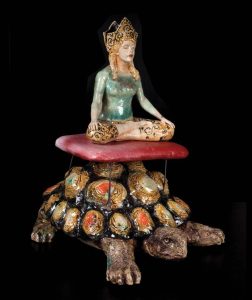
Ancient Sojourn | Salt Fired Stoneware/Porcelain at Cone 10 | 28 x 20 x 18 inches
Harder to explain scientifically is that during my recovery, I asked for a dream image at night for pieces that wanted to be made. Those dreams came and I would make what I had seen. Creativity became both my guide and medicine. Whether it was my subconscious, my spirit, or simply my brain finding a path forward, I don’t know. I only know that art gave me hope, purpose, and eventually a way back to myself. This is the mystery of creativity.
After my recovery, I’ve been asked to teach about creativity and to share my story as a way to inspire people to use their hands to create something that makes them feel alive. I enjoy seeing people find their creative voice and learn to trust their uniqueness. I hope to inspire others to experience something mysterious.
Showing up for our creativity is where the magic happens.
Caroline Douglas’s work can be found online at carolinedouglas.com and inperson at Open Studios, Boulder, Colorado, taking place this year October 3, 4, 10, and 11.
Faye Crowe, the Alchemy of Reality and Intuition
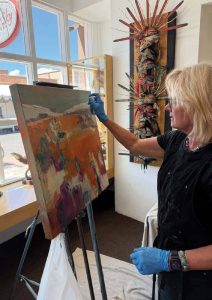
On the back patio of her home in Golden, Colorado, Faye Crowe watches the mesas do what they do every morning and evening: catch the light and hold it, just for a moment, before the color shifts into the flat light of day or drains away into the night. She has watched this performance countless times, yet never tires of the ever-changing display. That feeling is what she’s after in her work. “I paint how I experience a place — its light, atmosphere, scale, energy, and the emotional impression it leaves with me,” she says. “My paintings are less about documenting a landscape and more about expressing what it felt like to be there.”
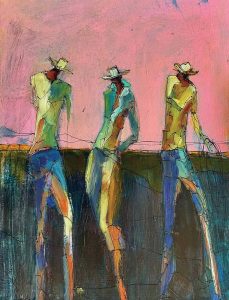
Background in Pink | Oil on Canvas | 16 x 20 inches
Crowe came to painting after a long career as an architect, and she resists any tidy story about swapping one discipline for another. “I don’t see it as leaving architecture behind,” she says. “Architecture shaped the way I think and continues to influence my paintings. I still look at a canvas with an architect’s eye, but painting gives me the freedom to be more intuitive and expressive. With architecture, I created physical spaces; with painting, I created emotional spaces.” And both, she says, are about finding ways to connect with people.
Crowe has always loved the logic of numbers and the freedom of images, twin fascinations that architecture let her hold at once. Buildings, after all, are about form, function, light, and material, worked out in three dimensions. She approaches painting in the same way.
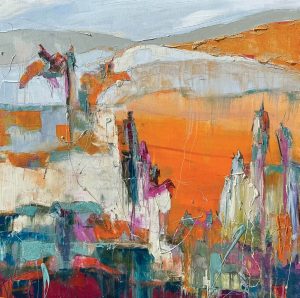
Dreams | Oil on Canvas | 48 x 48 inches
When asked about switching between left- and right-brain thinking, she’s quick to point out that current thinking among neuroscientists is that this notion is more metaphor than fact. Indeed, her own process bears that out. Mixing a color, for Crowe, is equal parts chemistry and instinct. Laying paint on a canvas is equal parts plan and improvisation. “I’m constantly moving between logic and imagination,” she says, “precision and spontaneity, planning and discovery.”
Her paintings rarely start with a literal place or concept. Instead, Crowe seeks inspiration in experiences that take her from the foothills outside her studio to the canyons and prairies of the American West and the small towns whose quiet holds its own kind of charge — all of it raw material for something less documented and more felt.
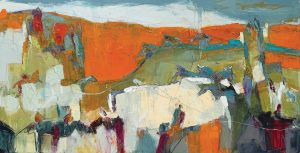
Among the Chaos | Oil on Canvas | 32 x 60 inches
The physicality of her work is evident in how she builds a painting. Crowe is often described as a palette-knife painter, and it’s true she reaches for one often, laying down thick, gestural passages of color. But she moves just as readily to a brush, to a pencil dragged through wet paint, to her own fingers pushing pigment across the surface. She mixes in wax and sand, materials that let a two-dimensional surface behave like something with weight and history. She often builds up paint, then scrapes part of it away, letting the ghost of an earlier decision show through so that the finished painting carries a record of how it was made.
And Crowe loves to work big, a natural inclination for the former architect who often considers how people experience space. “A large canvas creates its own environment,” she says. “And it allows the viewer to step into the painting rather than simply look at it.” Painting on a grand scale is also a more physical experience that requires the use of her whole body. “The gestures become larger, the marks become more expressive, and the process feels more immediate and dynamic.”
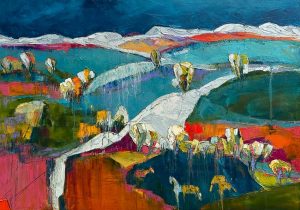
Between the Trees | Oil on Canvas | 45 x 60 inches
Crowe’s work and practice blends the analytical and intuitive to form a two dimensional iteration of her experiences. She paints the feeling of being, but her desire is for viewers to arrive at their own memory of a place, thereby making her paintings a little more their own.
Faye Crowe’s work can be found at Sorrel Sky Galleries, the Marshall Gallery in Scottsdale, Jane Hamilton Fine Art, Saks Galleries, and online at fayecrowefineart.com.
Nayla Shami, Carrying Traditions from Lebanon to the West

With all the turmoil in the world, it’s easy to forget that every place in the news is also filled with people who have their own beautiful culture and traditions. Lebanon is one of those countries caught between war and instability. And yet, this is a place of beauty and tradition, and one of its primary exports is fine jewelry.
We spoke with jeweler Nayla Shami about how her upbringing and Lebanese culture shape her work. She and her husband moved to Lubbock, Texas, in 1987 for his medical training but always made sure their children stayed connected to their heritage.
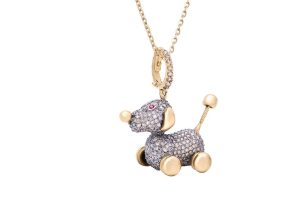
Pepper the Doggy | 18 Karat Gold, Sterling Silver, Champagne Diamonds and Ruby Eyes | 2.7 x 2 centimeters
Q: Why was jewelry the art you chose to pursue?
NS: Lebanese women have a very good sense of aesthetic and design. Jewelry is not only an important craft in Lebanon, it is also part of women’s fashion sense. It marks every major occasion — births, graduations, weddings, birthdays — and is often passed down through generations, each piece carrying memories and tradition. Growing up surrounded by women who cherished their jewelry inspired my own love for design. Those influences are reflected in my collections, which aim to blend timelessness with innovation.
Q: I read that you have a law degree. Becoming a jeweler seems like a big leap. Would you tell me why you chose jewelry?
NS: Yes, I practiced law in Beirut before moving to the US with my husband. Although I loved practicing law, I had a longstanding passion for jewelry design. Even while practicing law, I designed my own jewelry pieces and collaborated with skilled professional jewelers to bring them to life. Little did I know that my favorite hobby would ultimately become my profession. And while law and jewelry design are unrelated fields, they share a lot in common: attention to details, precision, discipline and careful consideration of every element.
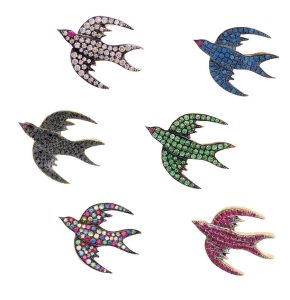
Bird Flock | 18 Karat Gold and Stone Options: Champagne Diamonds, Sapphires, Rubies, Tsavorites, and Black Diamonds | Four Sizes Available
The transition from designing pieces conceptually to working at a jeweler’s bench was a transformative experience. Years ago, a dear friend of mine, knowing my love for jewelry design, signed me up for jewelry classes with a professional jeweler in Lubbock as a birthday gift. Being hands-on with materials, tools, and techniques felt instinctive and was a profound revelation. My bench experience is an asset when having my designs executed by skilled artisans.
Q: What kinds of things inspire your work?
We spent our summers in Lebanon, where we enjoyed not only the beautiful shores of the Mediterranean but also countless mountain hikes. The Burro necklace was inspired by one particularly memorable hike when a stubborn burro decided to block our path. While everyone else was busy trying to figure out how to outsmart a donkey, I was thinking how to immortalize him in the form of a necklace. On another hike, we encountered a shepherd guiding his herd of goats up the mountainside. The goats wore tiny bells around their necks, creating a scene that felt timeless, ancient, peaceful, and incredibly beautiful. It was a moment that belonged to another era and from that memory, the Goat Necklace, complete with a bell, was born.
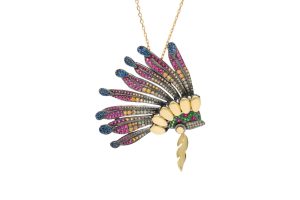
War Bonnet | 18 Karat Gold, Sterling Silver, Blue and Orange Sapphires, Rubies, Tsavorites, and Champagne Diamonds | 4.5 x 4.2 centimeters
Every piece I design is meant to create connection and carry memories. Lebanon’s diverse landscape and natural beauty have inspired many of my pieces, like the Olive Branch, Burro, Goat, Frangipani, Fish Collection, and Dove.
The Dove necklace, by the way, was my first design and has become my signature and logo. Inspired by my grandmother’s gold locket, the Dove collection is a tribute to family heritage and those who shaped us.
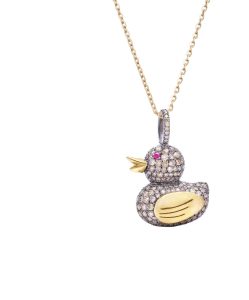
Bubbles the Ducky | 18 Karat Gold, Sterling Silver, Champagne Diamonds and Ruby Eyes | 1.7 x 1.7 centimeters
Q: And the Western US, that inspires you too, right?
NS: The Headdress necklace, one of my favorite and most intricate designs, was inspired by the spirit and artistry of the Southwest, as were the Arrow necklace, the Sleeping Bear necklace, and my turquoise and gold collection. These pieces have been created as a tribute to the richness of the culture, the beauty of the land, and the timeless stories woven into the history of the region.
Q: Along those lines, you have several humorous pieces. What inspired that series?
NS: I am so glad you asked! This collection is dear to my heart. We recently became grandparents. The overwhelming wave of pure joy and awe inspired The Liam Collection. We live in Texas, so Liam needed Toffee the Rockinghorse. Baby bathtime inspired Bubbles the Ducky, and I love dachshunds, so Pepper the Doggy is named after my dachshund and modeled after old wooden pull-toys — his gold wheels actually move when you pull it by the chain.
Q: You work with artisans in Lebanon. What kinds of things do they do? And, on a more personal note, how are they doing these days with wars all around them?
NS: Lebanese jewelry and designers are known worldwide. They use state-of-the-art jewelry techniques and equipment and have retained the artisan know-how that has been passed down through generations. Working with them was a natural choice for me. All my artisans are in Lebanon. I am always so impressed with their ability to stay focused on their craft and deliver a very high-quality product on time; they never cease to amaze me. I also thoroughly enjoy their sense of humor and look forward to my head person’s hilarious comments.
I am proud to say that I can support brilliant artisans through the difficult times of war and upheaval. I am proud to say that by having a successful business myself, I can support these artisans. I hope to be able to support them for many years to come and let the world see their incredible craftsmanship, resilience, and the pride they take in their work.
Nayla Shami’s work can be found at Slate Gray Gallery, Sorrel Sky Galleries, Schreiner Goods, Drest by Scott Malouf, and online at naylashami.com.
David Jonason Paints the Southwest That Lives in His Heart
There’s a moment in every commercial artist’s career, if they’re lucky, or maybe just stubborn enough, when the ad copy falls away and something truer starts to surface. For David Jonason, that moment arrived in the eerie aftermath of September 11th.
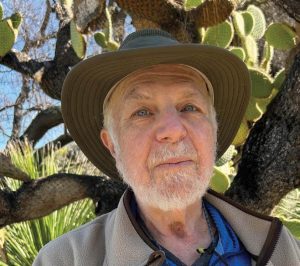
“The commercial art business got very quiet,” he recalls. “A lot of ad agencies seemed to be sitting on their hands thinking the world might end at any minute.” Fewer assignments meant more free time, and Jonason began painting the things that had been knocking around in his head for years. After about five years, the balance of assignments and paintings had shifted completely. One day Jonason realized illustration had quietly given way to something else entirely. Today he works with five galleries and takes no illustration assignments at all.
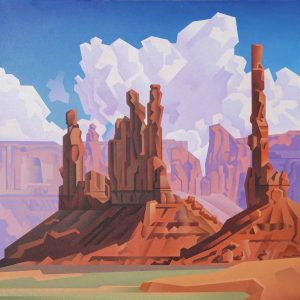
Valley Spires | Oil on Canvas | 48 x 48 inches
Jonason spent three decades in illustration and graphic design, work that instilled two lessons he carries into his studio. The first: Never, ever miss a deadline. He remembers a colleague’s mantra: ‘Better to walk down Fifth Avenue in your underwear than turn in work late.’ Sleep became a luxury. There were all-nighters and frantic drives to reach FedEx before the truck left. Ah, the days before PDF attachments.
The second lesson: An illustrator isn’t an art-world celebrity; he’s more like an electrician or a plumber, brought in to solve a problem. More importantly, the role demanded listening and empathy. “I’ve applied this to my relationship with the people who sell my work,” he says. “I always try to find out what their needs and concerns are.”
In his early days painting, Jonason worked from black-and-white sketches of subject matter he most wanted to paint: the American Southwest. But because he doesn’t live in the area, every road trip meant cramming in as many studies as he could. Then came digital photography. “It was the choice between doing two black-and-white sketches or shooting a hundred photos,” he says. These days, he composes his scenes in Photoshop, freely blending elements from different trips and locations such as red rock formations from Mexican Hat, Utah, that he layers beneath clouds photographed over a Walmart parking lot in Albuquerque. He overlays a grid, prints the composite, and sketches from there.
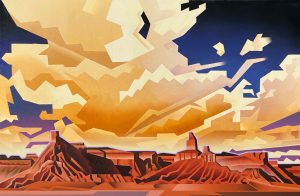
Cloud Power | Oil on Canvas | 24 x 36 inches
“There’s no problem for me mixing locations or contexts,” he says of the liberties he takes with his subject matter. “Much of my work has to do with an imaginary Southwest that lives in my heart.”
Of all the potential subjects the Southwest offers up, Jonason is most drawn to, well, rocks. “For me, it’s very satisfying to paint the physical mass and bulk of rock forms,” he says. Interestingly, his painting career actually began with architectural landmarks from the 1930s through the 1950s. A dealer from a Pasadena gallery noticed how he handled the rock formations and foliage surrounding the Arts and Crafts homes he painted and suggested he try landscapes. From there, the leap to the American Southwest was a short one. “In many ways the landscapes of the Southwest are just cityscapes in stone,” he says. Lately, he’s begun folding in desert fauna, small gestures of life against all that stone.
Jonason grew up largely in California before a stint back east, and today he lives in Mendocino, a Northern California coastal town perhaps best known as the setting for Murder, She Wrote. It’s a place with plenty of New England charm but, as he’s quick to point out, not exactly fertile ground for a painter obsessed with the American West. “It’s a place my wife dearly loves,” he says. “I keep trying to move to Arizona, but that’s a hard sell.”
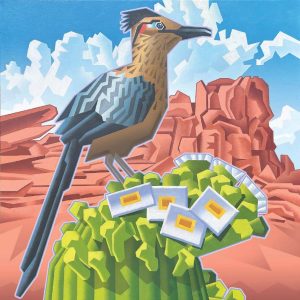
Roadrunner Rock | Oil on Canvas | 24 x 24 inches
So he hits the road whenever he can. He recently returned from a reference-gathering trip through Bluff and Mexican Hat, Utah. He describes the Valley of the Gods, a landscape most visitors would describe as unforgiving, as his vision of the Garden of Eden.
Jonason names Maynard Dixon, Emil Bistram, Andrew Dasburg, Victor Higgins, and Ed Mell among his influences. He says he admires these artists less for their subject matter and more for their refusal to romanticize it. “The thing that appeals to me about these artists is the unsentimental quality of their work,” he says. “They are basically city people painting the West. Their approach feels very urban and true to the time and place. There’s no fake nostalgia or idealized past that they are trying to portray.”
His own contribution to that lineage: a true reflection of his unique life. “I suppose I bring what any individual artist brings to the easel. It’s the Southwest filtered through my life story of design work, love of cubism, travel to India, advertising for hotels in the Caribbean…and so much more.”
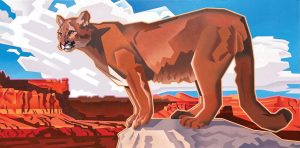
Canyon Cougar | Oil on Canvas | 24 x 48 inches
Jonason’s polished, dimensional surfaces are often mistaken for acrylic, but oil is his medium of choice for fine art painting. “I have never been a big fan of brush strokes and gritty paint textures,” he says. Oil paint, he notes, allows him to get that soft graduated modeling effect he achieved with airbrush in his days as an illustrator mimicking travel posters from the 30s and 40s.
Lately, however, he’s been experimenting with acrylics as a way to combat Mendocino’s coastal climate, which makes drying oils — even with heat lamps — take way too long. “My wife will ask, ‘Did the painting go out?’” he says, to which he can only shake his head and tell her it isn’t dry yet. But acrylics, he admits, are a different animal altogether, one that will take some trial and error before he gets the look he’s after. Thankfully, he’s got time to figure it out. These days, there’s no art director breathing down his neck.
David Jonason’s work can be found at Raitman Galleries, Mountain Trails Galleries, Big Horn Galleries, Ann Jeperson Fine Arts, Manitou Galleries, the Marshall Gallery, and at davidjonason.com.
No Comments