




03 Sep In the Studio: Infinite Color
Hunt Slonem’s New York City studio is an explosion of color, art, and objects, from antique furniture to top hats, harps, framed photographs, plants, and rugs. Though I can’t see his collection of 10 rescued exotic birds, their chatter periodically floats up through the breaks in our conversation. Easels surround him, displaying works in various stages of completion. Measured and thoughtful, his serene countenance belies the beehive of work happening all around him. Occasionally, off-camera, someone catches his eye. He excuses himself, stands, and takes a moment to respond to whoever needs him. Then he returns to our conversation exactly where he left off.
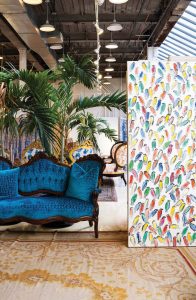
The artist’s New York City studio is a long industrial space filled with antiques, rugs, plants, art, and his rescued exotic birds.
The painter, sculptor, and muralist, now 75, still maintains an exhaustive schedule. This year alone, he’s had exhibitions from Carmel to Houston, Santa Fe to Sag Harbor, Newport to Cleveland. Next up is a show focusing on florals, opening in Scottsdale at Bonner David Galleries, September 10–October 31.

Around every corner one finds salon-hung walls filled with colorful paintings in antique frames. Scattered throughout are his sculptures, 3-D versions of his paintings, all richly painted to echo the joyful sensibility of his paintings.
He also created large scale sculptures for a massive exhibition at the Dallas Arboretum and Garden aptly titled Bunnies, Birds & Butterflies. Featuring Slonem’s characteristically joyful animals, some topping out at 20 feet tall, the sculptures — mosaic, bronze, neon, and glass — were installed throughout the garden’s 68 acres, along with hundreds more two- and three-dimensional works of art inside the Arboretum.
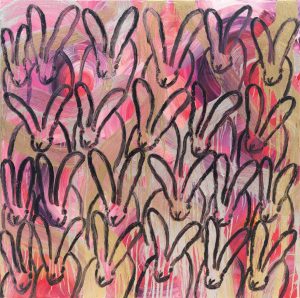
Totem Summer Bloom, 2026, oil on canvas, 60 x 60 inches
And then there’s his latest home renovation of a 38-bedroom historic manse in Newport, Rhode Island. As he describes his plans for installing hundreds of paintings there, I blurt out: “How do you have so much energy?”
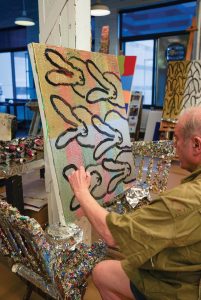
Slonem at work blending layers of paint by pulling a brush methodically across the surface. Photos: Allison Day
He pauses a beat, then says, “I go to Mass every day at 5:30 at St. Patrick’s Cathedral. That helps get rid of some of the nonsense that happens during the day.”
And suddenly, his work makes so much sense to me.
What’s Better Than Work? More Work.
Though Slonem once said in an interview that he decided to be an artist when he was two, he wasn’t brought up in a family of artists. His father was a naval officer, so the family moved often. Once, while living in Hawaii, Slonem recalls telling his mother he was bored at the beach; she told him he was too young to be bored. “Working,” he says, “gives me pleasure.” Clearly, he wasn’t cut out for a life of leisure.

Pictured here in front of his painting of toucans, with his hand resting on his whimsical tiger sculpture. Photo: Fadil Berisha
His parents weren’t art collectors, but they enjoyed antiquing and brought him along. His maternal grandfather painted. “He wasn’t a professional,” Slonem says, “but he would send us his paintings. So, I grew up around wet oil paint.”
When it came time to choose a university, Slonem says he didn’t have a state to call home because they moved so frequently. The Naval Academy was never in contention, but this didn’t bother his father, who simply encouraged his son to follow his own path. So Slonem picked Vanderbilt in Nashville, which was close to an aunt living in Chattanooga.
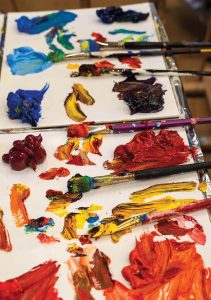
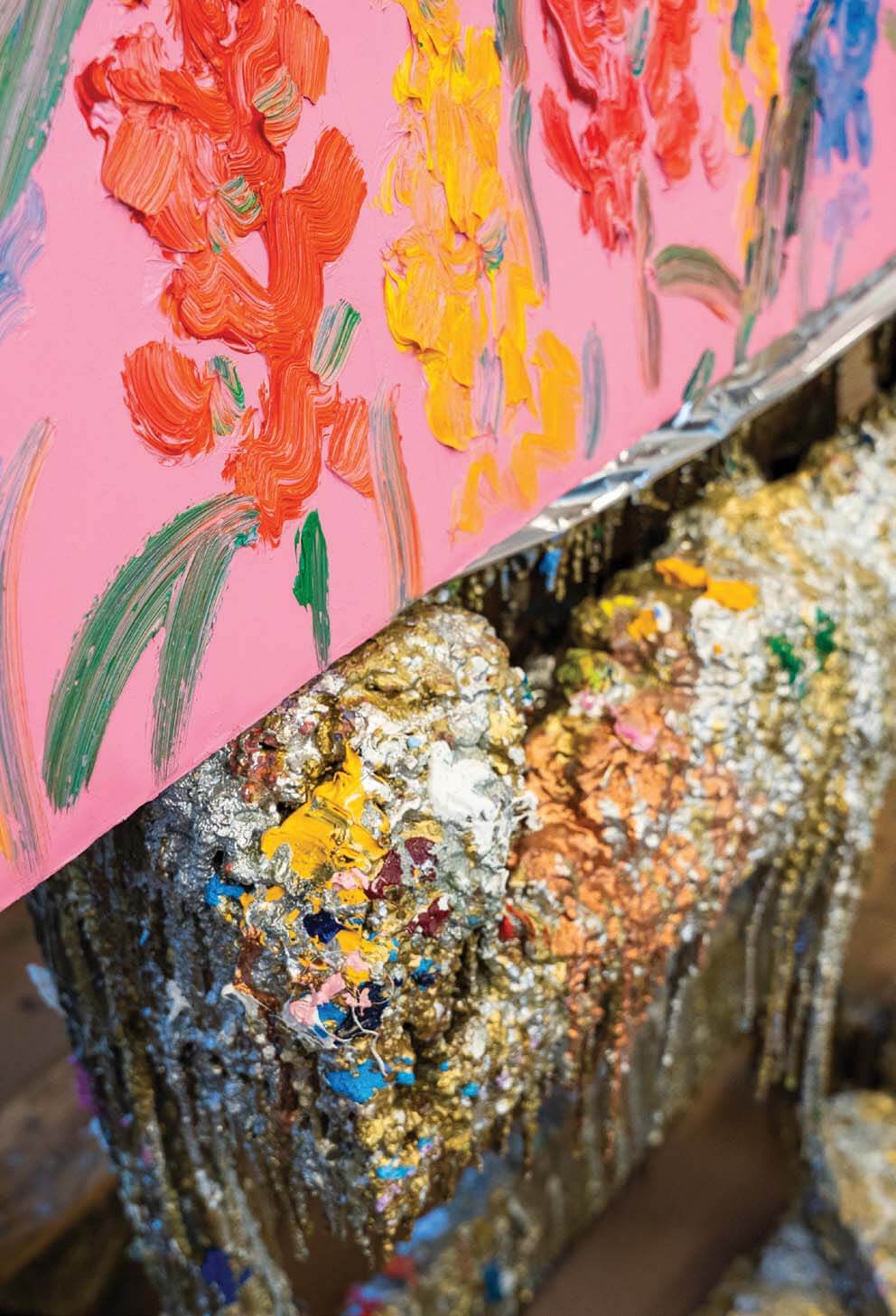
Slonem’s palette of oil paints laid out in the order he uses the lucious jewel-toned colors he favors in his work.
Slonem didn’t, however, stay long at Vanderbilt. He’d been an exchange student in Managua, Nicaragua, during high school and recalled playing hooky from school to head into the jungles and look for butterflies and birds. With a penchant for Latin America, he left Nashville for Mexico, to study art for a year.
After Mexico, he returned to the States and enrolled at Tulane University, where he earned a degree in painting and art history. After a class in architecture, he fell in love with New Orleans’ grand antebellum homes, many of which he noticed were falling into disrepair.
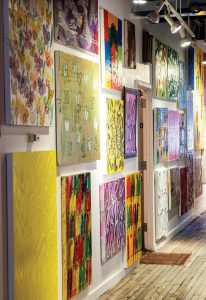
Hunt Slonem is not afraid of color or pattern and his life reflects it.
But Slonem knew that New York City was the place to make it in the art world, so in 1973 he moved there and never left. The first five years there were a struggle, but he was inspired by other artists who helped him find his way. And then artist Alex Katz, whom he met at the Skowhegan School in Maine, introduced him to Marlborough Gallery, which represented him for eighteen years and launched his career.
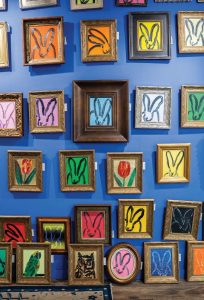
Because Slonem starts his day with small rabbit studies, he is able to display an ever changing wall of the works — with the occasional parrot or owl squeezed in for good measure. Photos: Allison Day
The Rabbits, the Rosary, and Repetition
Slonem’s rabbits are perhaps his most recognizable subject. They trace back to a painting of the Peruvian saint San Martín de Porros that he created for an exhibition on saints. He wanted to paint Santa Rosa de Lima, but she was already taken, so he was told he had to paint San Martín de Porros.
San Martín’s traditional attributes include a cat, a dog, a mouse, and a broom, so Slonem folded those animals into the painting alongside others he was fond of: rabbits, a tiger, butterflies, peacocks, and birds. He painted his first version of the subject in 1974, and it grew into an ongoing series over the decades that followed. This spurred on a series of paintings of Pierre Toussaint, a formerly enslaved Haitian hairdresser turned philanthropist who helped fund the original St. Patrick’s in New York and is buried at the cathedral. Toussaint’s portrait now hangs in St. Patrick’s.
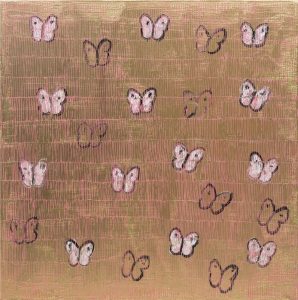
Pink Ascension, 2026, oil on canvas, 48 x 48 inches is one of Slonem’s meditative reflections on nature and the infinite patterns that never quite repeat the same way twice. Photo: Hunt Slonem Studio
The repetition that defines his work and commands the walls of his studio took flight on a mountaintop in India, where he attended the Blue Pearl course. There, he had a revelation. “In nature, no two things are the same. A tree is covered with billions of leaves, and they’re all different, but it looks like a tree,” he says. “Most religions have you repeat mantras or rosaries on a regular basis. And I thought that divinity is really repetition; and repetition is a way to divinity.” He adds, “It used to be considered a dirty word in art: repeating yourself. But nothing is ever the same. Nothing is identical.” To him, repetition brings one closer to the inner world.
As for those rabbits, he was once told by a channeler that the rabbits would take him to places he’d never been before. Indeed, they have.
Slonem’s spiritual life took a winding path before landing at Catholicism. He followed gurus for years, traveled repeatedly to India, and made more than fifty trips to Germany to see Mother Meera, to whom he still feels a close association. But on a frightening flight to Louisiana, a devout Catholic friend led him through the rosary to calm his nerves. He kept up the practice afterward and prays the rosary three times a day. He describes painting in almost identical terms to prayer, laying down mark after mark, one at a time, the way one might repeat a mantra.
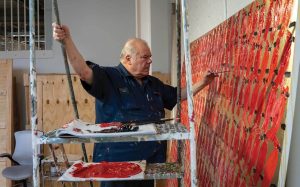
Surrounded by canvases in various stages of completion, Slonem’s studio accommodates very large paintings so that the artist works closely on details then can step back to see if the composition flows together as a cohesive thought. Photo: Allison Day
Color First
Color, for Slonem, is a source of pure pleasure that he compares to candy. That love isn’t confined to canvas. He says nothing gives him greater joy than holding a color wheel to choose paint colors for the rooms in his houses; they are drenched in the same palette as his paintings. Color on color doesn’t intimidate him; if anything, he’s ahead of the curve. Museums have only caught on to painting gallery walls in bold hues in the last fifteen years or so, he notes — practically an entire career after he started doing exactly that in his own homes.
An Insatiable Collector of Houses
The origin of Slonem’s devotion to restoring historic homes started with the memory of a home he never saw: his great-grandfather’s 1850s home in Chattanooga, Tennessee, that was torn down to make way for a highway.
And so, years after that architecture course at Tulane, he bought his favorite antebellum property, which led to acquiring more historic homes and orchestrating their restorations. He’s careful, he says, never to alter a home’s original structure — no moved rooms, no invented additions — only removing what later owners tacked on. It’s a philosophy shaped in part by loss: recently numerous historic Louisiana homes have burned or fallen into ruin, including the recent destruction of Nottoway Plantation, built by the 19th-century Louisiana architect Henry Howard.
Slonem’s current undertaking is a 54-room house in Newport, Rhode Island, purchased privately and now absorbing the contents of four other homes he has sold recently. Four months into the project, he is still sorting decades of collected antiques and artwork, choosing paint colors room by room. The house presents its own comic obstacles: light switches wired so haphazardly that finding the right one for the right room feels, he says, like solving a crossword puzzle; a roof that took six years to finish because of relentless hurricanes; a long-abandoned swimming pool he is trying to remove. And, of course, some five hundred paintings waiting to be hung, which will require industrial lifts to reach ceilings 50 feet overhead.
Persistence, Not Luck
For all the visible productivity — paintings, sculpture projects, exhibitions, and the houses under constant renovation — Slonem is matter-of-fact about how any of it happened. The secret to his success: persistence and inspiration.
And maybe, I think, the real message in Slonem’s work is that joy can be found in passionate persistence, and that life, like art, is as vibrant as we make it.
No Comments