





03 Sep Western Landmark: Long live the Grande Dame
By the 1970s, the cotillions and debutante balls that had graced Seattle’s Olympic Hotel since it opened in 1924 were things of the past. The hotel’s ornate Italian Renaissance Revival structure, with its crimson and gold interior, was suddenly considered garish and out of place amid downtown Seattle’s new brutalist skyscrapers. Worse yet, guest room bookings had plummeted. According to Alan J. Stein, whose book The Olympic chronicles the hotel’s history, occupancy dropped from 75 percent to just under 60 percent between 1969 and 1972, putting the hotel under severe financial strain. The Olympic’s downturn occurred in an era of federal urban renewal during which communities were given funds for demolishing old buildings and leveling undesirable neighborhoods. Thus, the prospect of debutante balls gave way to the threat of the wrecking ball.
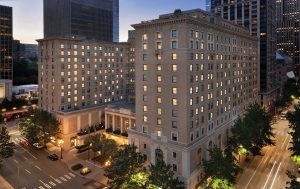
Opened in 1924, the Olympic has survived economic downturns and the wrecking ball thanks to preservationists.
In 1974, that wrecking ball hit too close to home. Directly across the street from the Olympic, the White-Henry-Stuart complex — 11-story Beaux-Arts treasure, was destroyed to make room for an aluminum and concrete edifice called the Rainer Plaza and Tower.
Such destruction galvanized preservationists, who feared the crown jewel of Seattle was next and leapt into action. Among the Olympic’s most influential defenders was architectural historian Miriam Sutermeister. With encouragement from Allied Arts of Seattle, a civic advocacy group, Sutermeister worked tirelessly to get the hotel on the National Register of Historic Places. Some 20 well-known and prominent Seattleites signed a “please rescue” letter, which was delivered to the Olympic’s landlords, the University of Washington regents.
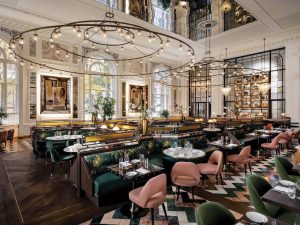
Featuring Pacific Northwest cuisine, the updated Georgian Room is now called The George.
A public hearing brought out nearly 100 supporters who begged decision-makers to preserve the landmark. A team of consultants investigated the property and the supporters’ claims and produced a report declaring that the Olympic had enough economic merit to be saved.
“There was a backlash over the loss of Seattle’s historic character,” recalls Jeff Murdock, preservation advocacy manager for Historic Seattle. And it wasn’t just the Olympic; beloved Pike Place Market was also slated for demolition, and ultimately spared thanks to public outcry. “The backlash to urban renewal,” Murdock says, “was well underway by the mid-70s.”
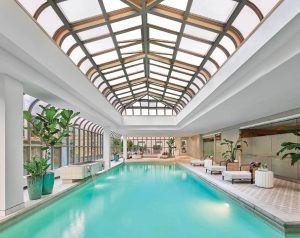
The hotel’s indoor pool is a rarity in Seattle.
Proponents of the hotel’s preservation asserted that the Olympic belonged to Seattle, not just to its current owners. Partly, they argued, because a public bond fund was issued to help with construction in the early 1920s. Average citizens enthusiastically invested, many referring to the Olympic as “our hotel.”
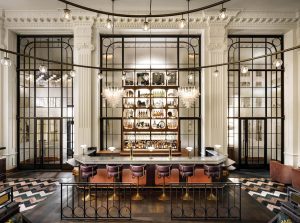
The various dining spaces, plus the bar at The George, are some of the true showstoppers at this legacy property. Better still: they are open for breakfast, lunch, and dinner. Photos courtesy of the Fairmont Olympic Hotel
The Rise of the Grande Dame
Built on a hillside, the 12-story dazzler seemed untouchable, almost sacred. On opening day, December 6, 1924, thousands poured in to see the $5.5 million beauty that spanned an entire city block. Speeches and parties were aired with commentary on the radio throughout the evening.
The time was right for a hotel of the Olympic’s caliber to make its debut. Seattle had become a prosperous city, thanks to steel, timber, construction, and shipping enterprises that transformed ordinary folks into captains of industry. Further, the end of World War I and the advent of the automobile age meant that people were now hankering to vacation.
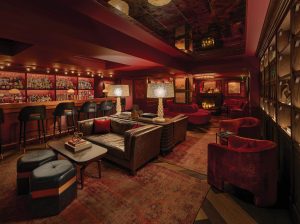
Be sure to book your reservation at the Founders Club, a speakeasy hidden behind a bookcase.
Prominent New York architecture firm George B. Post and Sons partnered with local firm Bebb and Gould to design the palatial hotel that would prove Seattle had arrived. Black Belgium marble, bronze, and gold toned Italian marble were among the exquisite materials installed by best-in-class tradesmen. Italian tile artisans who arrived via ship were commissioned to lay the terrazzo mosaic tiles. Wood workers carved intricate scrolls, leaves, and rosette designs on oak paneling. The preservationists working to save the Olympic warned that such craftsmanship would never again be seen if the hotel were destroyed.
Restoring History with Subtle
Modern Luxuries
The hotel’s massive lobby, nicknamed Seattle’s living room, has hosted the likes of Charles Lindbergh, who stopped in Seattle in 1927 after his famous trans-Atlantic flight, and President Roosevelt, who stayed at the Olympic in 1937 on his way to inspect his New Deal public works. In 1962, astronaut John Glenn, the first American to orbit the earth, arrived on a goodwill mission.
Through the years, the hotel has passed from owner to owner. After the decision to save the Olympic, the Four Seasons took over and, in 1980, closed the hotel for reconstruction, which included renovating the 735 tiny rooms into 450 larger ones.
To accomplish this remodel, everything had to go. A garage sale — the city’s largest ever — attracted thousands itching for a piece of Olympic history. They lined up around the block to shop for everything from bed sheets to kitchen sinks to hotel keys. In 60 days, the public picked the hotel clean.
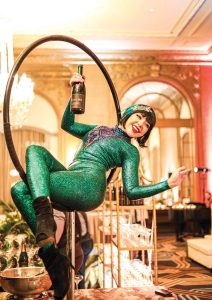
The Olympic held centennial celebration December 9, 2024 with a Roaring Twenties theme and locally crafted Fairmont Centennial Sparkling Wine. Photos courtesy of the Fairmont Olympic Hotel
The Olympic was sold once again in 2003, to Legacy Hotels Real Estate Investment Trust. Under that agreement, Fairmont Hotels & Resorts would manage the property. In 2020, at the beginning of COVID-19, the owners of what is now called the Fairmont Olympic invested $25 million towards reimagining the lobby with new lounges and restaurants along with room updates and other details. This time, an elevated design motif echoed the 1920s with lots of pink and green.
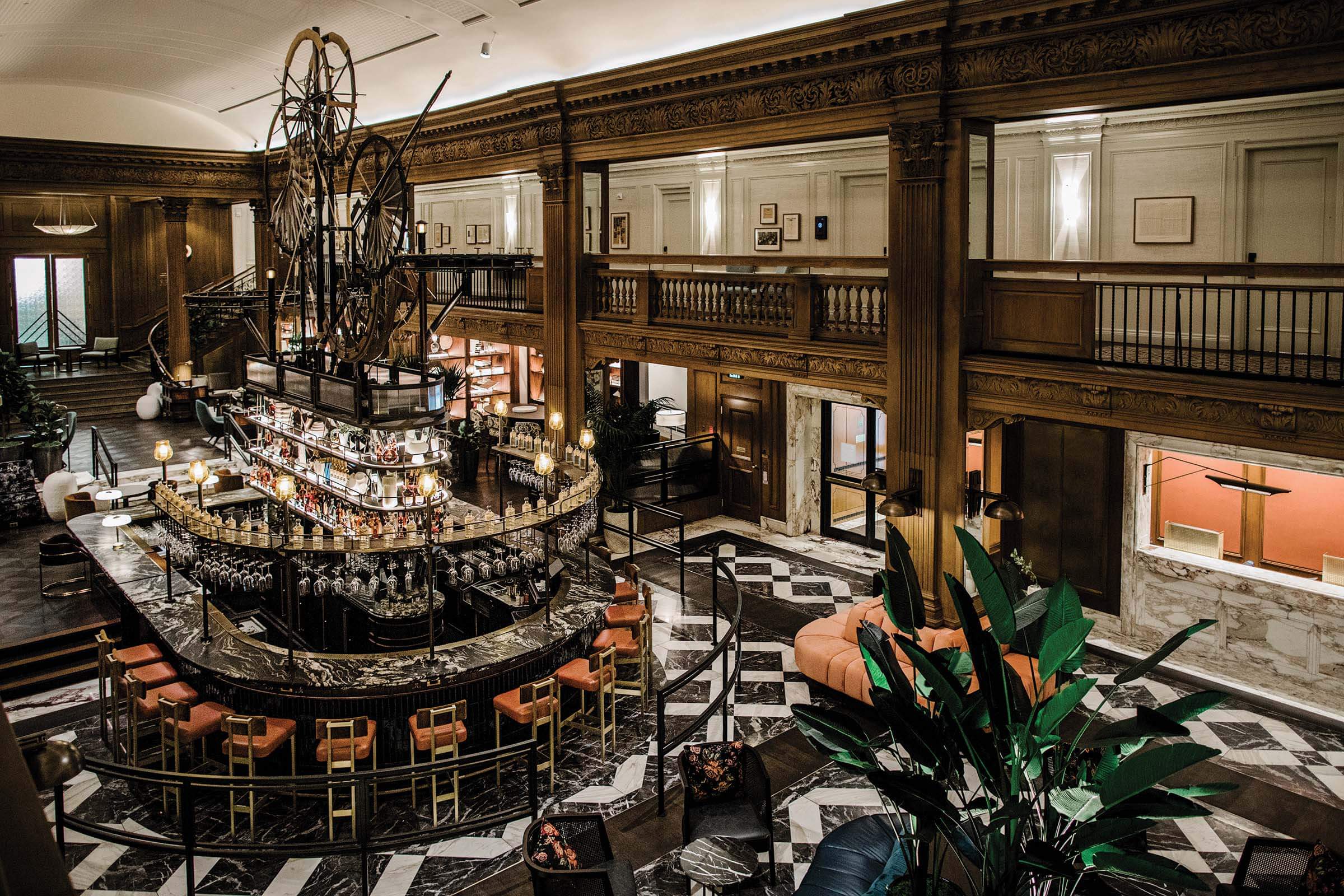
The careful renovation, completed in 2021, maintained the hotel’s charm of yesteryear, preserving antique chandeliers, marble columns, and ornamental wood trim. The new Olympic Bar, topped by a kinetic sculpture of 400 moving parts that resemble a sailing ship in motion, echoes the hotel’s original logo.
Behind a bookcase is yet another surprise: a hidden speakeasy called the Founders Club offering rare whiskies and cognacs. Upon the bar’s walls are landscape paintings with hounds and cattle evoking a hunting lodge ambiance.
Mechanical upgrades to the 1924 elevators left the character and the geometric brass detailing intact. Imperceptible changes extended the lobby’s matching wrought iron staircases to meet safety codes and a newly furnished wraparound mezzanine on the second floor gives visitors an aerial perspective on the lobby. Along the mezzanine walls is a timeline with framed newspaper articles, photos, and artifacts that tell the story of the Olympic.
During the remodel, the Victorian haberdashery that sold expensive men’s clothing was converted into Shuckers Oyster Bar, its 1930s tin ceilings and cherry and oak wood paneling preserved with a deep cleaning. Meanwhile, The George, formerly The Georgian Room, was transformed with modern brass chandeliers, accentuated 22-foot ceilings, and restored Palladian windows.
“The stewards of the hotel have taken very good care of the property over the first 100 years,” says preservationist Murdock. “Ongoing investments to keep the building relevant speak to the landmark’s enduring significance in the city,” he says.
The Olympic’s 100th anniversary celebration was an epic bash. Seattle’s mayor declared December 6, 2024, “Fairmont Olympic Day.” At the black tie soiree, the University of Washington Husky Marching Band paraded in with joyful blares; food was inspired by historic menus; and cocktails were served in the hotel’s legendary Spanish Room.
“The Fairmont Olympic,” general manager Sunny Joseph says, “remains Seattle’s Grand Dame, a place where celebrations unfold, traditions are created, and the community comes together for life’s most meaningful moments.”
No Comments