


06 Mar A Fractal World
Trekking poles, camping gear, and hiking boots – essential tools for Terry Gardner’s painting practice – fill one corner of his studio, ready and accessible for sojourns into Colorado’s public lands where he frequently travels for inspiration.
“Every summer, I map out hikes,” he says. “I go to the Windy Ridge Bristlecone Pine Scenic Area near Breckenridge every year and recently camped among the junipers at Black Canyon of the Gunnison, where the juniper at Dragon Point stands.”
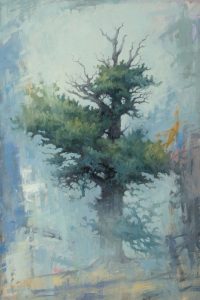
Ancient Arms | Oil | 24 x 36 inches
Gardner’s transcendent obsession with trees began some 25 years ago when he read a magazine article about wind-sculpted bristlecone pines, a species specific to the American West and known to live as long as 4,000 years. An aspect of these trees that struck Gardner’s fancy was fractals — natural geometric patterns mirroring the larger in the smaller and repeating in various sizes.
“As I explored trees – observing and painting them – I would see repeating patterns,” Gardner says. “This was a revelation, these fractal patterns in nature, like the way a small piece of broccoli looks like the larger piece.”
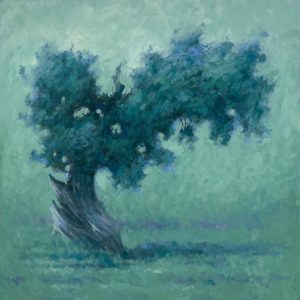
Juniper At Dead Horse Point | Oil | 36 x 36 inches
And Gardner, in turn, recognizes himself as a smaller part of the bigger picture. “I have such respect for trees and what they provide. Their benefits to the Earth and to humanity are immeasurable. I want to pay respect to trees through my own voice and to inspire viewers to think of trees differently. They’re like dignitaries,” he says and adds, “If only humans could be more like trees.”
Trees are Gardner’s muse for his solo show, Arboraceous: An Exploration of Trees in Paint, May 1 to May 23 at Gallery 1261 in Denver. “My memory and experience of trees is very much in my soul and part of who I am and what I paint,” Gardner says.
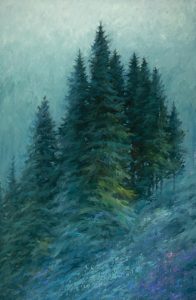
Shrine Trail | Oil | 40 x 60 inches
Widely celebrated for his traditional Western art depicting cowboys and cowgirls, Gardner has long created and sells an equal number of paintings of trees. This show, however, is an exploration, a sort of self discovery that expands beyond the representational works of the past.
“It takes courage when you break out, when the work is fresh and new,” Gardner says of this latest body of work that decidedly leans toward abstraction. “For me, it has a lot to do with getting older. I started thinking about artists throughout history and asking, ‘What is it that I want to be known for?’ And I realized I need to start painting what I feel in my soul.”
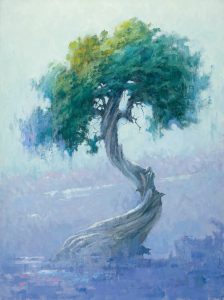
The Juniper at Dragon Point | Oil | 36 x 48 inches
For Arboraceous, Gardner plans to present 20 paintings — a mix of recognizable, representational works along side his new abstractions. “I look at this new body of work as an exploration of trees from many vantage points: as individual and iconic to forests and interiors of forests, and the intimate fractality of trees.”
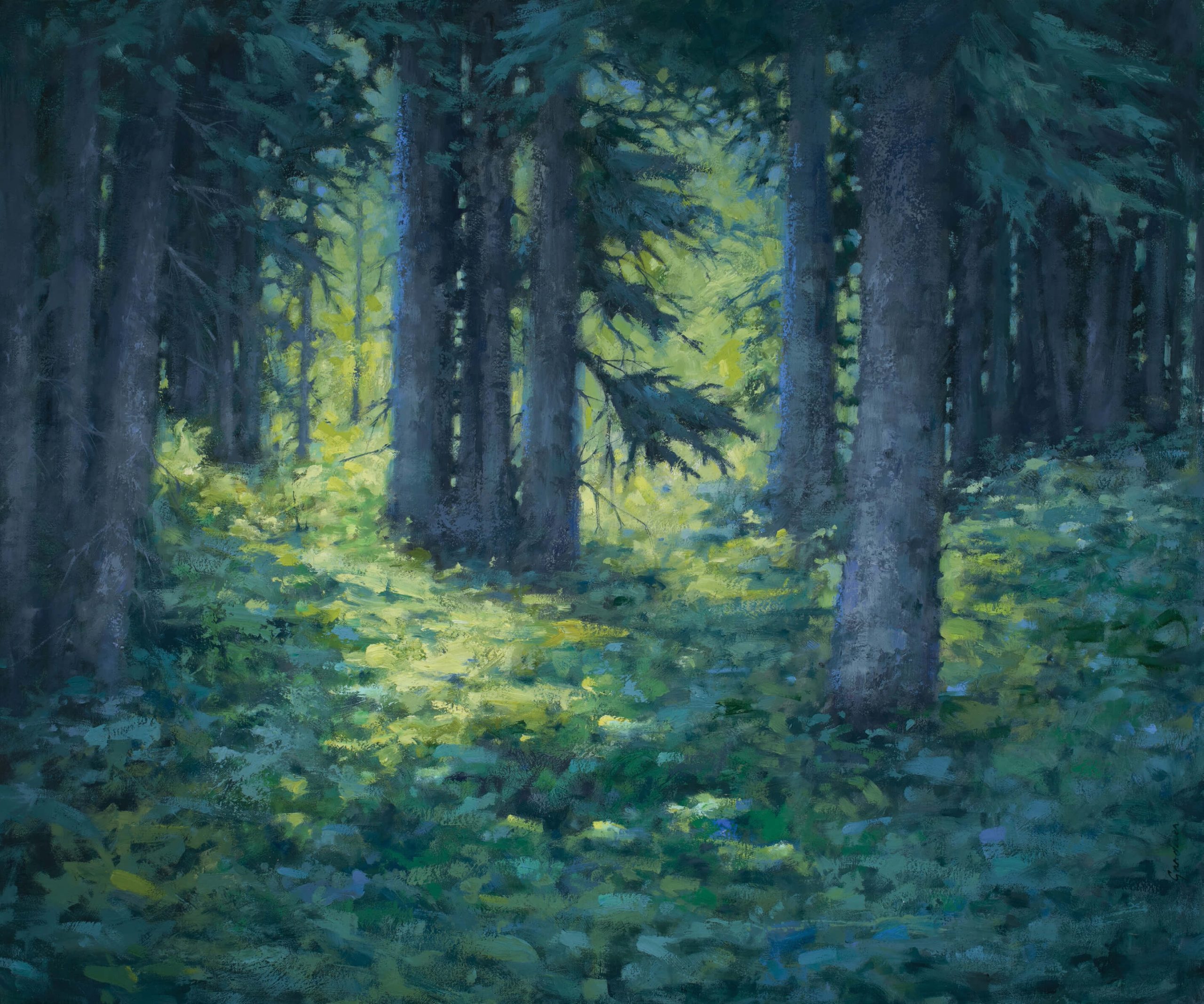
On the floor of his Morrison, Colorado, studio located a stone’s throw from the world-famous Red Rocks Amphitheatre, Gardner has arranged a selection of unframed paintings he’s considering for his show. On his studio walls, he points out a few finished canvases he’ll also exhibit. Several paintings present single, majestic trees rendered in loose brushstrokes of blues and greens with wisps of pink or red. Other canvases depict sunlight brightening a shady evergreen forest.
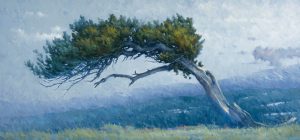
Above It All | Oil | 40 x 84 inches
Born and raised in St. Louis, Gardner began his art career in the advertising industry. Moving West was the artist heeding a calling. “I always liked camping and being in nature. I moved to the West because I loved the idea of open land and wild spaces, and that’s when I began my love affair with trees,” he says. “I have so much respect for our national forests and national parks, so much appreciation for accessing nature through these lands we have all enjoyed for a long time and taken for granted, and now we find these places under threat.”
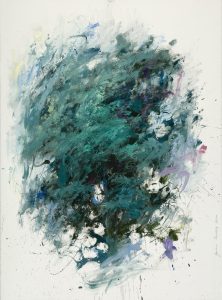
Fractality Alive | Oil | 22 x 30 inches
Gardner chose to paint his fractal tree series on paper. “Paint on paper sets up a little faster than on canvas and offers a layering process that creates depth,” Gardner says. On his studio floor, he has arranged a grid of nine 22-inch-by-30-inch paintings on Arches cold-pressed 300-pound oil paper.
Using brushes, palette knives, and oil sticks, the paintings aren’t as altogether abstract as, say, a Rorschach test, but can be distinguished in suggestive shapes and shadows, limbs and leaves and tree trunks. For the exhibit, Gardner plans to mount his works on paper onto wood, and float his paintings in wooden frames without glass, explaining that he didn’t want a layer of glass to come between the work and the viewer.
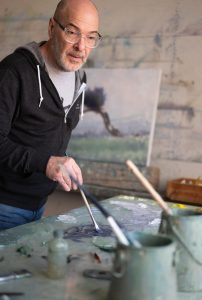
Pictured at work in his Colorado studio, Terry Gardner said, “I think a lot about process. I write a lot about process. I question what I’m trying to do and the philosophy behind it.”
The painter’s influence for his recent body of work is a quote from Hermann Hesse’s book titled Trees: “Whoever has learned how to listen to trees no longer wants to be a tree. He wants to be nothing except what he is. That is home. That is happiness.”
“I spent so much time trying to replicate or give justice to trees that they became stiff and forced. When I became more expressive, I started painting more from the influence of who I am. I don’t try to labor these,” Gardner says. “I’m typically starting with branches or the structure of a tree or the trunk. I put it down calligraphically from the memory of what I’ve experienced camping among trees, sitting with trees, observing impressions of trees in my soul.”
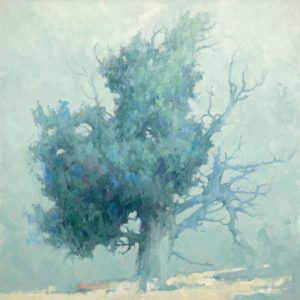
The Light of the Juniper | Oil | 36 x 36 inches
As part of his process, Gardner also took up rinsho, the Japanese and Chinese art of calligraphy using a brush and ink. With devotion, Gardner lettered the symbol for “tree” again and again.
For the painter, the abstracted trees are a vital part of his life as an artist who proclaims a love for the American West and wants to continue to evolve artistically and philosophically. To that end, he has tacked up numerous quotes, including one by the British Romantic poet and artist William Blake: “A fool sees not the same tree as a wise man sees.”
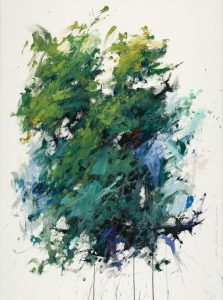
Fractality Evergreen | Oil | 22 x 30 inches
“It does take a bold step as an artist, and it takes courage on the part of the gallery, but Gallery 1261 embraces being bold and different,” Gardner says. “It also takes courage from collectors to embrace work that is unexpected and different.”
Gardner’s artistic evolution also takes courage and commitment to his passion and vision.
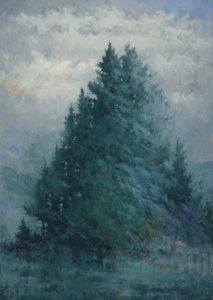
Connections | Oil | 36 x 48 inches
“I haven’t done many solo shows because it requires such an investment in time to create the body of work, but this feels different,” he says. “I’m excited about what I’ve been doing, and I want to share the work.”
As his solo show takes shape, Gardner is, much like the trees he paints: growing. “Doing this work,” he says with an enthusiasm bordering on rejoicing, “I feel alive.”
No Comments