



29 Oct Collector’s Eye: Ted Rowland’s Collection of Ideas
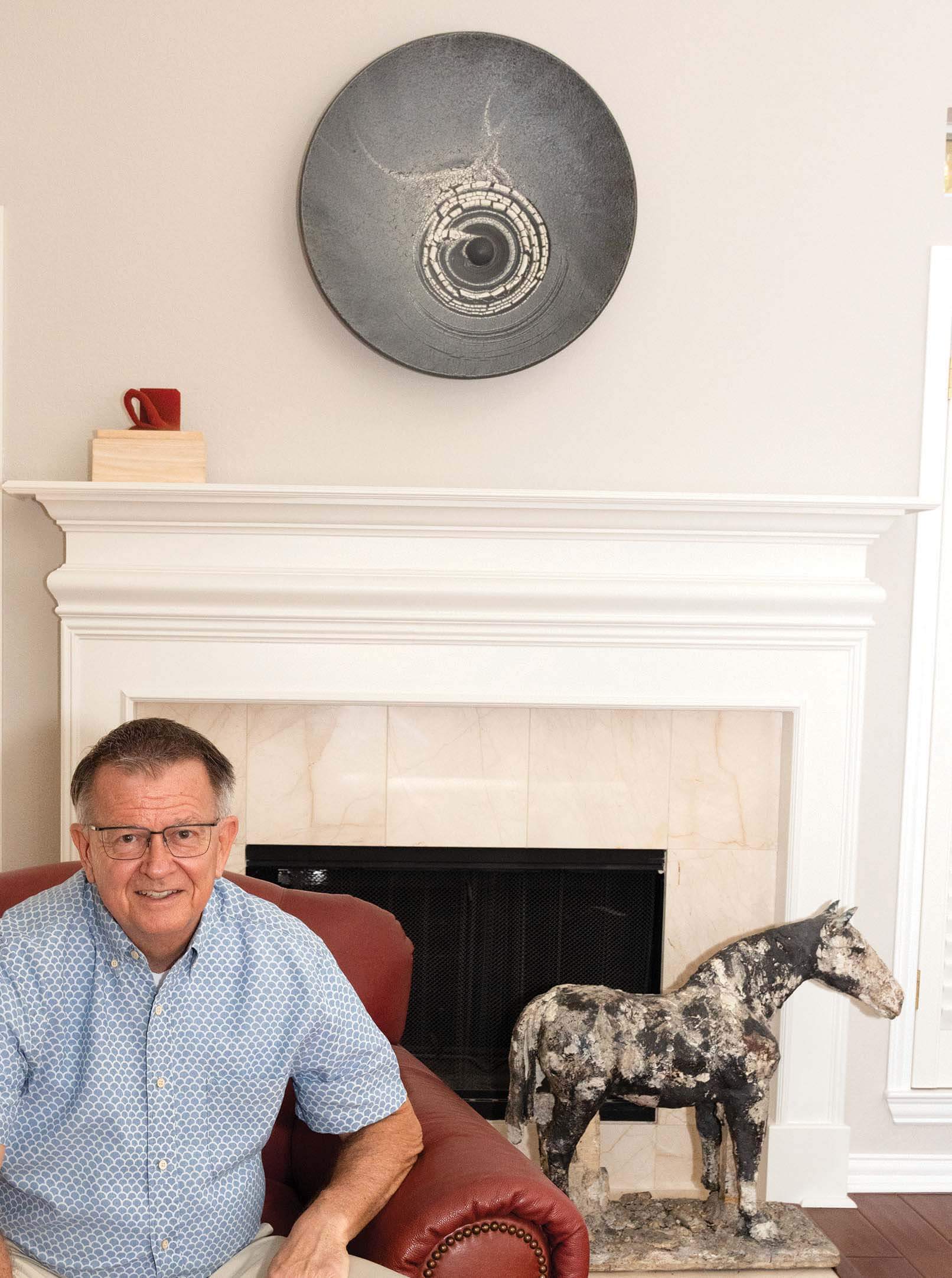
Ted Rowland didn’t grow up with art. What he had was a neighbor who paid him to house-sit. That neighbor happened to own one of the best Western art collections in the state of Montana. “Before he’d pay me,” Rowland recalls, “he’d pull out a chair, pull out an easel, take a painting off the wall, and I would have to sit through a lecture on the painting and the artist.” The neighbor was, in Rowland’s polite phrasing, an “eccentric” but fascinating character. Along with paintings, he collected beer steins. So Rowland started collecting beer steins too. Whenever he bought something, the neighbor would evaluate it for the quality and the price paid. Rowland knew he’d chosen well if the older man tried to buy it off him.
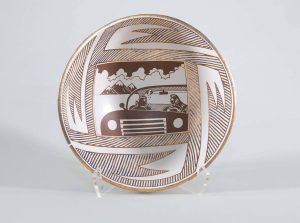
Diego Romero, Girl Talk | Terra Cotta | 5.5 x 11.25 x 11.25 inches | Photo: Evie Marie Bishop
Incidentally, that neighbor had a daughter who was an artist, and so Rowland also learned the value in supporting living artists. Since pottery was what a high schooler could afford, that’s where he started. But once he started making real money, Rowland says he was struck by the thought that he should either get serious about collecting or quit. He got serious and, to this day, clay remains the backbone of his collection.
WA&A: How did you decide to hone your collection?
Ted Rowland: Every time I would go to a show like SOFA [Sculpture Objects Functional Art + Design, in Chicago], there were so many people trying to get me to buy something. I realized having a focus would eliminate a lot of the noise. I started out saying I collected American studio ceramics. Then I realized I also liked artists who weren’t American, so it became just studio ceramics. Then I noticed I liked sculptural objects, but people pointed out a lot of what I own is vessel-oriented. So, now I call it a “collection of ideas”: artists doing innovative work in clay, whether it’s the old masters — the Voulkoses and Shaners and Fergusons — or younger people doing something new. It’s eclectic. When I buy something, I genuinely don’t know where it’ll end up in the house.
WA&A: Tell me about a sculpture with a story behind it.
T.R.: I have two pieces by Gerardo Monterrubio. One is a skull, which is his symbol for Mexico, and on the skull is a painting of his family coming across the border at night. In the eye socket is a candle because they came by candlelight, and throughout the skull are the names of all the family members who made the journey. On the back of the skull is the Virgin of Guadalupe, who was their guiding saint.
Another Monterrubio piece, Eduardo Arellano Félix, is a bust of a notorious trafficker. It is tattooed with stories the artist collected from people who were in rehab. The eyes are left blank because Félix has no soul.
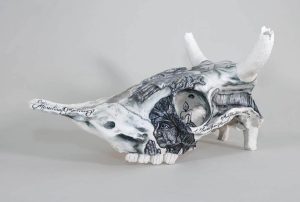
Gerardo Monterrubio, Assimilation | Underglaze Pencil on Porcelain | 12.5 x 14.25 x 22.5 inches | Photo: Evie Marie Bishop
I think those pieces do an extraordinary job of illustrating the issue and also exposing the humanity behind it. You know, political art, I think some of it is well done, but a lot of it is ham-fisted.
WA&A: Do you rotate the collection?
T.R.: Yes, when I lend pieces and when new work comes in, I’ll try a piece in several spots. Placement changes how it speaks. Like, I have Ken Ferguson’s first slump jar and it sits in my kitchen by itself. I once moved it into a grouping with three other pieces, but it was totally wrong, practically screaming that it was in the wrong place. So, I moved it back by itself.
WA&A: It seems like ceramics all get lumped into the same category, whether it’s functional fine craft or fine art. Do you think that affects how people think about ceramics as collectible works of art?
T.R.: Yes, and within the ceramic world, transportation plays an important role. If you’re buying a $50 coffee mug, you don’t want to spend $25 shipping it. So most functional clay is regional because of the transportation expense. When you get into what I will call the fine art market, the number of artists and collectors decreases dramatically. But people have a perception that clay is supposed to be inexpensive; they don’t want to pay more than a couple hundred dollars for a piece of clay. Whereas a clay sculpture can be thousands or hundreds of thousands of dollars. So that market is really thin.
Clay is not widely shown in Texas, so I follow certain galleries and museums, and I keep track of shows. I buy a fair amount online, if I know the dealer and the artist. If I’m not familiar with them, I like to see the work in person.
WA&A: Do you buy multiple works by an artist?
T.R.: Jason Walker, I have a whole arc of his work: a piece he sold to buy an engagement ring, pieces from when his marriage was struggling, and finally a flying penguin escaping a pile of wreckage, palm trees on one side, corporate towers on the other.
One of his penguins was made around the time his wife was expecting their second child, and on its belly is a portrait of his daughter, and sitting between the feet is a cherry bomb. The portrait of his daughter is surrounded by cherry bombs. In the penguin world, the male penguin guards the egg, so in this piece, he’s sitting there and he’s worried. Here’s this baby, and he doesn’t know if this is going to be good, if this is going to be bad. And with the portrait of his daughter, all she can think about is “baby.” That’s why there’s all the cherry bombs.
WA&A: What advice do you give new collectors?
T.R.: Start at the end. Decide what you want the collection to do. If it’s decorating your house, fine — you have an endpoint. If it’s for your kids, ask them; they’d probably rather have cash. If it’s headed to a museum, that changes everything — museums want big statement pieces, not small objects. Most people just start picking things up, realize they’re collectors, and try to fill every gap before asking what they’re building toward.
No Comments