





29 Oct Collector’s Notebook: The Last of the Classic Vintages
Wine collecting has always been about knowing what is worth seeking out, but right now, the stakes are changing.
There has never been a better time to collect wine. To understand why, let’s look at what is happening in the world’s greatest vineyards and the current wine market. Together, these forces are creating a remarkable moment for wine collectors.
Just over a decade ago, climate scientist Dr. Lee Hannah foretold an upending of traditional wines because of climate volatility and water shortages. He estimated that many iconic wine regions may no longer produce signature or quality wines by 2050. Within a few years, many of those regions were already feeling the impact.
This year, early harvests and riper grapes led Champagne’s governing body to authorize alcohol levels up to 15 percent, a historic first for an appellation that had held its ceiling at 13 percent since the region’s formal codification in 1936. “This summer has been quite challenging for the vines, and we are entering an unseen and unknown era,” explained Cyril Delarue, Champagne Bollinger’s sixth-generation scion. Harvest began August 13, just 76 days after flowering, compared with 83 to 85 days in recent vintages. Higher grape sugar levels threaten Champagne’s signature balance, while heat, frost, and drought reduced yields. David Chatillon, president of the Union of Champagne Houses, reported, “We lost 43 percent of the potential production to the spring frosts.”
Alexandre Gobillard, production director at Gobillard & Fils, called the early harvest “historic in Champagne; we’ve never seen anything like it.”
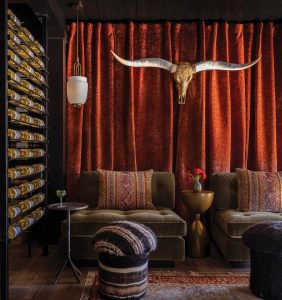
Vintage View’s bespoke wine-racking ingenuity ranges from modern to rustic. Constructed here from powder-coated steel, it creates a fascinating and functional room divider in this mountain home. Designer: Bankston May Associates; Photography: Julie Sofer; vintageview.com.
Burgundy faces the same acceleration. Scientist Thomas Labbé found that from 1354 to 1987, grapes were picked, on average, from September 28, but from 1988 to 2018 harvests began on average 13 days earlier. This year, on August 13, Brice de La Morandière of Domaine Leflaive said, “We have started harvesting the Montrachet. Clearly, it’s extremely, extremely early.”
Bordeaux made its own concession in 2019, when the French National Institute of Origin and Quality (INAO) approved six new grape varieties, including Portuguese Touriga Nacional and Marselan, to cope with rising heat. Napa, Sonoma, Porto, Rioja, Tuscany, and Piedmont face parallel pressures: earlier harvests, riper fruit, and shifting alcohol and acidity profiles are altering classic wine styles.
This is why older vintages matter more now. A bottle from a decade or two ago may preserve what these regions tasted like before they had to rewrite their rules. If the trajectory continues, iconic styles may become historical artifacts rather than living legacies. Seek them out while they still exist in their classic forms.
Meanwhile, public health warnings that no level of alcohol is safe have tempered consumption. But some experts also indicate that sharing wine with friends and family supports socialization in an increasingly isolated world. These days, wine collectors and casual drinkers seem to be splitting the difference by gravitating toward fewer bottles of greater quality. As a result, inflated wine prices are gradually depreciating, creating a buyer’s market. A multiyear market correction has given way to renewed buyer conviction in 2026, with major auction houses reporting some of their strongest sell-through rates in years.
I believe the only thing a collector truly needs to know about wine is what they like, but even the most passionate collector can benefit from an expert’s advice. Annual vintage charts identify the best vintages and indicate which bottles to drink now or hold for aging. And some companies specialize in fractional ownership and investment in blue-chip and extremely rare wines. For most collectors, a dedicated cellar and trusted guidance are enough to build and manage a prized collection.What I’m Collecting Now
France
Champagne remains the cornerstone of any serious collection, with 2002, 2008, 2012, and 2015 vintages continuing to command premiums. Think têtes de cuvée from Krug, Salon, Bollinger, Perrier-Jouët, Dom Pérignon, Jacques Selosse, and Louis Roederer.
In Burgundy, recent outstanding vintages include 2015, 2016, 2018, 2019, and 2022, with Domaine de la Romanée-Conti anchoring the top tier. Look to Domaine Leroy, Armand Rousseau, Leflaive, Coche-Dury, Raveneau, and Comte Georges de Vogüé.
Bordeaux vintages 1985, 2016, 2019, 2020, and 2022 stand as the recent benchmarks. The great châteaux, such as Lafite Rothschild, Mouton Rothschild, Latour, Margaux, Haut-Brion, Angélus, Pétrus, Cheval Blanc, and Ausone, still command attention.
Italy
Piedmont belongs in any thoughtful cellar, and Barolo and Barbaresco from 1989, 2004, 2010, and 2016 are exceptional, with prestigious names like Giacomo Conterno, Bartolo Mascarello, Giuseppe Rinaldi, and Roagna carrying long-term value.
Tuscany follows a similar logic, with Brunello di Montalcino and top Chianti Classico from 2010, 2013, 2016, and 2019 offering both critical acclaim and relative affordability. My favorite producers include Gaja, Bindi Sergardi, Antinori, Tenuta San Guido, Biondi-Santi, and Ornellaia.
Spain
Spain is often overlooked by American collectors. Rioja from legendary producers López de Heredia and Muga, and Ribera del Duero from Vega Sicilia and Pingus in 2004, 2010, and 2016 represent some of the strongest values in the fine wine market today. Consider Marqués de Riscal, CVNE, La Rioja Alta, Remírez de Ganuza, Marqués de Murrieta Castillo Ygay, and Artadi.
Portugal
Portuguese wines can be extremely collectible and deliver great value. Casa Ferreirinha Barca Velha, Quinta do Vale Meão, Pêra-Manca Tinto, and Wine & Soul Pintas are great finds.
United States
California boasts 2013, 2016, and 2019 as the most collectible recent vintages, particularly from Cabernet-focused producers whose allocations remain difficult to secure. Names like Screaming Eagle, Harlan Estate, Scarecrow, Sine Qua Non, Colgin IX Estate, Hundred Acre, Dominus Estate, and Promontory dominate this category.
Fortified and Dessert Wines
Fortified and dessert wines round out the essential wine collection. Rare vintage and tawny port from Taylor, Quinta do Noval, Graham’s, Fonseca, Dow’s, or Niepoort, particularly the 1977, 1985, 1994, 2011, and 2017 vintages, represent extraordinary value relative to their longevity. As does Spanish sherry or Pedro Ximénez like Toro Albalá Don PX Convento Selección.
Château d’Yquem Sauternes from 2001 and 2011, and Royal Tokaji Essencia and Tokaji Aszú from Hungary in strong years such as 1999, 2007, 2013, and 2017, represent some of the most age-worthy wines in existence, often at a fraction of the price commanded by other wine categories.
One of my favorite collectible wines is the versatile, food-friendly Madeira. Try Broadbent, Blandy’s, Cossart Gordon, and D’Oliveiras Madeira, which can age gracefully across decades and even centuries given its oxidative style.
Collecting across these categories builds both resilience and genuine intellectual depth in a wine cellar and reflects an understanding of the full breadth of what the wine world has to offer.
What to bring to holiday parties
Broadbent Madeira is among the world’s most enduring and remarkably food-friendly wines. Styles range from bone-dry Sercial to rich, sweet Malmsey, but brilliant acidity runs through them all, making Madeira an unexpected partner for everything from oysters, salty cheeses, and charcuterie to fruit, nuts, and desserts. Once opened, Madeira can last for years, while fine bottles can age gracefully for decades and even centuries.
Its remarkable longevity is rooted in the very heat and oxidation that would destroy most wines, making Madeira virtually indestructible and one of the wine world’s great collectibles.
Madeira also holds a singular place in American history. It was the favored wine of Washington, Jefferson, Franklin, Hancock, and other revolutionary leaders. Madeira became deeply entwined with the fight for independence, and glasses of the wine were raised to celebrate the signing of the Declaration of Independence.
The Revolutionary Cocktail
• ¾ oz. Denver Distillery Applewood Smoked Rye Whiskey
• ¾ oz. Broadbent 10-year Sercial Madeira
• ¼ oz. Leopold Bros. Rocky Mountain Peach Whiskey
• A dash of orange bitters
• A generous splash of Gusbourne Brut Reserve or dry sparkling wine
• A mint sprig and viola flowers
Fill a cocktail glass with crushed ice. Add the rye whiskey, Sercial Madeira, peach whiskey, and orange bitters. Stir to incorporate, and add sparkling wine. Top with additional crushed ice. Garnish with fresh mint and edible viola flowers.
Created by Jayme Marie Henderson of The Storm Cellar Winery and Vineyard, Hotchkiss, Colorado
No Comments