

03 Sep Auction Block: Holding the line
At a time when certain U.S. markets — and markets within markets — are bouncing around like a pinball inside its machine, the demand and prices for Western and Native American paintings and sculptures show steadiness. Steadiness is a strength, especially in uneven economic times, and it is a credit to both sellers and buyers that they remain invested — financially and emotionally — in the lasting legacy that has been and is still being shaped by some of the nation’s most talented artists.
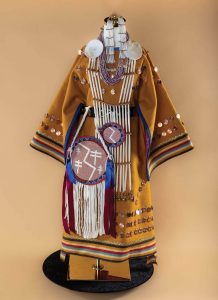
Aydrian Day, Wanbli Gleska Win | Photo: Gabriella Marks | Winner: Youth
It is a truism in the circles of Western and American Indian art evaluators, admirers, and collectors that a certain passion for the same beautiful things gathers like to like and can influence whether prices slip or surge.
Summer and early fall sales indicate that the desire for the works of celebrated historic and contemporary artists in the genres has not abated and that collectors continue to bolster their aesthetic and artistic tastes with their wallets.
Southwestern Association for Indian Arts | Santa Fe Indian Market
August 15-16
Total: N/A
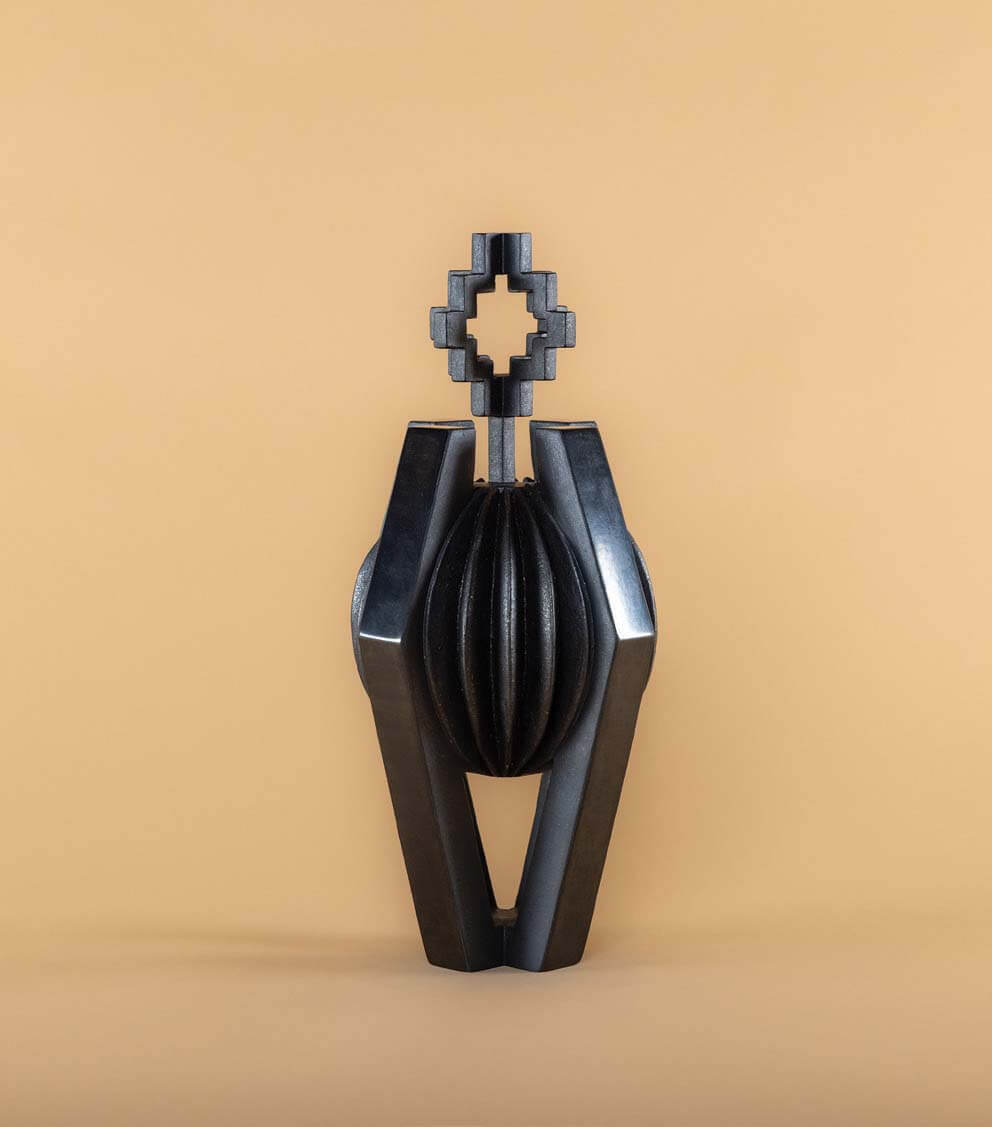
A Santa Clara Pueblo potter received the highest honor of the Santa Fe Indian Market in New Mexico, a two-day showcase of Native American culture and arts, from bead- and quill-work to basketry, from jewelry to figurative carving.
Floating Melon Bowl, the work by Sergio Lugo named 2026 Best of Show, is a coil-built pot of hand-dug clay fired outdoors, burnished with a mica slip, and polished with stone. At the awards ceremony, Lugo said the finished piece was preceded by three failed attempts. “I was going to give up and try again next year, but I decided to dedicate my whole summer so I could complete this piece,” he said in a statement.
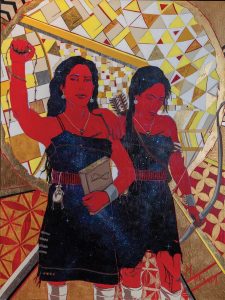
Marla Allison, Life | Photo: Gabriella Marks | Winner: Painting
The numerous accolades that heralded the opening of the premier event of the non-profit Southwestern Association for Indian Arts (SWAIA) included Jack Tom (Diné), winner, jewelry, Dragonfly; Felix Vigil (Jicarilla Apache), winner, sculpture, Realm of the Rainmaker; Lola Cody (Navajo Nation), winner, textiles, Transition; Juanita Growing Thunder Fogarty (Dakota/Nakoda), winner, bead- and quill-work, Tataga Hugá; Arthur Holmes, Jr. (Hopi), winner, wooden Pueblo figurative carving and sculpture, Eototo; Marla Allison (Laguna Pueblo), winner, painting, Life; Jolene Bird (Santo Domingo), winner, diverse arts, Harry and Anabella; Caleb Hoffman (Cherokee/Penobscot), winner, basketry, Perseverance; Aydrian Day (Ho-Chunk/Anishinaabe/Lakota), winner, youth, Wanbli Gleska Win.
SWAIA seeks to open economic and cultural opportunities for Native American artists by producing and promoting the Santa Fe Indian Market, widely viewed as one of the most prestigious Native art events in the world.
Coeur d’Alene Art Auction
July 25
Total: $17 million
It’s difficult to describe the Coeur d’Alene Art Auction without reaching for superlatives. And for good reason. A premier Western art event of the summer season, the sale invariably brings together great works, great artists, and great company.
This year’s auction in Reno, Nevada, saw John Clymer’s The Trader sell for $1,119,250 with fees, the top price among lots and a new world record for the Western artist.
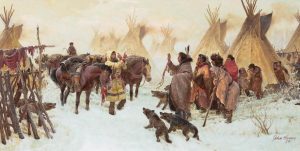
John Clymer, The Trader | Oil on Canvas | 20 x 40 inches | Sold: $1,119,250
Bidding for The Trader prompted an overflow crowd to applaud as two bidders — one on the floor, the other on the phone — battled for supremacy. The latter ultimately won the day and the painting: a historical-themed picture the artist said depicts “a trader with his helper leading a string of pack animals into an Oglala Sioux winter camp, making the sign for ‘trade.’”
A lifetime cast of Frederic Remington’s celebrated bronze, The Broncho Buster, No. 2 in the edition, galloped into second place among top-selling items. The sculpture is arguably the most recognizable of the Western artist’s three-dimensional pieces. It stills the vigor of horse and rider in a tactile work that evokes the storied frontier days of the American West.
The Law of the Wilderness by Philip Goodwin fetched $847,000, an amount only surpassed by the record achieved in 2022 when the Coeur d’Alene auction sold Goodwin’s Between the Devil and the Deep Blue Sea for $968,000.
A watercolor by Charlie Russell, Pablo-Allard Buffalo Drive, brought $484,000 in a sign of the lasting legacy of a giant of traditional Western art, while The Duck Hunter by E. Irving Couse went for $453,750. The happy price for the Couse is illustrative of a pattern in Western art auctions in which works by one or more of the painters tied to the Taos Society of Arts elicits competitive bidding and lucrative outcomes.
Native American artists, including Oscar Howe, Earl Bliss, Fritz Scholder, John Nieto, and Tony Abeyta “continue to attract attention at the Coeur d’Alene Art Auction, reflecting the staying power with Indigenous perspectives in Western art,” said Mike Overby, auction partner, in a statement.
Underscoring Overby’s point, the sale saw Howe’s Horse Dancer and Herakawin (Elk Woman) each go for $272,250 even as Howe’s Sioux War Dancer climbed to $217,800.
John Moran Auctioneers Art of the American West
June 30-July 1
Total: $842,000+
A casein-on-paper by Native American artist Oscar Howe led John Moran Auctioneers’ sale of Western art, with Sioux Singer going for $152,400 with fees, which was within pre-sale expectations. Casein, Howe’s preferred medium, is a paint made from milk protein.
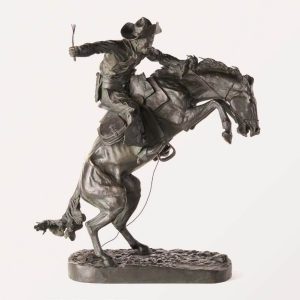
Frederic Remington | The Broncho Buster | Bronze | 23.75 x 20.25 x 12.25 inches | Sold: $968,000
The follow-up to Howe’s Sioux Singer was Howe’s Sioux Mother and Child, which, at $101,600, brought the second highest amount at the auction.
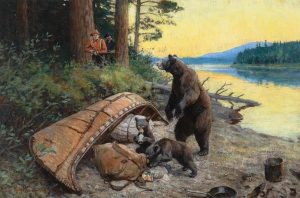
Philip R. Goodwin, The Law of the Wilderness | Oil on Canvas | 24 x 36 inches | Sold: $847,000
When Arion Putnam’s Cowboy on Horseback Observing a Pierce-Arrow Motorcar in a Western Landscape, came before collectors, all expectations were exceeded. The large-sized oil, thought to bring between $3,000 and $7,000, trotted out of the ring and into hefty-sum territory by fetching $36,300.
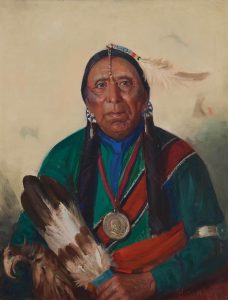
Kathryn Woodman Leighton, Sun Chief | Oil on Canvas | 36 x 28.25 inches | Sold: $25,400
A miniature by E. Irving Couse, The Lesson, showed strength in smallness, with the oil on canvas-board going for $34,290 against estimates of $20,000-$30,000.
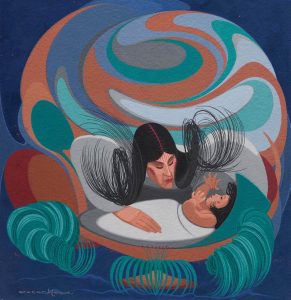
Oscar Howe, Sioux Mother and Child | Casein on Paper | 20 x 19 inches | Sold: $101,600
Eiteljorg Museum of American Indians and Western Art | Indian Market & Festival
June 27-28
Total: N/A
In its 34th year, the two-day Indian Market & Festival at the Eiteljorg Museum of American Indians and Western Art in Indianapolis showcased the works of 134 American Indian, Alaska Native, and First Nations artists. The festival also highlighted dance and other performative arts, featured food provided by Native-owned vendors, and gave collectors and art enthusiasts the opportunity to buy pieces directly from Native artists.
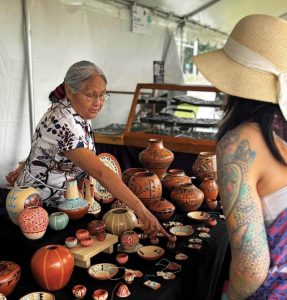
Courtesy of Eiteljorg Museum of America Indians and Western Art
Deer Man, a signature cloth doll by Lakota artist Gene Swallow, captured the imaginations of the more than 4,000 guests and received the Harrison Eiteljorg Purchase Award, which will see the textile sculpture entered into the museum’s permanent collection.
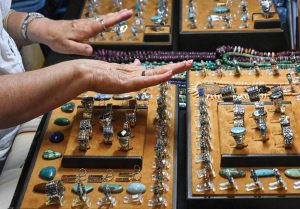
Courtesy of Eiteljorg Museum of America Indians and Western Art
Artist Wade Patton, an enrolled member of the Oglala Lakota Tribe, saw two of his works, Up Above and Standing Strength, likewise awarded, purchased, and destined for the Eiteljorg. “Up Above” demonstrates Patton’s continuing depictions of the limitless skies of his native Northern Plains while Standing Strength, a wearable cuff bracelet, is demonstrative of his skill in bead- and quill-work.
The juried competition selected entries from 10 divisions, awarding more than $41,000 in prize money, according to museum officials.
Heritage Auctions
Texas Art Signature Auction
June 26
Total: $845,000+
Western Art Signature Auction
June 18
Total: $1.4 million+
Little Blue Heron brought a big amount at Heritage Auctions’ Texas art sale, with the striking oil by David Bates going for $175,000 with fees to share the No. one slot among top-priced items. Pre-sale estimates for that and other top sellers were not publicly disclosed.
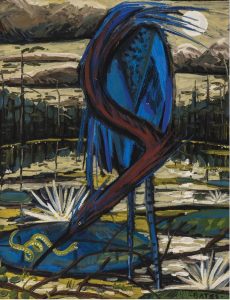
David Bates, Little Blue Heron | Oil on Canvas | 24.5 x 18.5 inches | Sold: $175,000
A painting by Bates was followed by a painting by Bates, which was followed by – you guessed it – a painting by Bates. The artist’s oil on canvas, Floundering, went for $175,000 to tie for bestseller, while his Maria Roses fetched $87,500.
Bates, a native Texan, celebrates a distinctly American and narrative style of art that is arguably best compared with 20th century pioneers such as Marsden Hartley and Thomas Hart Benton.
Bates prefers realistic figures over abstraction, according to a biography of the artist compiled by Heritage Auctions. Angular, colorful, Little Blue Heron is a powerful picture, the symbolism of which is easy to read.
Floundering is similarly powerful — yet in an entirely different key. The vertical oil was painted in 1991, a period in which the artist underwent a seminal transition in his creative life, according to Heritage Auctions.
“In the early 1990s, he created some of his thickest and most tactile paintings that were increasingly architectural, ultimately leading to his sculptural period in 1994,” according to the auction house. “To Bates, these paintings are two-dimensional predecessors to his sculptural works and an ever-important visual reminder of his artistic career.”
Paintings by two celebrated Native American artists sandwiched the three top-selling items at Heritage’s Western art sale earlier in the summer.
Fritz Scholder’s Indian Sitting on a Bed led with $237,500, followed by Night Passage by G. Harvey at $93,750 and, rounding out the three, a John Nieto acrylic, Plains Archer, which brought $78,125.
Christie’s | Heart of the West: The Betsy Harvey Collection
May 28-June 25
Total: $1 million+
Betsy Harvey’s name goes with Western art as Lorenzo de Medici’s goes with Renaissance art. A founding member of the Eiteljorg Museum of American Indians and Western Art in Indianapolis, Harvey was a refined and dedicated collector of works by Western artists she cultivated and championed. Pieces from the late patron’s collection amassed more than $1 million during Christie’s nearly month-long online sale this summer.
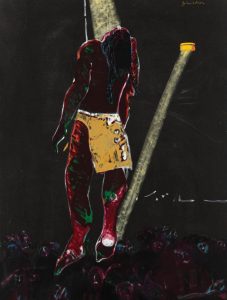
Fritz Scholder, Sun Dance | Oil on Canvas | 60 x 45 inches | Sold: $165,100
Yet no amount could fully represent what the auction said was Harvey’s “deep dedication to Western art and to preserving its enduring legacy.”
That said, it was pleasing to reflect on the painting by Fritz Scholder that led the online auction. Sun Dance, depicting a Native American figure suspended in the stance of a sacred ceremonial ritual, soared past expectations, rising to achieve $165,100 with fees.
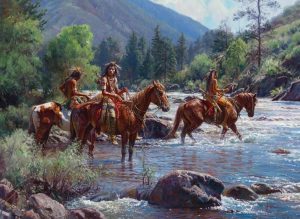
Martin Grelle, Cautious Crossing | Oil on Canvas | 40.25 x 52 inches | Sold: $127,000
The large-scale, vertical oil, shadowy and mysterious, was estimated to bring $25,000-$35,000.
Cautious Crossing by Martin Grelle brought $127,000 against projections of $80,000-$120,000, and Kenneth Pauling Riley’s The Black Eagle went for $127,000 to tie for the No. 2 slot.
Works by Riley finished out the top five best-selling items, and it is not difficult to ascertain why. The Cowboy Artists of America member drank from the well of realism even as he sipped from the stream of symbolism.
Riley’s paintings, Sacajawea and The Dandies, went for $95,250 and $82,550 respectively, with the latter roughly twice its low estimate.
Morphy Auctions Old West and Native American Art
June 20
Total: $900,000+
The price for a revolver believed to have been owned by Jesse James shot to $100,860 with fees to claim a top spot in Morphy Auctions’ sale in Santa Fe in late June.
The Manhattan Arms Navy Series IV came with a provenance that “unequivocally states that not only was this revolver used by the legendary outlaw Jesse James, but also that it was specifically used at a Russellville robbery of the Southern Bank of Kentucky,” according to auction officials.
The single-action percussion revolver was estimated at $100,000-$150,000.
A silver tabletop sculpture of Frederic Remington’s The Rattlesnake, cast in silver in an edition of 100 from a since-retired mold at the Frederic Remington Art Museum, fetched $86,100. The price was shy of its high projection of $100,000 but easily topped the low of $70,000.
Bids for a Olsen Nolte silver parade saddle, circa 1937, settled at $46,740, landing softly between estimates ranging from $40,000 to $60,000. The piece was the first high-end saddle built in the San Francisco-based Olsen Nolte Saddle Shop, benefitting from the talents of skilled leather artists and silversmiths, according to Morphy.
A Sharps Old Reliable cartridge belt blew through estimates to garner $24,000. The belt, found in an old hunting camp in Northern Ontario, Canada, was thought to bring $4,500-$6,500.
Bonhams, Modern and Historic Native American Art
June 7-18
Total: $422,000
It has been said that Ansel Adams’ stark and stirring Monolith, The Face of Half Dome, marked a seminal shift in landscape photography and strengthened a national desire to protect geographic treasures found, like Yosemite’s Half Dome, in Western states.
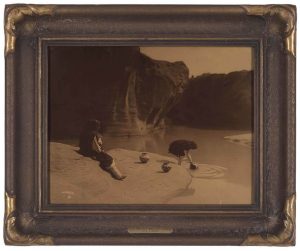
Edward S. Curtis, At the Old Well of Acoma | Orotone on Glass | 10.5 x 13.5 inches | Sold: $16,640
American photographer Edward S. Curtis rose to fame during roughly the same period for capturing images of a different national treasure: Native Americans. The staged tableaux in which Curtis placed his subjects evoked both a celebration and a lament, leading cultural gurus to refer to his portraits as those of a “vanishing race.”
A photographic print by Curtis, At the Old Well of Acoma, topped lots at Bonhams’ online sale in June, with the orotone on glass garnering $16,640 with fees against estimates of $5,000-$8,000.
Likewise, the Curtis orotone, Flathead Camp on the Jocko River, surpassed expectations for price, fetching $12,800 compared to $7,000-$10,000. Curtis’ The Vanishing Race landed in the No. 3 slot at $9,600 compared to projections of $4,000-$6,000.
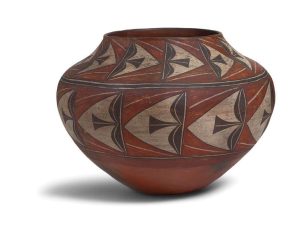
Zia Polychrome Jar | Clay | 13.25 x 17.75 inches | Sold: $8,960
Original prints by Curtis constituted the six top-selling items at the online sale that highlighted the photographer’s work.
A pastel drawing by the late Rick Bartow, Wiyot Tribe of Northern California, brought $9,600 against an anticipated $4,000-$6,000, with the ultimate price modest compared to the work, created in 2010 and untitled.
In a sign of its desirability, a Zia polychrome jar climbed to $8,960, surpassing estimates of $1,500-$2,400.
National Cowboy & Western Heritage Museum Prix de West Invitational Art Exhibition & Sale
June 12-13
Total: $3.7 million+
The 54th Prix de West Invitational Art Exhibition & Sale saw more than $3.7 million in sales on a single day of its annual weekend extravaganza in Oklahoma City.
A modernist oil by Kim Wiggins was rewarded for its drama and dynamism with the Ann Noble Brown Prix de West Purchase Award. The honor brings $7,500 to the artist and the Prix de West medallion for How the West Was Won — Chisum at Castle Gap. Perhaps the greater accolade was the $95,000 the National Cowboy museum gave to secure the picture for its permanent collection.
“As a modernist, it’s been a very long road to the awards,” Wiggins said in a statement. “It humbles me when I walk through (the Prix de West show) and see the art hanging next to mine.”
The Donald Teague Memorial Award went to Dean Mitchell for his watercolor, Cactus Jungle. The award, which brings the artist $4,000, targets a work on paper with exceptional artistic merit. The honor was created in memory of Western illustrator and watercolorist Donald Teague.
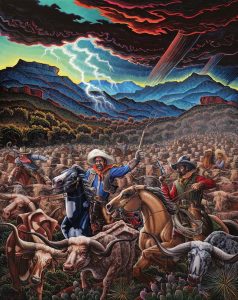
Kim Wiggins, How the West Was Won — Chisum at Castle Gap | Oil | 60 x 48 inches | Sold: $95,000
Sandhill Cranes on the Great Migration by Andrew Peters was a two-time winner, gaining the Frederic Remington Painting Award and selling for $56,000. The large-scale picture of oil, gold, wood, and metal evokes the style of ancient Asian panel paintings yet Peters is celebrating a creature that gained its name from the Nebraska Sandhills and the river where the cranes gather in advance of mass migration.
Grant Redden received the Great American Cowboy Award for his action-oriented Anxiously Engaged, which a collector purchased for $16,000. Redden’s “portrait” of a cowboy seeking to keep his seat on a horse equally intent on throwing him off has the dual effect of providing a “portrait” of high-elevation scrublands.
The Jackie L. Cotes Buyers’ Choice Award went to John Coleman for his statue Wedding at Crow Fair. The yearly honor goes to the work of art voted most popular by patrons who attend the show.
Launched in 1973, the Prix de West is the National Cowboy’s largest annual fundraiser, with proceeds supporting the exhibits and educational programs of an institution whose collection exceeds 28,000 Western and Native American works and artifacts.
No Comments