


03 Sep Perspective: Vance Kirkland [1904-1981]
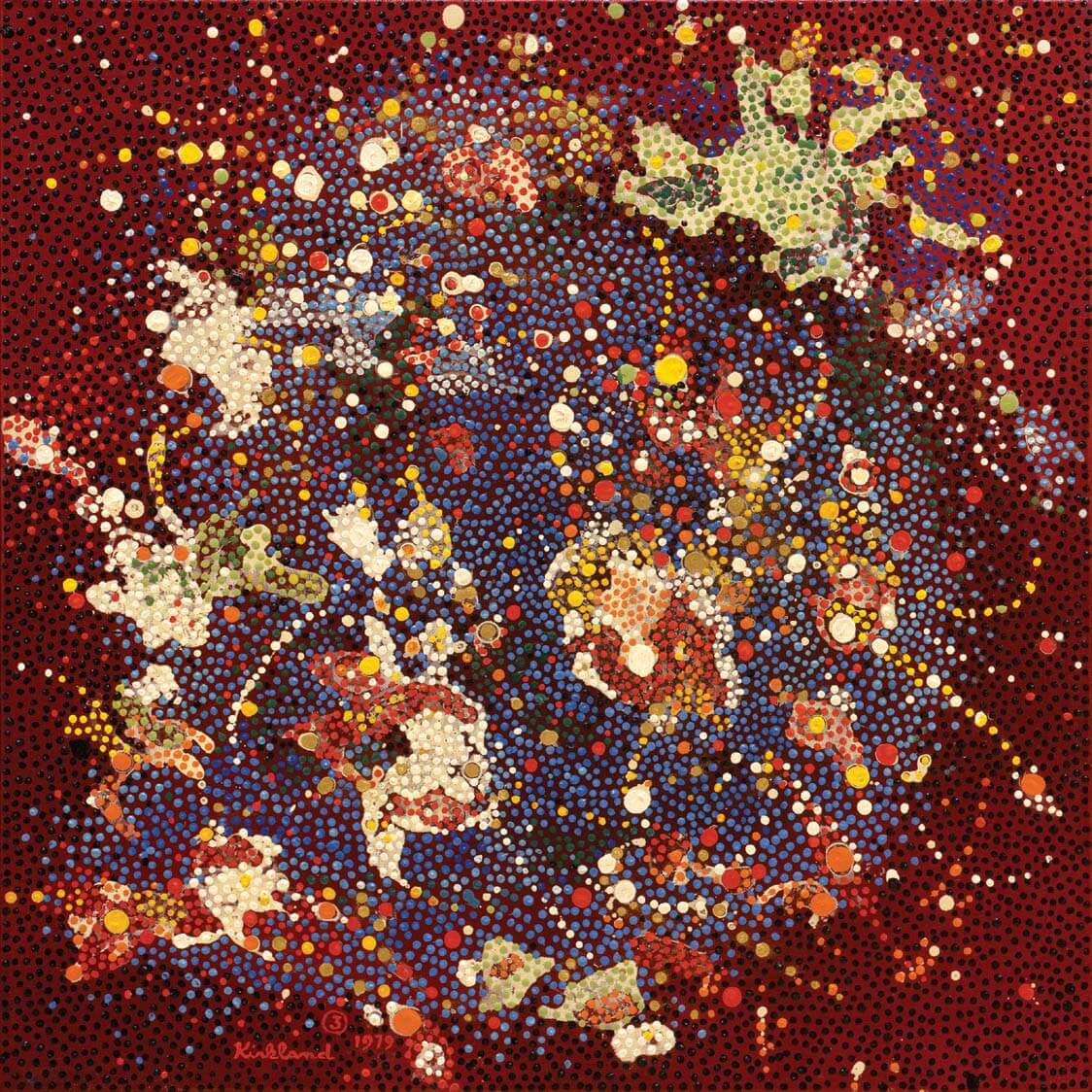
At an exhibition a few years before the end of his life, Denver-based artist Vance Kirkland was standing next to his painting Unknown Space Mysteries 9 Billion Years B.C. (1979), part of his Dot Paintings series, when a scientist walked up and stood beside him. The two gazed at the painting, composed of various sizes and colors of dots in a dance of wild amoebic forms and pearl-like strings against a background of dark blue and red dots.
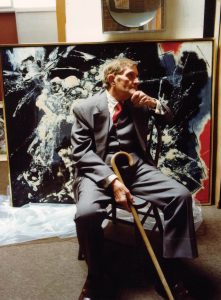
Vance Kirkland in his Denver studio 1980, photo by Glenn Cuerden, provided by Hugh Grant, ©The Estate of Vance Kirkland
The scientist turned to the artist, knowing that photographs of outer space at the time lacked the kind of detail suggested by the painting. “What makes you think this is what it looks like?” he challenged. Kirkland, a small elderly man with a cane, looked up at the scientist. “Tell me I’m wrong,” he said. The scientist responded with the certainty of someone steeped in his field of study. “The universe started six billion years ago,” he said. “Yes,” Kirkland said, with equal confidence, “but that’s your universe. This is my universe.”
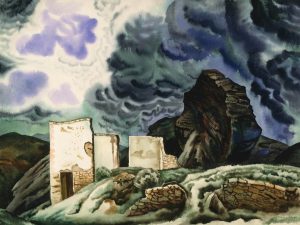
Ruins, Central City | [1st Period, Designed Realism] 1940, Watercolor on Paper, 22 x 30 inches; Collection of The Kirkland at the Denver Art Museum, KVK1940.05, gift of Merle Chambers, ©The Estate of Vance Kirkland. (Miners come, miners build, miners leave when the veins of gold and silver run out, and the wilderness reclaims itself, as clouds represent the passing of time.)
The story, recounted by Hugh Grant, co-founder with Merle Chambers of the Kirkland Museum of Fine & Decorative Art (now part of the Denver Art Museum), reflects the artist’s quiet self-assuredness, a lifelong trait that compelled him to consistently follow his own artistic path and to remain in Colorado, eschewing New York City and other magnets for Modern art, throughout his long career. It also points to the inventive, visionary nature of Kirkland’s art and his desire, as he once put it, to show people “something they have never seen before and new ways to look at things.”
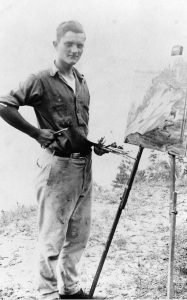
Vance Kirkland age 20, 1925, Burt Lake, Michigan, provided by Hugh Grant, ©The Estate of Vance Kirkland
Kirkland’s beginnings in rural Ohio gave little hint of the path his life would take. The son of a dentist who expected Vance to follow in his footsteps, he received no encouragement for his early attraction to art. He had no role models, mentors, or access to art instruction, even in high school. He drew and painted anyway, and decades later told Grant it was “almost eerie” to feel so driven to become an artist under such conditions.
Against his parent’s wishes, Kirkland enrolled in the Cleveland School of Art (now the Cleveland Institute of Art) in 1923. He failed his freshman watercolor class, not for lack of skill but explicitly for his paintings’ non-naturalistic colors and for using colors that “fought” with each other. “He told his professors he thought those paintings were more interesting because of all that, but they flunked him anyway,” Grant says. Forced to paint more realistically, Kirkland’s talent was recognized with first place awards in watercolor in his junior and senior years, and in 1927 he was the first student to ever win a prize at the Cleveland Museum of Art.
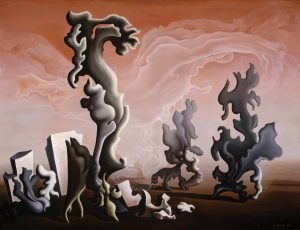
Prairie Monuments | [2nd Period, Surrealism] 1954, Oil on Linen, 36 x 48 inches; Collection of The Kirkland at the Denver Art Museum, gift of Hugh Grant, KVK1954.12, © The Estate of Vance Kirkland. (Monumental leaf forms dance on the Colorado prairie, like dust devils.)
In 1929, a 24-year-old Kirkland graduated with a diploma in art and a Bachelor of Education degree and moved to Denver. There, he became the founding director of the University of Denver’s School of Art. When the first class completed the four-year program and the school reneged on its promise to grant a BA in art, Kirkland left the university and established the Kirkland School of Art at 1311 Pearl Street in Denver. The Colorado University Boulder (CU) Extension in Denver agreed to grant the new school’s students full recognition toward a BA degree within a year. The early 1900s building housed the school for more than a decade and served as Kirkland’s studio the rest of his life. It later became the Kirkland Museum’s first home.
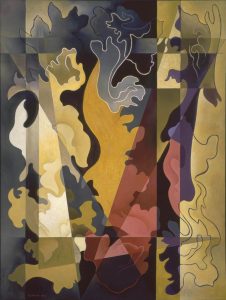
Timberline Abstraction | [3rd Period, Hard-Edge Abstractions and Nature Abstractions] 1953, Oil on Linen, 48 x 36 inches; Collection of Hugh Grant, VK1953.08, ©The Estate of Vance Kirkland. (Leaves have fallen on the floor of the forest, as sun beams divide the scene.)
Kirkland closed his eponymous school in 1946 when the University of Denver rehired him as director of the School of Arts and chairman of the Division of Arts and Humanities. By the time he retired to paint full-time in 1969, the School of Arts was the university’s largest undergraduate department. “He had a way of working with students and gently coaxing out of them their artistic impulses. He inspired his students, and people in general, to be drawn to art and not to be shy about creating art,” Grant says.
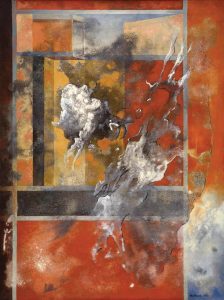
Villa dei Misteri (Pompei) | [4th Period, Abstract Expressionism] 1956, Oil Paint & Water on Linen, 48 x 36 inches; Collection of Hugh Grant, VK1956.11, ©The Estate of Vance Kirkland. (Roman Abstraction Series, where a disintegrating wall in Pompei is depicted with Kirkland’s unique oil & water mixtures and with the geometric painting on the wall, that the Pompeians enjoyed.)
Aside from teaching, Kirkland actively promoted art in Denver, serving in numerous roles, including as a Denver Art Museum trustee and curator. And he painted prolifically, over time being honored with exhibitions around the country and abroad. His insistence on respecting his own artistic voice remained throughout his career, which saw him evolve through five distinct but overlapping periods, each with its own methods, mediums, and styles. As he explained in the catalogue for a 1978 retrospective, “Whenever a cycle of ideas seemed satisfactory, I knew I had done that and needed to move on and develop a greater challenge.”
Kirkland’s explorations in designed realism — paintings based on intentional color and compositional choices rather than copying a scene — were inspired by the Colorado landscape and by Regionalism, yet always presented in his singular style. His focus from 1926 to 1944 produced paintings primarily in watercolor. Lewis Sharp, former director of the Denver Art Museum and a former curator at the Metropolitan Museum of Art, once stated that Kirkland handled the medium of watercolor “as well as any American artist ever has.”
Between 1939 and 1954, Kirkland turned to surrealism in various mediums, including watercolor, gouache, egg tempera, and oils. His paintings during this period featured amorphous shapes and sometimes incorporated tiny human-like forms hiding among twisting roots or deadwood. Such imagery emerged in part from the artist’s disillusionment and sadness about World War II, says Grant, whose parents were friends of Kirkland and his wife. At a young age Grant became fascinated with Kirkland’s paintings and watching him work. They became good friends and Grant later served as executor of the artist’s estate.
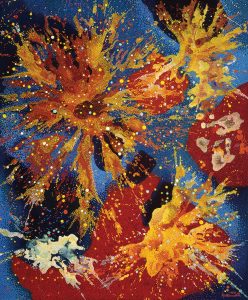
The Energy of Explosions 24 Billion Years B.C. | [5th Period, The Dot Paintings] 1978, Oil Paint & Water on Linen, 65 x 55 inches; The Collection of The Kirkland at the Denver Art Museum, gift of Hugh Grant, KVK1978.03, ©The Estate of Vance Kirkland. (Dots depict stars of different temperatures, on top of the oil & water mixtures, which together portray an exploding galaxy in Kirkland’s imaginary universe.)
For twelve years, the prestigious Knoedler Gallery in New York City carried Kirkland’s surrealist paintings, finding them commercially successful. When the artist moved on to hard-edge abstraction and abstractions from nature (1947-1957), Knoedler dropped him from its stable. Kirkland didn’t look back. He continued evolving in the direction of pure abstraction while inventing resist techniques by mixing liquid mediums that don’t mix. The first he created by combining watercolor and denatured alcohol. While painting in the high country in late fall, he would take along some of his favorite red wine or scotch to sip, Grant says, and to keep his paints from freezing he mixed alcohol with his watercolors. Eventually he discovered that denatured alcohol provided the best results, creating textures that mimic such surfaces as coral, rocks, or ancient bronze sculpture.
Later he worked with mixtures of oil paint and water, the resistant mediums producing interesting textures, some resembling a cratered moon surface, and other unexpected effects. Created between 1953 and 1964 in an abstract expressionist style, many of these pieces suggest decaying stucco or the ancient temple walls from his travels in Asia, Rome, and Greece. Grant points out that although Kirkland was not part of the New York scene, he was an important first-generation abstract expressionist. Linda Cook, co-owner of David Cook Galleries in Denver, which has represented the artist for more than 20 years, agrees. “His work should not be considered as regional,” she says. Cook cites Kirkland’s large-scale abstract expressionist piece, Memoria Romana No. 5 (1961), as one of his most compelling paintings. “His ultimate conversation is with the paint,” she says. “He allows the medium to tell the story. I think he enjoyed the mystery of what the paint does.”
In his final period, the Dot Paintings (1963 to 1981), Kirkland used the tip of various-sized wooden dowels to meticulously paint countless individual dots, often over layers of color in mixtures of oil paint and water. Because these needed to be worked on flat, he rigged up a harness hung from the ceiling, in which he lay suspended face down to apply the dots, especially with large canvases. Assistants handed him his paint mixtures and moved the paintings beneath him on skateboards.
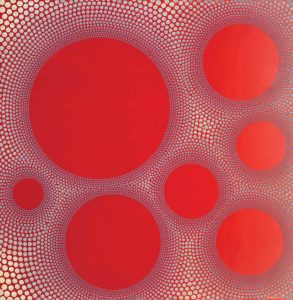
Seven Red Suns in Grey Space | [5th Period, The Dot Paintings, Open Sun Series] 1971, Oil Paint on Linen, 66 x 66 inches; Collection of Hugh Grant, VK1971.08, ©The Estate of Vance Kirkland. (Kirkland portrays the beating heart of his universe with the pulsations of his Open Sun Series.)
Kirkland’s Dot Painting titles contain words such as energy, vibrations, explosions, mysteries, and forces, hinting at the scope of his imagination and his fascination with time and deep space. Even more than his earlier work, color combinations in this fifth period with dots, vibrate and interact with kinetic intensity. They also reflect his lifelong chromesthesia, a neurological condition in which he experienced sounds as colors. Classical music, in particular, inspired the color combinations in many of his paintings.
For Kirkland, these dynamic hues represented something beyond the visual, although he didn’t publicly share the philosophy behind his paintings during his lifetime, fearing it might be seen as overly sentimental. He asked his friend Grant not to speak of it either. Forty-five years after the artist’s death, Grant decided to break this silence by providing words from Kirkland to be read during a live multimedia event in Denver that included Kirkland’s art. The universe, as the artist envisioned it, is “governed by love, as represented by the vibrations of color in my paintings, radiating that feeling, not by the constant wars of humans, with their greed and selfishness, who only care about wealth and power. My universe…[possesses] principles of justice and morality, behaving honorably, and with female equality.” With this insight, Grant says, Kirkland’s paintings “glow a bit brighter.”
No Comments