





03 Sep Rendering: Obsessed with the Ephemeral
Patricia Benner, much-awarded landscape designer and founder of Benner Reibel Landscape Architects, began her professional life with an MBA. She worked in finance for several years before deciding it simply wasn’t for her. Then her mother, a landscape architect in New Jersey, created a plan for a garden at Benner’s Los Angeles home; implementing that plan did much more than simply make a garden.
“I thought: this is really fun,” Benner recalls. “I want to look into this.”
A sandy clearing in the dune grasses creates an inviting spot for a beach picnic or bonfires.
Coincidentally, in 1985, the University of Southern California (USC), launched its landscape architecture program. As Benner notes, she was not only their first student: “I was the only student in the program for the entire time I was there. That sounds odd, but it was absolutely a fantastic education because I was in the studio with the architects. I really learned how to design in three dimensions, which I don’t think is the case in a lot of landscape programs. My two thesis advisors were architects, and my other advisor was the head of the landscape program; that meant one-on-one classes with her, which was incredible.”
Ipe decking paths meander through the barefoot garden, connecting the ocean to the beach meadow.
With offices in Los Angeles and Berkeley, Benner describes her firm’s style as modern, informed by classical principals. They work with a wide variety of architectural styles and are known for imaginative, sensitive designs that create tranquil escapes for city dwellers. Often, they incorporate hidden seating areas where space allows. This aesthetic, Benner says, took hold before she started at USC, when she met prominent landscape architect Mark Rios, founder of RIOS, an interdisciplinary design firm. “He was really my original mentor,” she says. “And he was a huge fan of Dan Kiley, who for the longest time was my north star, and I think still influences me. He is an all-time favorite.”
A sculpture by Jude Paul welcomes visitors at the gravel garden.
Benner’s partner Catherine Reibel feels the same about Kiley (1912-2004), who was a leader in modernist landscape architecture, working with prominent architects including I.M.Pei, Eero Saarinen, and Louis Kahn. “I think that’s maybe the root of why we work so well together,” Reibel says.
Reibel began working with Benner in 2021 and became a name partner in the firm in 2025. They met when Benner expanded her practice to Northern California, and Reibel was suggested as someone to work with there. Reibel had practiced in Los Angeles before opening her own company, Ground Collective Landscape Architecture, in 2019.
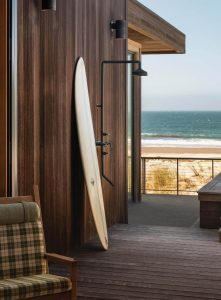
Ipe decking and an outdoor shower provide views over the dune grasses and beach. Photos: Haris Kenjar
“For a while I thought I wanted to be an architect,” says Reibel, who had studied both art history and architecture at Yale. “But along the way I discovered that I loved the outdoors so much that maybe architecture was a little too static for me. I began to appreciate how ephemeral the landscape is; I really embraced how landscape is ever-changing, and that piqued my interest. I went to graduate school for landscape architecture at UC Berkeley.”
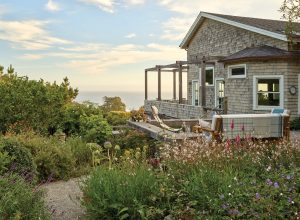
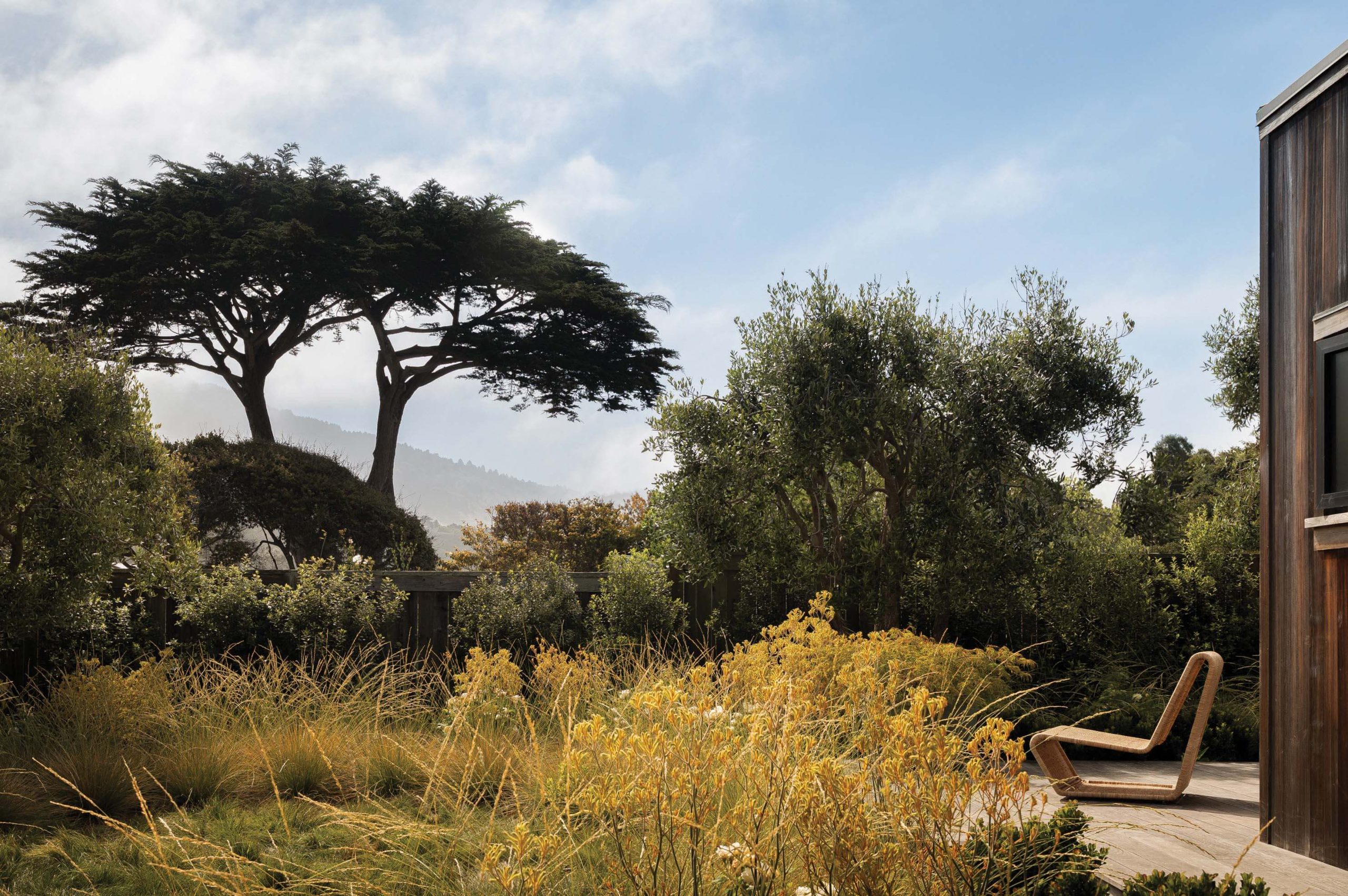
At Patricia Benner’s garden in Stinson Beach, the plantings are what she calls her “Garden Lab.”
Reibel discovered Dan Kiley’s work early on at Berkeley, where one of her first studio projects was on the Miller House and Garden in Indiana. The house was designed by Saarinen, the garden by Kiley. “I was just obsessed!” Reibel says. “Obsessed with referring to the plan and wondering, ‘how did you create these moments?’ I was really studying everything down to the dimensions and the details of that garden.”
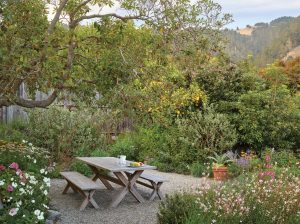
The charming, rugged coastal garden is an experiment in planting design.
Their work together began slowly, but Benner and Reibel found they were like-minded and their design talents complimented one another’s ideas. They’re known for their craftsmanship and their ability to connect people with nature, even in urban settings. More than that, they’re known for interpreting client’s desires with imagination and sensitivity.
“We do a lot of renderings,” Reibel says. “A lot of sketches to paint the picture of what the space could look like. It’s that iterative design process of drawing inspiration from things people might gravitate toward, then making models to capture what it could look like. We can do so much with visualization; that’s become a great tool for us.”
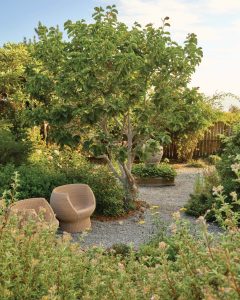
Gravel paths wind through the garden and widen to allow no-frills, naturally sheltered seating areas with ocean views. Under a magnolia tree are Munder Skiles chairs. Photos: Marion Brenner
Reibel also says that their clients tend to be excited about landscape. “Californians know they’re going to be spending a lot of time outside, so they have a lot of ideas they want to talk about, and they’re very collaborative, which is fun. We’re really lucky in that regard. We don’t need to convince them about, for the most part, sustainability and fire resilience; they get it. So, I think we’re a little spoiled in that way, with good client collaborators.”
Benner adds, “In our practice, we really focus on both the plant palette and the materials palette. Those two really should sing. And how you choose materials to convey and design hardscape and fencing — all that supports the concept for the garden, which is as important as the plant material.” She recalls a plant teacher at USC who always emphasized that you can have a beautiful garden without a flower in it. “It’s all about foliage, texture, form, and color. I really embraced that,” she says. “And I bring that into the planting design to set off the individual plants and create gardens that will carry through the winter well, too, because even in California we have winter, and blooms can disappear.”
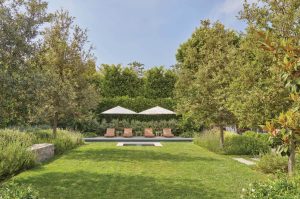
At Sycamore Garden, the strong axial relationship in the rear garden between the swimming pool and fountain is supported by a grid of quercus ilex (or holly oak) trees.
Equally important to the firm is how gardens are experienced from inside the home. “The views out to the garden must be really beautiful,” Reibel says, “but we also want people to use the gardens. So, if the property is quite large, we need a reason to get people out into the landscape, which is why we create a secret garden to discover. Beauty is first and foremost, but making sure that people want to get out there and use the garden and interact with it, I feel, is a non-negotiable.”
“And in a small space,” adds Benner, “you have to create layers to make it seem larger. You have to have focal points.”
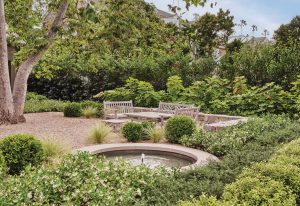
New England granite forms the low stone walls that define the seating area under a native sycamore tree in the front garden. Photos: Caitlin Atkinson
Of course, in California, fire is an ever-increasing issue, and Benner has always been conscious of the considerations it entails. The firm’s website contains an entire section on fire resilience along with photos of fire-resistant design concepts, plants, and hardscape.
“We’ve always had to do fire-resilient planting, so this is not new to us,” Benner says. “We’ve developed a palate of plant material that is more fire resistant but still has that look and aesthetic of the fullness of a garden, without looking like a desert landscape. For hardscape, of course we’re looking at non-combustible materials and thinking about how stone can be used, and metals, and some of the less flammable wood for decking. With hundreds of years old stone, there’s fire resilience, but you can also use them to give a sense of character and depth.”
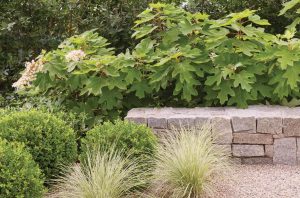
The design reflects a New England sensibility while simultaneously complementing the modern lines of the home.
Maintenance, they acknowledge, is not as glamorous. “But making sure that people are tending to vegetation size and not letting things get too close to the house is the practical reality of fire-wise design,” Benner says. “Maintenance is really important.”
After the Pacific Palisades and Altadena fires, there was tremendous concern about how to rebuild the two communities so that they could maintain their former appeal, but also be fire resistant. Benner is a member of the Design Leadership Network (DLN), an international association of architects, landscape architects, and interior designers dedicated to collaboration and promoting the future of design.
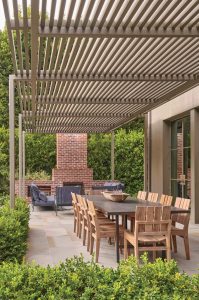
The shaded pergola and fireplace, along with seating and dining spaces, provide views across the tranquil garden. Photos: Caitlin Atkinson
“The DLN identified seven different architecture styles that were predominant in small lots in Pacific Palisades and Altadena,” Benner says, explaining that the idea was to offer residents who couldn’t afford to hire an architect the services of a contractor working with one of the seven styles. While each style was developed by separate teams, Benner Reibel was the landscape architect for all seven plans.
“It’s such a wonderful profession,” Reibel says, summing up her love for their work. “For me, that attraction to the ephemeral and how every day and every individual project is so different and exciting is something that will keep me interested for life. I don’t know if you can say that about every profession.”
No Comments