




03 Jul Collector’s Notebook: Hidden Hazards
On a recent visit to a museum in the Southwest, I toured their collections, which included a long-term loan of Western saddles, bridles, and spurs. The museum staff member guiding the tour mentioned that the saddles had recently been frozen as part of the museum’s pest management protocol, then motioned for the group to continue on. I raised my hand. “Your what protocol?”
Apparently, and this will be no surprise to the equestrians out there, saddles harbor bugs. So, before those minuscule pests could ride into the museum where they would discover loads of new food sources — textiles, paper, canvas, wood, and other organic materials — they and their host saddles were wrapped and frozen (-30°C to -40°C) in specially designed trucks for several days to weeks. The wrapping and freezing process kills not only the bugs but their eggs and larvae, too. Problem solved. Sort of.
Here’s the thing: Bugs are the tip of the museum-sized iceberg. Mold is and has been an ongoing struggle, especially in old, drafty museums in Europe. These are issues no one wants to talk about, which makes matters worse. And because of the stigma of discussing these pesky problems, another troubling issue has come to light.
Enter textile conservator Paulette Reading. For 20 years, Reading has maintained a private practice in Denver, working primarily with institutions that don’t have a staff of conservators, which is the majority of them. Over that time, she has become an outspoken advocate for the proper conservation and handling of historic collections. But not for the reason you might think.
When the Cure Is the Problem
A decade into her career, Reading began developing skin sensitivities. What she discovered brought her to the intersection of art, science, and occupational health — a place that has defined her work ever since.
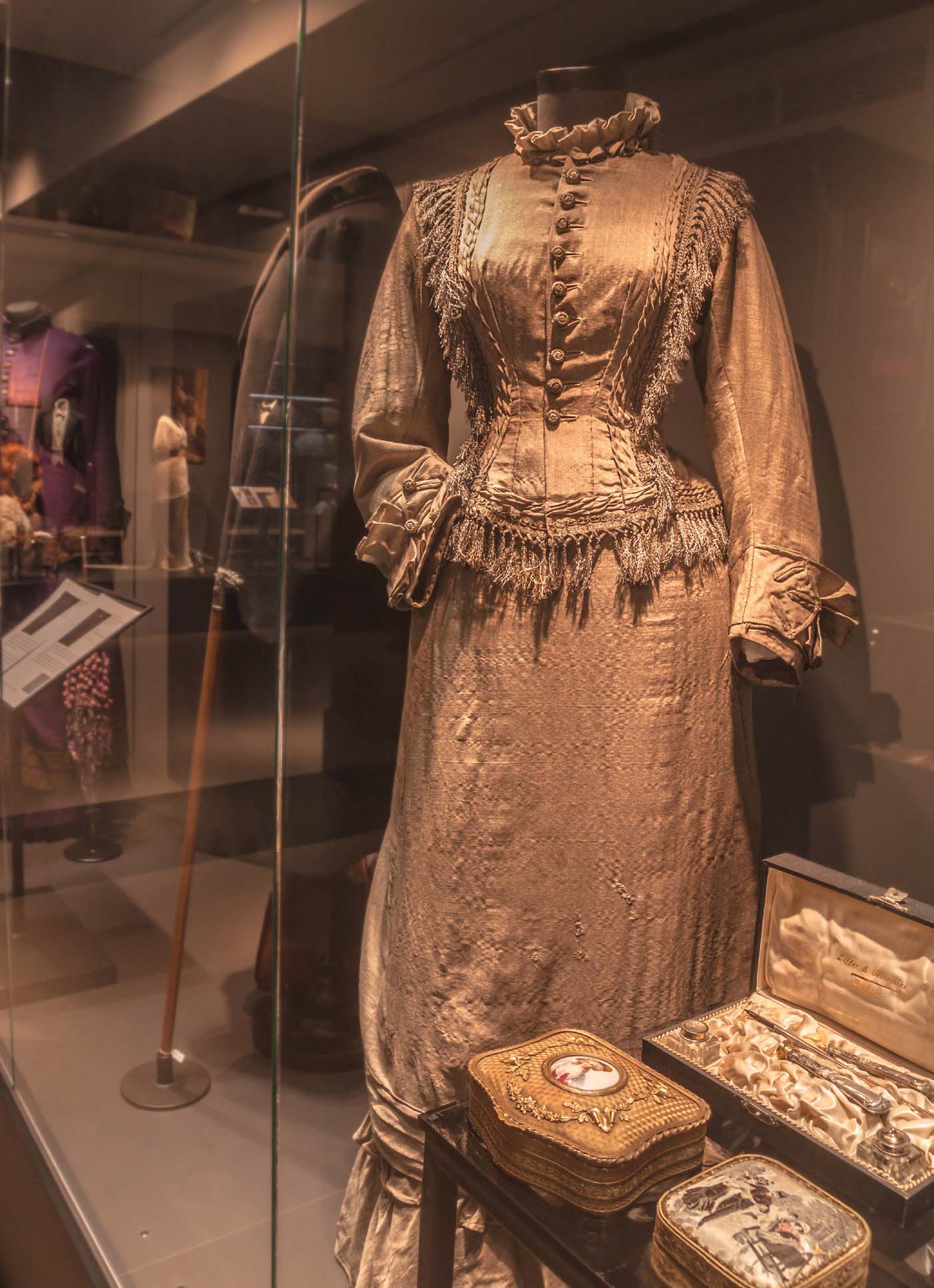
“Historic textiles are quite toxic,” she says plainly, “whether from applied pesticides such as arsenic and mercury used from the 19th into the 20th century, or from the way they were manufactured.” Century-old silk gowns, weighted textiles treated with heavy metal salts, and books with deep green cloth binding, she explains, were often made with toxic materials that didn’t necessarily pose a problem at the time because the chemicals were bound into the fibers.
But as those textiles age, they get powdery; that’s when they present a hazard that Reading likens to lead paint in homes. “If it’s sealed,” she says, “it doesn’t necessarily pose a problem. When it starts flaking, then you’ve got an issue.”
A Long and Complicated History
When I spoke with Reading about pests and mold in museum collections, she was quick to point out that this isn’t an isolated issue; it’s endemic. As is the fact that, until the mid-20th century, the accepted practice for killing infestations was fumigation, and the substances used closely tracked what the agricultural industry was developing for field use.
Arsenic compounds, mercury-based treatments, and later organic pesticides, including DDT, were used in museum storage rooms and private homes alike. “This was a widespread practice,” Reading says, noting that in the 1930s, noxious sprays developed for home use to kill moths and other invasive insects were heavily advertised, often depicting frantic housewives holding up moth-eaten coats. “That’s why it’s ubiquitous,” Reading says.
Today, museums have integrated pest management systems that include monitoring, isolation, freezing, and anoxic treatment. But the problem, Reading stresses, is that the elemental poisons applied long ago — arsenic, mercury, and the like — don’t degrade. “They are actual elements. They’re not going anywhere.”
Who Is Really at Risk?
To be clear, there’s no risk for museum visitors. “Even if they’re not aware of some of the problems, visitors aren’t allowed to touch things,” Reading says. “It’s more the staff and people who are handling collections.” And she says, “You’re probably breathing in more poisons waiting for a bus or breathing the air after a wildfire.” Well, that’s a relief.
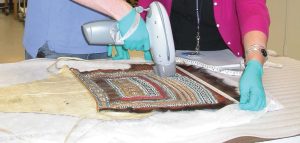
Testing for metal pigments in textile. Photo: K. Makos
The story is different for people whose work or hobby involves regular hands-on contact with historic objects. Dealers, conservators, museum collections staff, registrars, and dedicated collectors face cumulative exposure in a way that a casual visitor does not. Reading describes the moment she understood this personally: “I started working on a project — not wearing gloves — and later found out it had been completely covered in arsenic. It was very upsetting to learn that I was handling something at work, and then headed home, stopping to pick up my kids from daycare.”
Silence Isn’t Helping
One of the persistent challenges is institutional reluctance to discuss the problem openly. The fear is understandable: Publicity about toxic collections might make other institutions reluctant to lend to your museum or host traveling shows, plus it will alarm the public, which might prompt hasty deaccessioning and sensational headlines.
Disposing of objects that could be safely managed is part of what Reading hopes to prevent through education. “I think it’s better to have more knowledge,” she says. “People who work with collections every day might have a lot of exposure. Even if, compared to industrial jobs or working in mines, the levels are very low; there’s no reason we shouldn’t protect ourselves when we know it’s there.” She takes a breath and adds, “I think it’s an ethical problem not to make this common knowledge.”
Leading Reform
While there are now effective and safer protocols for eliminating pests and mold in museum collections, there isn’t yet a single handbook for addressing toxic hazards in historic collections. Thankfully, a vital collaboration is making headway: the Museum and Cultural Heritage Industry Working Group, housed within the American Industrial Hygiene Association (AIHA). Founded in 2017 by Kathryn Makos, an industrial hygienist who spent her career at the Smithsonian, the AIHA is developing a database of industrial hygienists specifically familiar with cultural property.
Another resource Reading recommends is Old Poisons, New Problems by Dr. Nancy Odegaard. An essential reference for conservators, this publication has been in print for roughly two decades, and yet, Reading says, clearly frustrated, it has not become standard knowledge across the field.
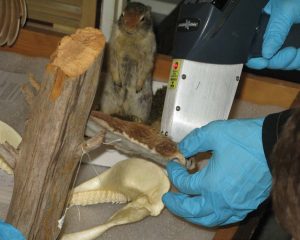
Testing of animal specimen. Photo: K. Makos
She also points to the Poison Book Project under the direction of Dr. Melissa Tedone. Based at the University of Delaware’s Winterthur program, the project has made a specific hazard visible: arsenic-based green dyes used in 19th-century bookbindings. “Studies indicate that arsenic in bookbindings is less an airborne problem,” she explains. “It’s more of a handling issue.” Thankfully, the Poison Book Project’s work has drawn attention beyond the museum community to a hazard that affects libraries, rare book dealers, and antique collectors alike.
For pest management, Reading directs everyone, from major institutions to home collectors, to the website: museumpests.net. There you will find resources applicable to both museum protocols and household collections.
Reading’s emphatic plea to all: “Do not use mothballs. They’re toxic. It’s a carcinogen. It’s not good for us, it’s not good for the objects, and they smell bad. And most people aren’t using them correctly anyway.”
Practical Steps for Collectors
For those who own or are acquiring historic organic objects, Reading’s guidance is straightforward. Start with a working assumption of contamination for any organic historic textiles, leather, saddles, taxidermy, books, wooden artifacts, particularly those that predate the mid-20th century. This doesn’t mean panic or disposal. It means awareness and basic precaution.
For anything entering your space, the first step is isolation. Reading freezes every incoming object in her studio before examining it, as a precaution against pest transfer. For a private collector, this may not be feasible, and many objects may be damaged by freezing. The best approach is to wear gloves and a mask, and open questionable finds in a garage where you can monitor them for signs of damage, such as frass (insect droppings), webbing, holes, or fine debris.
“And try to keep things contained so as not to cross-contaminate,” Reading warns. The goal here isn’t to make handling impossible but to create a barrier between uncertain hazards and skin or airways.
While visible pest damage may sound awful, Reading says it’s a good sign. “That means the object might not have been treated with toxic pesticides.” But she warns, “If you have an 1890 weaving with absolutely zero damage, I might be suspicious of that.” The takeaway isn’t that damage is reassuring, but that perfect condition in a very old textile should be treated with care.
Of the latest trend, a resurgence of interest in Victorian and early 20th-century fashion, Reading is direct: “I have heard people are buying historic garments and wearing them. That’s problematic without knowing whether a Victorian-era textile was treated with pesticides, had more toxic dyes, or was dirty. A lot of that sooty stuff on textiles contains lead from its environment.” Cleaning, she warns, is not a simple fix: Such garments are typically too fragile for dry cleaning, which also doesn’t reliably remove toxins and introduces its own chemical hazards. This is a situation for a conservator.
The Perspective Worth Keeping
Reading is careful not to leave the impression that historic collections are uniformly dangerous or that engagement with them requires hazmat protocols. The goal of her work and the goal of the conservators, industrial hygienists, museum professionals, and researchers building out this field is preservation and continued access, not avoidance.
“There are affordable, practical ways of handling and preserving objects,” she says. “And there are safe ways to protect yourself, if you know the hazards and have the resources.”
That last point is key. The knowledge exists. The resources exist. The professional networks exist. What the museum world is still catching up on is getting this information out of the specialized corners of the conservation field and into the hands of the dealers, collectors, and museum volunteers who need it most.
“My mission,” Reading says, “is to make this common knowledge.”
Curator and writer Rose Fredrick shares her extensive knowledge about the inner workings of the art market on her blog, The Incurable Optimist, at rosefredrick.com.
Sidebar:
Resources
American Institute for Conservation (AIC) — Find a Conservator directory; Health and Safety Network working group. culturalheritage.org
AIHA Museum and Cultural Heritage Industry Working Group — Database of industrial hygienists familiar with cultural property. aiha.org
Old Poisons, New Problems by Dr. Nancy Odegaard — The essential reference on contaminated collections. Available through museum booksellers and Amazon.
The Poison Book Project — University of Delaware / Winterthur; research on arsenic in historic bookbindings. Search “Poison Book Project Winterthur” for current resources and publications.
museumpests.net — Integrated pest management resources for institutions and home collectors; includes identification guides, protocols, and links to scholarly literature.
Connecting to Collections Care — Free webinars and guidelines for collections care across a range of object types. connectingtocollections.org
Conserve O Grams — National Park Service technical bulletins on collections care, freely available online.
No Comments