




03 Jul Restoring the Story
I’ve been wrestling for some time with what makes a home Mid-Century vs. Modern vs. Ranch-Style, other than the timeline,” says Craig McMahon, principal at Craig McMahon Architects. “It was a very unique time where everything seemed to be changing culturally, including architecture. I can’t think of an era where there was such a drastic change in architecture across the U.S., globally really, but this seemed to encompass music, art, and design.”
In Castle Hills, Texas, McMahon encountered a dilapidated, long-forgotten house that seemed transported from another geography and another architectural conversation entirely. Rising beneath a canopy of mature live oaks, the 1961 William Dukes house carried the experimental spirit of the California Case Study era of the late 1940s through the mid-1960s into South Texas through conceptual elements, including glass walls, floating roof planes, exposed structure, and a striking openness to the surrounding landscape.
Restored to its dramatic street view design. Custom concrete panels, expansive glazing, and sweeping smooth-troweled concrete stairs restore the home’s dramatic street presence; Beaumont Mood lighting and a landscape of Turks Cap plantings and black shadowstone reinforce the original architectural vision.
“You have to come see this house!” McMahon’s wife insisted repeatedly after passing the property during school pickups. At the time, the couple was immersed in designing and building their own home, and McMahon resisted the detour until his wife and curiosity finally won. When they arrived, the architect immediately recognized something extraordinary. “After spending years in Los Angeles researching the Case Study homes of Eames, Entenza, Neutra, and Saarinen, I was shocked to see such a similar Mid-Century Modern home in South Texas,” he recalls.
Restored as a private office and study, the former William Dukes workspace features Flor Concreto carpet tiles, an Eames Lounge Chair, cabinetry by IKEA Stockholm, and artwork from Society6. Exterior panels were replaced to match the original design, and windows that followed the opposite side of the living room.
Once thought to be an O’Neil Ford project, the residence had actually been designed by architect William Dukes for his own family in 1961. The central living space and expansive living room with soaring ceilings were organized with a strong visual connection to the outdoors, opening out to four bedrooms, a creative room, and bathrooms, all intended to support entertaining and family life. Dukes maintained a secluded second-story office with a separate entrance overlooking the neighborhood.
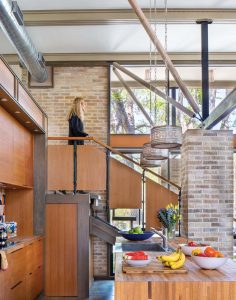
The original hand-carved stairs float above the kitchen space, with restored Douglas fir stair treads and hand-carved mahogany risers by Jack Peterson Architect. Complemented by Douglas fir screens, Steel-Tek supports, and an exposed spiral metal duct.
By the time the McMahons discovered it, the house had suffered decades of neglect, resulting in significant deterioration, followed by an ill-conceived renovation that stripped much of the interior framework and character before the project was ultimately abandoned. McMahon, recognizing the treasure, decided to preserve and restore Dukes’ original vision, which turned out to be a labor of love as much as a scavenger hunt for clues, blueprints, plans, and insights into the original structure.
“What I felt was untouchable was changing the clear architectural concept,” McMahon says. “A modern glass home with a soaring, thin-profiled upper roof that engaged the outdoors on all sides. From the beginning, restoring the story was as important as the building itself.” That principle guided every restoration decision during the three-year reconstruction project. McMahon admitted that the project drove him to an often futile search for the backstory of Dukes’ design that had been sketched out years before the aid of computers to an exacting 1/8th inch of accuracy in some points; truly remarkable precision for the time.
The challenging renovation involved far more than cosmetic preservation. Utilities, glazing systems, framing, insulation, finishes, and exterior materials all required careful rebuilding to preserve the visual lightness and structural clarity that defined Dukes’ original design language.
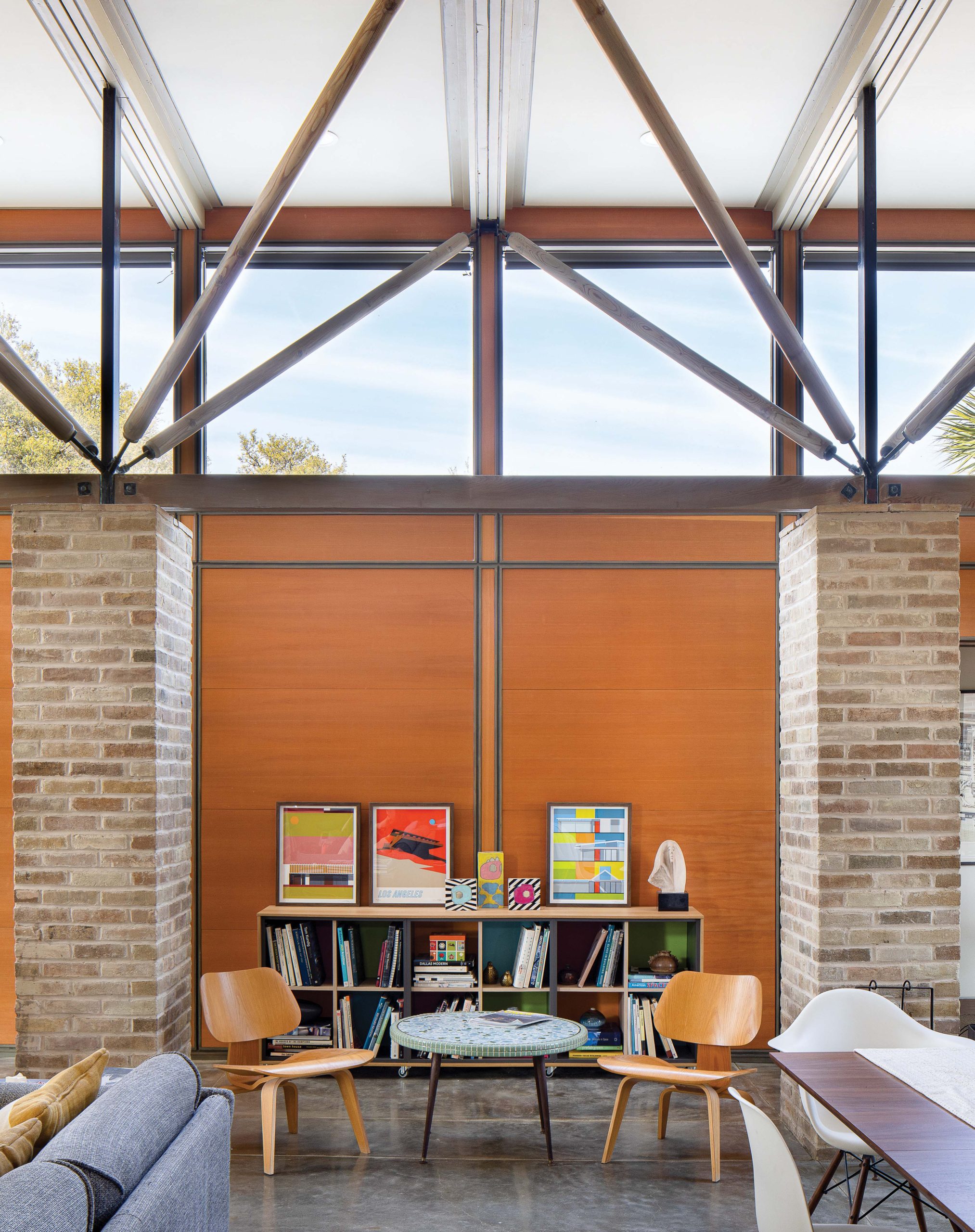
The home’s elevated roof system remains among its most compelling architectural features. Triangulated structural supports rise like branching trees beneath the floating roof plane, creating an engineered rhythm visible from nearly every room. McMahon later realized the system echoed the spread wood legs of Charles and Ray Eames molded plywood chairs. “The structural frame design and upper roof remained as we found them and were in good condition, so we merely refinished them,” he explains.
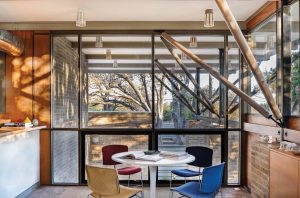
Originally William Dukes’ private home office, the restored loft features floor-to-ceiling glazing, custom Douglas fir cabinetry, a Saarinen table, Steelcase chairs, and Flor Concreto carpet tiles. With the large floor-to-ceiling window facing the backyard, the loft fully embraces the transparent outdoor connections on all sides.
One of the restoration’s most ambitious undertakings involved recreating the original exterior Cemesto panels, a cement asbestos material widely used during the era for its insulating and fire-resistant properties. Only three original panels survived intact, leaving McMahon and his team to reverse engineer an entirely new system capable of preserving the same appearance without using toxic materials. “To do the home right, we had to figure out how to remake the panels in a non-toxic way,” he says. “It had to be concrete.”
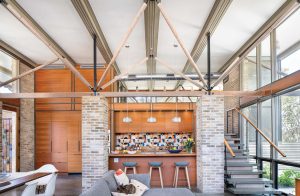
Restored Douglas fir cabinetry by Ray McMahon pairs with IKEA Sektion bases, Blum hardware, and Red Oak butcher block countertops from Floor & Décor; refitted original ceramic pendants and Beaumont Mood fixtures illuminate the kitchen and loft beyond. Bosch appliances, Kohler sink, and Hansgrohe faucet.
The process became an exercise in experimentation. Working from a makeshift casting bed assembled inside one of the former bedrooms, McMahon, his brother, and the construction team developed approximately 50 custom panels using thin-set concrete bonded to Cem-panel substrate. Each piece was wet sanded, polished, sealed, and individually installed to recreate the home’s original mineral surface quality.
The resulting palette reflects the original language of the home. Yellow sand brick, polished concrete panels, Douglas fir framing, stained wood, and muted painted steel preserve the material relationships established in Dukes’ original drawings and surviving documents. The original Beaumont Mood ceramic light fixtures, suspended within the upper roof structure, were inaccessible enough to escape earlier renovations. “The existing lights included a unique color to each, adding variety to the space,” McMahon says. Forty-seven fixtures in all were carefully removed, rewired, cleaned, and reinstalled throughout the home.
The hand-carved front door became another emotional centerpiece of the restoration. Originally carved by Jack Peterson, Dukes’ lead draftsman and occasional visitor to the restoration project, the damaged panels were painstakingly restored by McMahon’s daughter, Rachel, who spent months re-carving each triangular detail by hand.
Ultimately, the restoration demanded significant technical adaptation. “It was very difficult not to change the appearance of the home to meet expected energy performance needs,” McMahon explains. Original single-pane glazing gave way to insulated systems inserted into recreated Douglas fir frames milled according to Dukes’ construction drawings. Thin roof profiles required rigid insulation systems capable of preserving the narrow architectural lines central to the house’s identity.
The indoor-outdoor relationships remain essential to the experience of the house. Courtyards, terraces, gardens, and glass walls maintain continuous visual engagement with the landscape while carefully controlling privacy from neighboring properties.
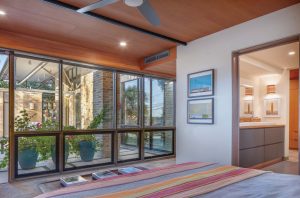
Floor-to-ceiling windows connect the primary bedroom to the backyard patio, while custom Douglas fir ceiling panels, IKEA cabinetry, and retrofitted Beaumont Mood sconces continue the home’s warm modern material palette.
McMahon relocated the primary suite from the front of the house to the rear courtyard, extending Dukes’ original design intention while adapting the plan for contemporary living. The residence now boasts three bedrooms, two baths, and preserves the expansive central living space with an open wall kitchen, while maintaining the second-level architect’s office, in an interesting extension of creative legacy.
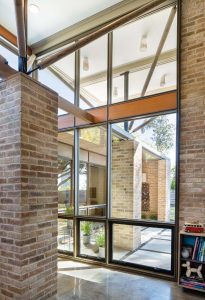
A new glazed connection links the living spaces to the relocated primary suite, replacing an enclosed room with a light-filled passage framed by floor-to-ceiling glass, backyard patio access, and a canopy roof.
Inside, the interiors balance historical reference with selective contemporary interventions. Much of the original Saltillo flooring was damaged when new plumbing, electrical systems, and utilities were routed beneath the slab. Rather than attempting an imperfect material match, McMahon introduced polished concrete floors poured within the home’s original grid pattern, preserving the geometric language established throughout the architecture.
Furnishings and finishes were selected through research into the period and the home’s original intent. McMahon chose butcher block countertops rather than contemporary stone surfaces and built much of the mahogany cabinetry as movable furniture pieces, following the flexibility common in homes of the era.
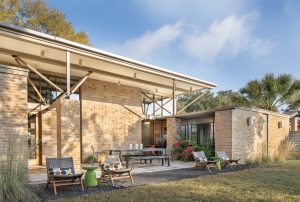
The expansive roof canopy extends shelter across the back patio, creating a seamless connection between the primary suite and living spaces. Original yellow sand brick, Beaumont Mood ceramic wall sconces, and Girona chairs from World Market reinforce the home’s indoor-outdoor character.
Walnut tables, Modernica platform beds, and carefully sourced furnishings reinforce the experimental spirit McMahon discovered while studying architecture and interiors from the 1960s. The completed restoration preserves the experimental character that originally defined the residence while allowing the home to function comfortably for contemporary living.
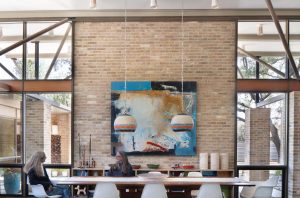
The living room, designed contrary to the era of construction, is an open plan, with no formalized dining and living space, but as an open layout found in current living spaces. The dining area is framed by the large sand brick wall, allowing for bookcases. A walnut dining table from Design Within Reach and Eames molded chairs anchor the open-plan dining area, illuminated by restored Beaumont Mood pendant fixtures acquired at auction and retrofitted for contemporary use.
While the Dukes house is now McMahon’s primary residence, the 2,450-square-foot home continues to function as a gathering space for architecture and design communities across Texas, hosting AIA events that regularly fill the living room, courtyards, and gardens with guests. McMahon is confident he fulfilled Dukes’ vision and honored Peterson’s adroit draftwork with his meticulous restoration of this incredible house. “Every architect should hope that someone might see the unique nature of their work long after they are gone and decide that this is special enough to fight for,” McMahon says.
No Comments