




03 Jul A Forever Project
When Lynn Gray needs to place an object in her Santa Fe home, she makes use of her own internal Geiger counter, understanding intuitively where a thing belongs. She used that talent as a highly sought after interior designer for clients in various cities before retiring. In fact, it was one of her clients who first noticed her rare ability to pinpoint an exact spot where energy is concentrated.
More than 13 years ago, Gray was working on a home for a client in Houston. “I had a beautiful bowl in my hand and was walking through the rooms, trying to figure out where it needed to go in their house,” she recalls. “The moment I found the right place, I stopped and put the bowl down. And I discovered after a subsequent visit, that the homeowners still hadn’t moved it or anything I had put in place. The owner said to me, ‘I like the way you use your own personal Geiger counter.’”
Gray uses her uncanny instinct as a designer and a collector to know exactly where a painting or pitcher, a chair, or even a taxidermied puffin belongs in a room. Take the Andean feathered mask that hangs in her Santa Fe, New Mexico home above a glass-fronted cabinet filled with blue and white porcelain pieces. “My husband has had that mask since we got married 34 years ago, and it was never my favorite thing,” she confesses. “But my personal Geiger counter brought me to this spot in our house — and it works perfectly there, framed and set between carved African figures.”
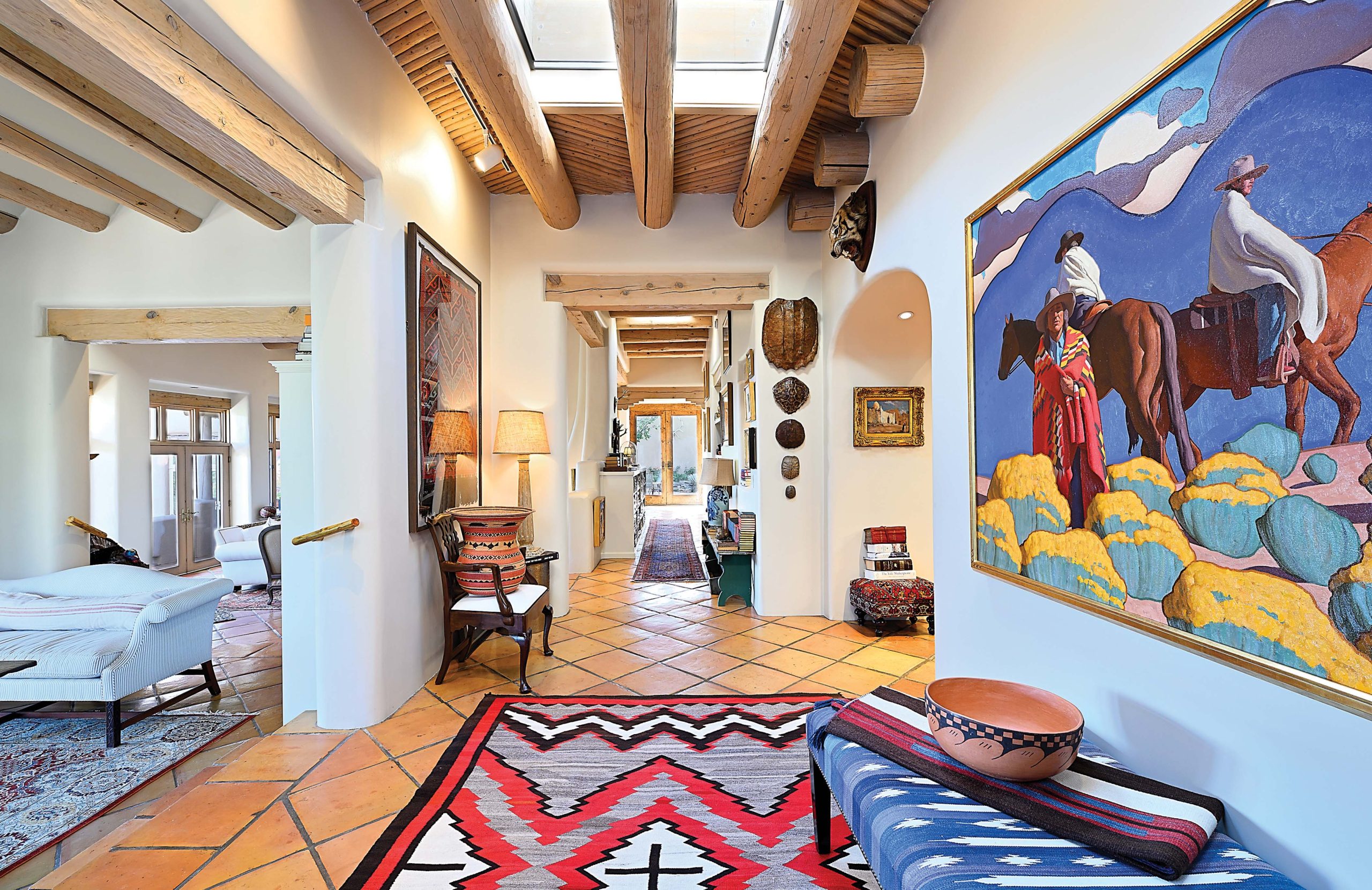
Upon entering their expansive Santa Fe home, an especially chic interpretation of a Southwestern vernacular adobe, the couple’s ever-growing collection of art and artifacts comes into full view. Yes, there is a lot of it — paintings hung salon-style, coffee table books stacked on chairs, signed first-edition novels filling bookcases in what was once the dining room, massings of white pitchers, turtle shells that appear to climb a wall, a dressing room surface adorned with Spanish metal Milagro crosses — yet every object they own is visible and never lost amid the many other things.
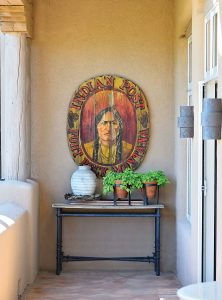
An original Indian trading post sign, from Fort Peck, Montana, becomes the focus of an area off the living room of a couple’s Santa Fe home.
What Gray is able to do as a designer is mass the objects she and her husband collect in such a way that the interiors become a series of perfectly composed vignettes of similar yet seemingly disparate objects. As her husband, known as W.L., says, “So many observers in our home have used that word vignette to describe Lynn’s vision and placement.” And as an indication of their strong bond as a couple and their mutual love of collecting art, W.L. adds, “It is a lot of fun not only living with her in her world but also watching the master at work — her mind is an endless loop of spatial relations and a kaleidoscopic color vision.” Of her design penchant, Lynn adds, “The way I mass things, create vignettes, curate, it’s not something I do consciously, I just start doing it like I’m having an out-of-body experience! It’s a talent I was born with.”

The house is designed like a hacienda in that the lush internal courtyard is open only partially on one side.
While every corner of the home beckons with visual displays of items, some of the more arresting sights that appear throughout are taxidermied animals — so many that, with her characteristic sense of humor and whimsy, Lynn says she runs “a dead animal rescue society.” By that, she means she regularly scours flea markets, auction houses, and antique stores in search of such creatures. “So often, I’ll see these poor animals, dusty and forgotten, stuck on some shelf, and they just look so sad,” she says. “I bring them home, give them a place of pride in our house, and that makes them happy.” When she says she has the ability to imbue these long-deceased animals with new life, she adds wryly, “I’m very quirky.”
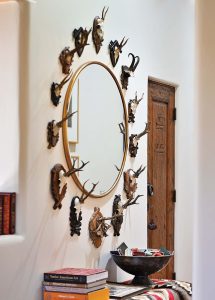
Lynn Gray configured a series of Roe deer antlers as a perimeter around a mirror.
Of the animals that now “live” with the couple, there are four buffalo heads, each named for a U.S. president. Roosevelt appears to guard the front door, staring, fully horned from an outside wall. The more diminutive Woodrow presides over a seating nook the couple calls a “Little Snug,” adjacent to the enclosed courtyard. Lincoln has a moody presence in the living room, and Truman occupies the guest bathroom. The “presidents” are in good company, too, with Midas, a perky puffin that “lives” in a domed cloche above first-edition books signed by the likes of F. Scott Fitzgerald, Eudora Welty, and William Faulkner. A duo of multi-hued pheasants, seemingly still in flight, known fondly as “The Pair,” appear to be ascending in the high-ceilinged home next to a Native American textile with red, black, taupe, and white hues that reference the colors of the birds. Silky, a white rooster, appears ready to crow amid a collection of white pitchers.

A view of the living room reveals works by many Santa Fe artists, including Sheldon Parsons, John Moyers, Eric Bowman, Helmuth Naumer, and David Halbach.
Oscar, however, is a little different. He is a 19th-century French bust of a man, made of cement and seashells; he rests on a plinth and assumes the pose of a resident sage. “We found Oscar in a Houston antiques store,” Lynn recounts. “Even though he weighs more than you can believe, I have been dragging him around with us for many years.”
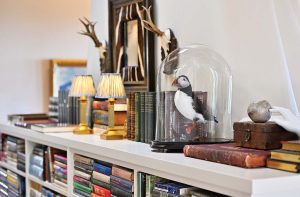
A library bookshelf houses a collection of Civil War books and journals.
Lynn describes herself, too, as “a colorist,” not only for her ability to match and echo hues throughout the home, but also for her ability to discern shades in ways most people cannot. “I really am able to see colors that nobody else sees,” she says. “I surprise myself still.”
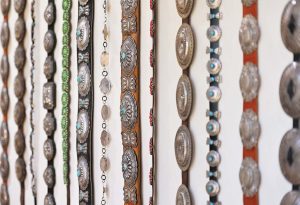
An array of antique silver Navajo and Pueblo Concho belts, some of which Lynn wears, as well as displays.
She describes walking into a room, for instance, seeing a single shade of green, finding a green-spined book of that same hue, and adding it to the room for a subtle yet powerful echoing effect. For that cabinet of blue-and-white Chinese, French, and Japanese porcelain pieces, she has tucked in select complementary blue-and-white-spined books, stacked to serve as small-scale plinths for some of the pieces.
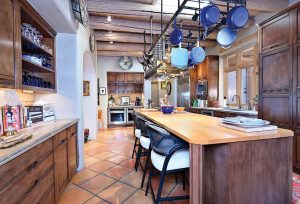
Many of the ceramic bowls on display in the kitchen were designed and created by Ford Ruthling.
While the couple enjoys entertaining, they have deliberately configured their home and its separate casita as spaces exclusively for themselves. They both describe themselves as “voracious readers,” each even keeping annual lists of the books they have read (Lynn admits to having read seven books in the last ten days). So enraptured are they with reading and the collecting of rare books, as well as new volumes on art and design, that they turned the dining room into a dedicated library. A long wooden table divides the room’s two seating areas, with the wooden surface doubling as a study area reminiscent of those found in a research library.
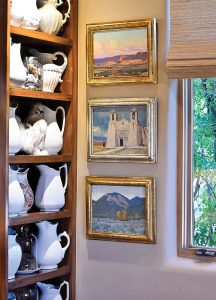
Shelves of a corner nook are filled with antique white English stoneware pitchers.
The most viscerally colorful elements in the home, though, are the paintings, which range from boldly hued, contemplative Southwestern scenes of Native Americans and Western landscapes to depictions of adobe buildings and more whimsical scenes of animals and figures. When deciding where to put the latest canvas on an already busy wall hung salon-style with works, Lynn says she simply “takes out my Geiger counter to find the right place on the white plaster wall to put it.” Many of the works that emerge from the neutral-hued interiors are by contemporary Western painters such as David Mann, John Moyers, and Santiago Perez, along with vintage works by Gaspard De Latoix and Shep Chadhorn, a 20th-century Western artist who was a member of the Blackfoot Confederacy. Sepia-toned Edwin Curtis photographs of Native Americans line a hallway.
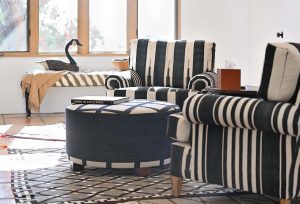
An onsite casita serves as a private reading space, though the couple often read together.
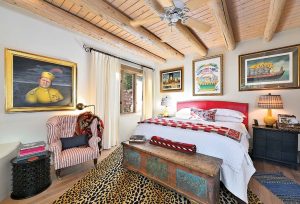
Julie Speed’s The Bandleader (left) occupies a wall in the guest suite.
When asked where she learned such design techniques, apart from innate skill, Lynn fondly recalls her girlhood in Memphis. “When I was a senior in high school, I spent my summer in my hometown doing window displays for Sears & Roebuck,” she says. “I started realizing, even then, that I could create and put together installations.” W.L. echoes that sentiment, adding, “We’re very proud of what we have put together over the last three-plus decades, and Lynn is the core of it all.”
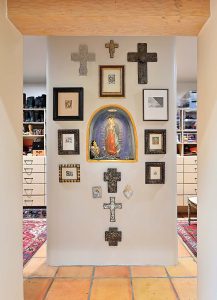
The entry to the primary suite closet with a Nicho of Madonna surrounded by Milagro crosses and a compendium of New Mexico Cathedral woodcuts by Will Shuster and Willard Clark.
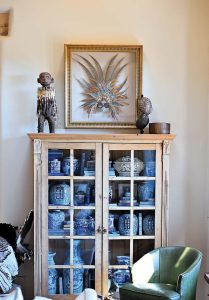
A cabinet in the living room holds a collection of English and Oriental blue and white porcelain, above which are African totems and an Andean feather mask.
For years, though, Lynn has been practicing a technique she only now admits to. “I collect constantly, and I’m able to do it in such a way that my husband doesn’t really know what I’ve gotten. I just work the new item into the home, and it usually takes a few weeks before he notices it. He’ll suddenly ask me, ‘Where did that come from? I hadn’t noticed it before.’ ‘Oh, that,’ I’ll say, ‘We’ve had that for a long time.’”
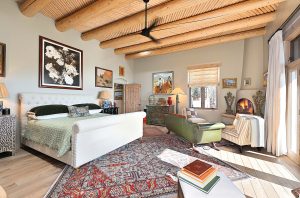
The primary suite’s walls feature oil paintings by many artists, notably Charles Bensco, Glen Dean, John Moyers, Ed Natiya, and Roseta Santiago.
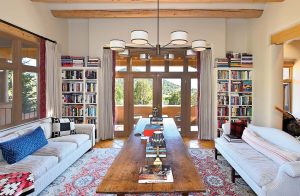
The formal dining room has been turned into a library, where most of the couple’s collection of first editions, many of them signed, are housed.
As for the scale of their collection now, Lynn says, “I’m not done. I’m never done. This is my forever project.”
No Comments