




03 Jul In the Studio: The Art of Wearing a Story
Patricia Michaels moves through the world like silk through light: with a gentle grace that belies a structural integrity stronger than steel. She is Taos Pueblo, a mother, a teacher at Parsons School of Design, and one of the most singular fashion designers working in the American West today. She is also the woman who, at 18, walked into Manhattan production houses without an appointment, talked her way onto the workroom floor, and then did the thing that silenced the skeptics in the room: She draped an original concept on a dress form in front of everyone.
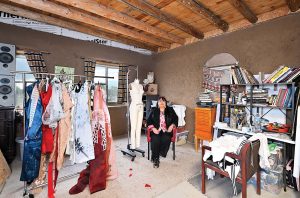
Michaels takes a rare break in her studio, a traditional Taos Pueblo adobe constructed and built by her husband, whose work is part of the movement to keep traditional building methods alive.
Her instinct to let the work speak when words fall short has carried Michaels through four decades of bootstrapped fashion shows, a high-profile appearance on “Project Runway” Season 11, international runway debuts, and a growing roster of clients and collectors that includes prominent figures in art, politics, and culture. Actress Tantoo Cardinal (Cree and Métis) wore one of her designs at the 2023 Cannes Film Festival opening of Killers of the Flower Moon, and Representative Deb Haaland wore a silk gown Michaels created in her honor upon her return from Washington, D.C. Michaels embellished that dress with hand-painted golden-tipped eagle feathers.
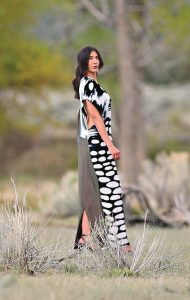
Taos Pueblo model Midnight wears Michaels’ hand-painted corn motif gown of silk, rayon, and velvet.
“She had just come back from D.C., and I wanted to welcome her home for all that she had done for Native America and natural resources,” Michaels says. “The tip of the eagle feather is significant because it’s the strongest part of the feather. Across Native Nations, the eagle is celebrated; the wing tips are for healing, ceremonies, and giving strength. I wanted to put that on her dress because to me, she was that strength.”
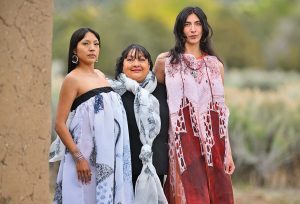
Michaels, along with Taos Pueblo models Bear (her niece) and Midnight, each wearing hand-painted silk gowns. Models frequently help in the studio with fittings before Michaels presents her work on the runway.
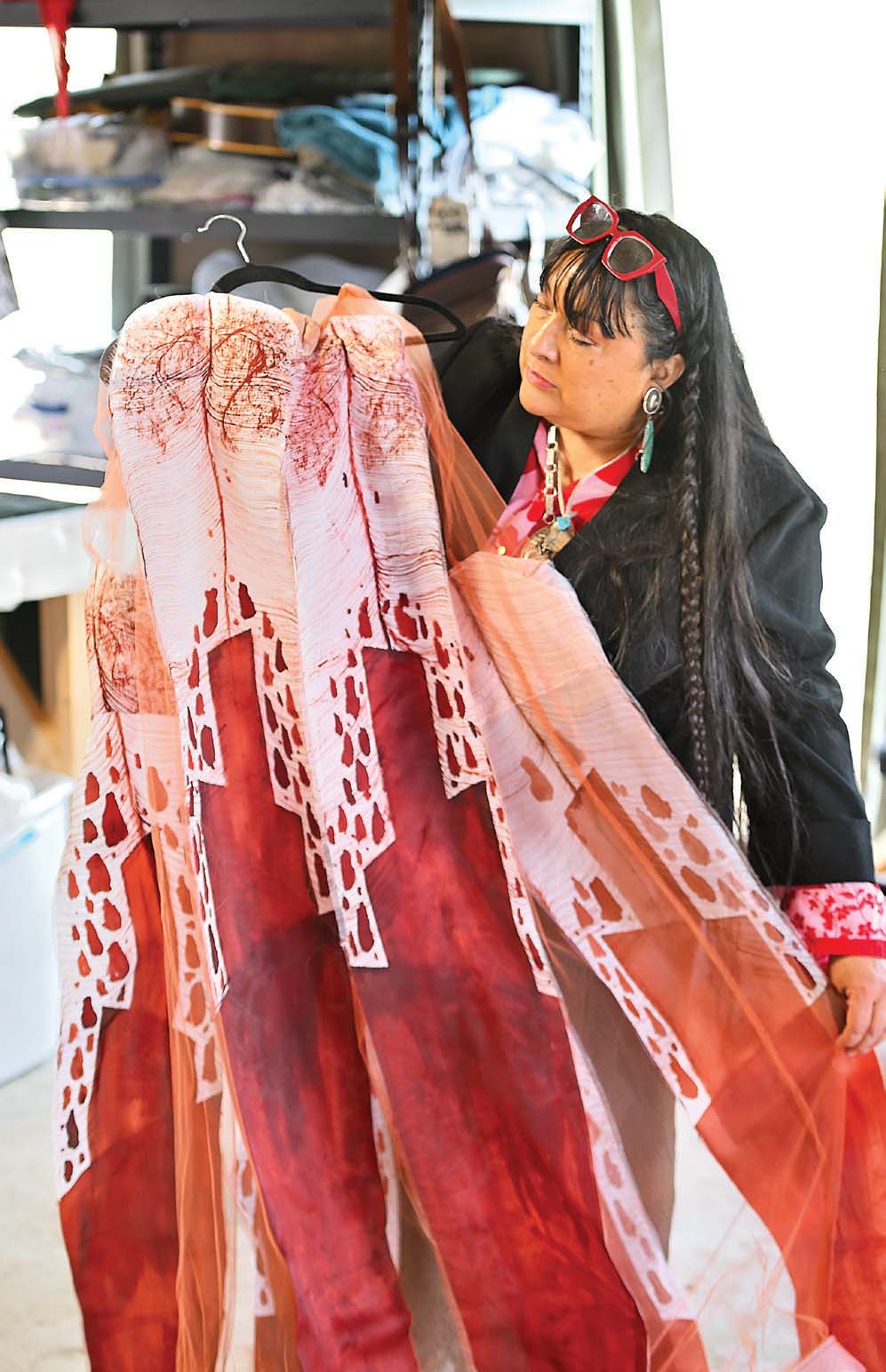
Michael’s work is not fast, and that is, in many ways, the point. Many of her pieces begin with a length of raw silk and a brush. She mixes her own dyes, as her mentor artist Nick Cave taught her when she studied with him at the Chicago Art Institute. She applies dyes by hand, meditating beforehand on what the collection is asking of her. When I caught up with her in March, she was hand-painting cornfield imagery across nearly 100 yards of fabric, gesturally depicting the field through seasons of winter snows that feed the acequia, the spring spores and blooms, the summer stalks, the harvest, and after, when the deer and birds have moved through fallow fields.
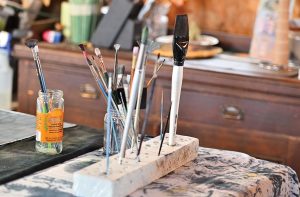
Variety of brushes Michaels uses for hand-painting her silk fabrics.
That hand-painted fabric will be used to create pieces for her next runway show in May. Those designs will be completed with handmade dragonflies and water lilies (her Native name is Water Lily) scattered across the finished garments. In fact, everything, down to the smallest embellishment, will be made by hand.
It took most of mainstream America until 2013 to discover Patricia Michaels. That was the year she appeared on “Project Runway” Season 11, competing on the Lifetime reality series against 16 other designers, with no eliminations until the finale. Week after week, she constructed entirely original textiles for each challenge. Judges were awed and sometimes baffled. One competitor reportedly told her it wasn’t a textile competition. “As Native Americans, that’s what we’re known for,” Michaels responded. “We’re known for not being fast fashion, but by taking the time to create the textile that’s going to be about who we are as designers.”
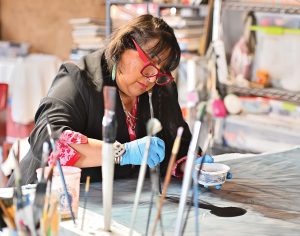
Michaels holding a container of fiber-reactive dye that she mixed for this painted bird motif.
The show transformed her career overnight. Museums began reaching out. Universities invited her as a guest designer and speaker. Fashion weeks around the world sent invitations. “Before, I couldn’t pay anybody to come to my studio; now they were paying me,” she says.
But the recognition “Project Runway” brought was not a beginning; it was a culmination. Michaels had been staging runway shows and presenting her work at galleries in Santa Fe since the 1980s, doing so largely alone, largely without capital, and largely without the support of the Native arts community that initially saw her contemporary silk fashions as a betrayal of tradition. Her booths at Indian Market were placed “by the latrine or by the dumpsters.” But in 2004, she caught a lucky break after a potter sold out early and Michaels was allowed to take that prime booth space along Palace Avenue. There, a PR director for Men’s Fashion in Milan discovered her. “She said, ‘I want you to come to Milano Fashion Week with me, so that you can see that your work is beautiful. The things you have in here are completely amazing.’”
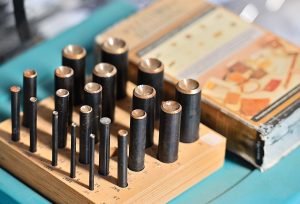
Dies she uses for punching holes of various sizes in her handmade leather accessories and overlays.
Her success, however, came at a cost: Her marriage ended in 2008 when she chose to pursue a career in fashion rather than support her husband’s art career. The following year, Michaels did her first major New York runway show at Bryant Park. Unfortunately, the show opened on the day British fashion designer Alexander McQueen died. “My show was not well-attended because the media went to cover his death,” she says quietly. “They were all mourning him, and anybody who came had these upside-down crosses because McQueen used that symbol in his work. It was such a dark show.”
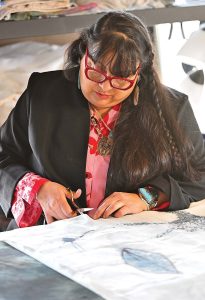
Cutting hand-painted silk motif titled Mother Earth’s Spores.
Upon returning home, Michaels slipped into three years of depression fueled by second-guessing her decisions. She met and remarried a wonderfully supportive man who pulled her back, pointing her toward the Taos Pueblo mountains outside their window. He told her, “You need to think about where you come from. You’re rooted in that kind of strength.”
She started praying and soon was back to work with renewed energy. Then came the “Project Runway” audition.
Michaels’ studio is governed by a simple but vital philosophy: Nothing goes to waste. Scraps of hand-painted silk become jewelry or migrate into future textiles. Patterns are kept simple when possible, while couture pieces intended for ceremony or celebration are given more complexity, more time, more adornment. The philosophy has roots that run deep: Pueblo ceremonial regalia is made entirely by hand, from materials used in full. “That’s the only way our ceremonial clothing is made,” she says, “through our hands and through us taking the time to make them.”
Her studio’s emotional atmosphere is also carefully tended. Michaels does not permit cruelty or drama in her workroom, and she pushes back against the idea of the tyrannical designer. “People are going to wear this garment,” she says, “and I want the feeling to be the good energy that goes into it. I want that to resonate through everything I do.” Drama, she says flatly, is a waste of energy.
She describes the silk she uses as a living material. Michaels discovered silk by watching a black widow spider she kept in a jar when she was young. She watched how it moved without fear across its web and she thought, “You’re teaching me how to be fearless, to work with silk without any fear.” She taught herself how to coax silk into her designs and became so adept that, as a teenager, she was hired by the Santa Fe Opera to work on their costumes.
Her process is to press silk with steam and water, gently working it into place. “When you wet it, it comes to life, like you’re watering a plant.” She also loves sculpting wool that can be felted and deconstructed into something architectural. Silver, copper, and locally sourced mica complete the palette for embellishments. She casts her own dragonflies, water lilies, and eagle feathers.
That Michaels was hired as a fashion design instructor at Parsons School of Design in New York, a position she won after three and a half months of interviews, is another astounding feat. Her biggest hurdle: She does not have a conventional college degree. Michaels is dyslexic. “I had to take English 14 times,” she recalls. “I would stay up all night just to read and take notes and practice the answers.” She told one English professor at the Chicago Art Institute, “Fail me now. I’m here to learn the tools I need to go forward. I’m not ever going to learn how to read, write, and spell the way you want me to because I’ve already tried.” What she brought instead was 40 years of runway shows, international collections, artist residencies, museum acquisitions, and the kind of knowledge that cannot be credentialed.
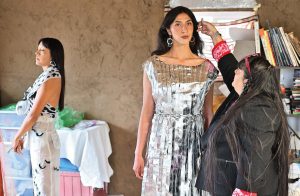
Adjusting Midnight’s hair to show off the mica and silver earring Michaels made, while Bear enjoys the warmth of the afternoon sun. Midnight is wearing a black pearl-motif dress in Devoré silk, rayon, and velvet. The dress, a bold fashion statement that combines hard and soft elements, is cinched at the waist with a wrought-iron belt, a nod to Michaels’ stepfather, a renowned blacksmith.
As an instructor, she starts each semester by asking students to introduce themselves by stating their name, heritage, and place of origin. The effect is immediate. “Suddenly, that person has all of her ancestry behind her; she’s coming with her whole tribe behind her, because she’s a survivor of that tribe.” Competition dissolves and the classroom quickly becomes a meeting of tribes. Fellow students are suddenly resources rather than rivals, which is vital because, she tells them, “Fashion is teamwork.”
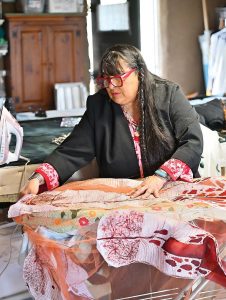
Michaels irons a silk gown using her intimate understanding of the delicate push and pull needed to coax the notoriously finicky fabric into high fashion.
She teaches what she knows to be true: that designers need to find their muse in their natural environment. And so, she sends them outside to get grounded. She talks about sustainability not as a trend but as an inherited practice: simple pattern pieces, no waste, slow construction. She teaches time management by reminding them that they are human and will make mistakes, which is imperative to the process. And she imparts the deepest lesson Nick Cave taught her when she first presented textiles based on what everyone told her to do. She recalls him saying, “I don’t even want to look at this. What is this, Patricia?” When she tried to explain that this was her Native American fashion collection, he replied, “So what? I’ve already seen this before. You are Native, and you are Patricia. You need to do Patricia.” And then he told her, if she ever showed him something like that again, he would never look at it.
“All of a sudden, the walls just crumbled down around me,” she says. “And this light came. He gave me the liberty to be me, and that’s what I try to give to my students because the minute he allowed me to be me was the minute I was a designer.”
For most of its history, the fashion industry’s engagement with Native American design was a story told by outsiders, a facsimile of cultural aesthetics stripped of meaning, and traded without permission or understanding. Michaels spent decades trying to enter a conversation that did not yet know it needed her. Recalling the time she was dismissed by the fashion houses in New York when she was 18, she says, “Of course, I wasn’t ready for them. They weren’t ready for me. It was all about throwaway fast fashion. We were never going to understand one another. It makes sense that I’m doing it now.”
With slow fashion on the rise, Indigenous designers are finally claiming space in the conversation. Michaels had won numerous awards for her fashion and her activism with such organizations as Missing and Murdered Indigenous Women and Relatives; Community Against Violence; the Indigenous Fashion Initiative; and the Preservation of Native Culture and Natural Resources. Her pieces are held in major museum collections, including the Peabody Essex Museum, which purchased 31 of her hand-painted parasols for its permanent collection. Finally, the world has caught up with what she has always been creating.
And so, as she paints silk at home in New Mexico, the yards of material unfolding across her studio floor, she meditates on the land and what her grandparents told her about slowing down and paying attention. “Take a moment to think about it,” she recalls them instructing her. “It’s nothing new. All the things that were important in the past are still important today.”
Patricia Michaels designs are available at Native Beauty, 631 Fifth Avenue, San Diego, CA 92101, and through her website at patriciamichaelsdesign.com.
Editor Rose Fredrick admits to being star-struck when talking to celebrity artists like Patricia Michaels, and she’s grateful that they share their very human stories.
Based in Santa Fe, New Mexico, photographer Daniel Nadelbach’s clients include Smithsonian, Whole Foods, Vogue Australia, Auberge Resorts, and Head Sportswear, among many others.
No Comments