


03 Jul Perspective: Agnes Martin [1912-2004]
In the 2002 film about Agnes Martin, produced by Mary Lance when the artist was 90, Martin looks mischievously at the camera and delivers this classic line: “Somebody once asked me what was my happiest moment painting? And I told them, ‘When they go out the door.’”
This may sound like the sentiment of someone who just doesn’t care for people or the world. On the contrary, in her later years when she lived in Taos, New Mexico, Martin was known around town as having a lively sense of humor and for being warm and generous. What her quote reflects is the fact that, throughout her long life, painting was an intensely personal, immediate, and meditative act; it was not something she could do with an audience. It was not even done for the sake of producing an object.
Instead, Martin’s gradually evolving iterations in line, color, and gesture were her way of shedding thoughts, ideas, and her own ego and opening into, as much as she could, a state of pure awareness, a state she likened to innocence. Along with many of her artist peers in New York City in the 1960s, she was influenced by Eastern philosophies including Zen Buddhism and Taoism, whose practitioners aspire to a state of peaceful, inner stillness. Painting was Martin’s meditation practice. As Jordan Carter, curator at the Dia Beacon in Beacon, New York, puts it, “She took egolessness and cultivating an empty mind to a singular end. Only the purest relationship with the practice is what is being articulated in her work.”
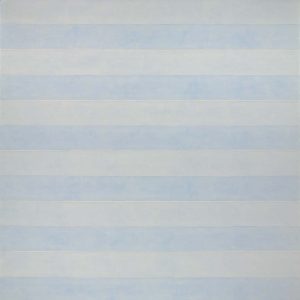
Untitled (Friendship) | Acrylic on Linen | 60.0625 x 60.0625 inches | 1993-1994 | Gift of the Artist. ©Estate of Agnes Martin / Artists Rights Society (ARS), New York, Photography courtesy of the Denver Art Museum, 1994.0011.0003
Martin’s early childhood on a farm in rural Saskatchewan, Canada, where she was born in 1912, may have instilled in her an affinity for the quiet of vast, open landscapes, which she rediscovered later in New Mexico. When she was seven, her family relocated to Vancouver, British Columbia, and in 1932 she emigrated to the U.S. to become a teacher. She studied at a teacher’s college in Bellingham, Washington, then moved to New York City to enroll in Teachers College, Columbia University.
In New York Martin encountered the work of modern artists such as Arshile Gorky and Joan Miró who were taking painting in new directions. She enrolled in studio classes at Columbia and began envisioning a career in art. In 1946 she traveled to Albuquerque to earn a studio art degree from the University of New Mexico. The following summer she took part in UNM’s field school in Taos and taught there in 1948.
“She was influenced by Taos as soon as she got here,” says Juniper Leherissey, executive director of the Harwood Museum of Art in Taos. “You see her experimenting with more muted palettes and moving into abstraction.” She was inspired by New Mexico painter Andrew Dasburg, the Cubists, minimalized landscapes, and other modernist influences.
Martin went back and forth between Taos and New York for several years, eventually completing her B.A. from Teachers College. In 1957, on the invitation of gallery owner Betty Parsons, an influential early champion of Abstract Expressionism, Martin returned to New York City and rented a loft in a part of Lower Manhattan called Coenties Slip. There her neighbors and friends included the artists Robert Indiana, Ellsworth Kelly, and Lenore Tawney. Abstract painter Ad Reinhardt became an especially valued mentor.
Martin’s years in New York were marked by continual artistic experimentation as she moved increasingly toward pure abstraction. She began developing the work for which she became best known: meticulously penciled grids covering a 6-foot-by-6-foot painted canvas, edge to edge. Each piece emerged as a subtle variation on the previous work in what Carter describes as a “durational, sensitive, and sensual connection with the painting … where you feel the sense of her groundedness and perception.”
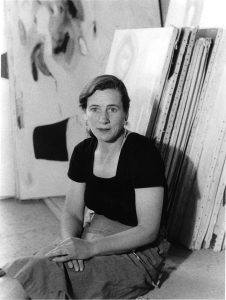
Agnes Martin in her studio on Ledoux Street, Taos, New Mexico | Mildred Tolbert | Photograph | 1955 | Gift of Mildred Tolbert. ©Mildred Tolbert Family | Collection of the Harwood Museum of Art
While Martin’s art has been called Minimalist, it stands apart from the prevailing approach to Minimalism at the time, and the artist did not see her work fitting into that box. Pure Minimalism attempted to eliminate any reference to emotion or external influences, often employing industrial materials to produce simple forms that represented nothing beyond themselves. Although Martin often used a ruler to draw lines, evidence of the artist remains. “She eschewed the idea of the impersonal. There are slight tremors of hand; it’s not perfect precision,” Carter says.
At least as important, while Martin’s goal was immersion in the process of painting unfiltered by thought, she was clear that emotion was an integral part of her state of being and that it was reflected in the art. In this sense, her work more closely aligns with Abstract Expressionism, to which Martin herself felt a greater kinship. In a video produced by Pace Gallery, New York, the gallery’s founder and Martin’s longtime dealer Arne Glimcher remarks, “These paintings are pure emotion.”
In her later years, Martin referred to this type of subtle feeling as abstract emotion, by which she meant it arises from no apparent cause. In Mary Lance’s film, With My Back to the World, Martin explains: “I say that I paint with my back to the world because if you woke up in the morning and you feel very happy about nothing, no cause, that’s what I paint about … And I’m hoping that people, when they respond to [the paintings], will realize that they make responses to the completely abstract, and that their lives are broader than they think.”
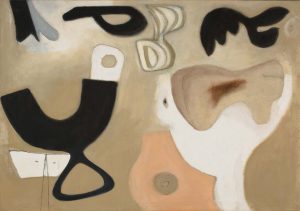
Untitled | Oil on Canvas | 33.5 x 47.5 inches | 1953 | Mildred Tolbert Collection, M.A. Healy Family Foundation Purchase Fund. ©Estate of Agnes Martin / Artists Rights Society (ARS), New York, 1993.0017.0000, Harwood Museum of Art Collection
In New York, Martin had been struggling for years with mental health issues diagnosed as schizophrenia that resulted in extended stays in a Manhattan psychiatric hospital. After her friend Ad Reinhardt died suddenly in 1967 and many of the buildings at Coenties Slip were slated to be demolished for new development, she decided to leave the city. She traveled for a while before settling in New Mexico where she began what became a seven-year hiatus from painting. Carter sees this period as an intuitive pulling back, a retreat into her interior world and a refusal to comply with external demands. She rented a 50-acre property near Cuba, New Mexico, and built herself an adobe home, living simply and austerely.
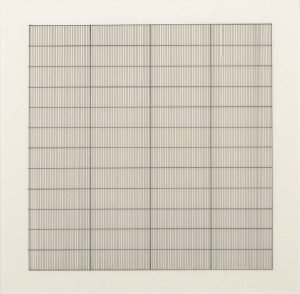
Untitled | Offset Lithograph on Vellum | 11.75 x 11.75 inches | 1990 | Gift of C. William and Eleanor Reiquam. ©Estate of Agnes Martin / Artists Rights Society (ARS), New York, 2004.0091.0006, Harwood Museum of Art Collection
Gradually her interest in painting returned. She approached Pace Gallery in New York; they represented her through the rest of her career and continue to represent her work. Beginning in 1974, after years away from the canvas, Martin’s paintings were a departure but also a continuation of her earlier work, Carter says. There was a shift toward horizontal bands or stripes of color and away from the grid. The use of a ruler was replaced by intuitively-drawn lines, with the bands in later years taking on varying widths.
In 1977 Martin purchased land near the rural village of Galisteo, New Mexico, and built an adobe home for herself. While solitude and simplicity remained her preferred lifestyle — and essential for her artistic and spiritual practice — she traveled, exhibited, and lectured at universities. Over her lifetime, Martin’s work was in dozens of shows around the United States, Canada, and abroad, and earned numerous honors and awards.
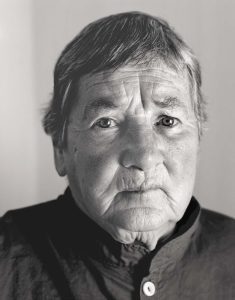
Agnes Martin ’94 | Paul O’Connor | Black and White Photograph | 1998 | Gift of Dr. Orrie M. Friedman, Harwood Museum of Art Collection
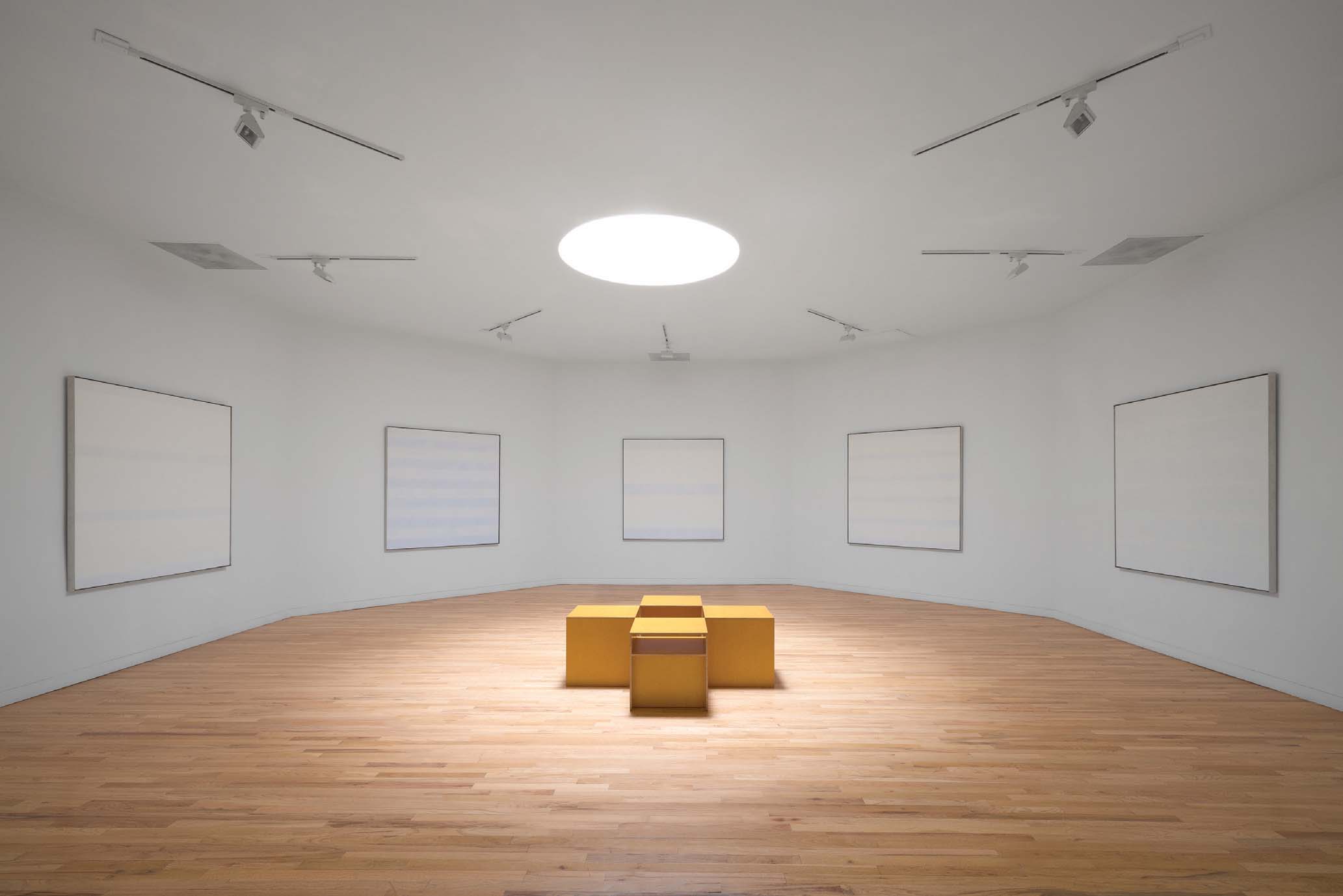
When Martin was 81, she moved to a retirement home in Taos. She decreased the scale of her canvases to 5-by-5 feet to make them more manageable, and continued to paint. Two years after a group of seven pieces was exhibited at the 1991 Carnegie International, she gifted them to the Harwood Museum of Art, where a permanent gallery was built specifically for them. She was closely involved in the gallery’s planning, indicating the order of the paintings on the walls and suggesting that benches designed by the artist Donald Judd be placed beneath the oculus in the center of the octagonal room. She later hand-wrote titles for the previously untitled paintings, including Friendship, Lovely Life, and Innocence. She would sit there often, quietly absorbing the feeling of her work in the serene space, Leherissey says.
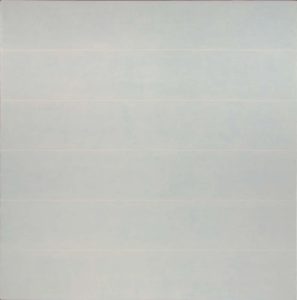
Untitled (Friendship) | Acrylic on Linen | 60.0625 x 60.0625 inches | 1993-1994 | Gift of the Artist. ©Estate of Agnes Martin / Artists Rights Society (ARS), New York, Photography courtesy of the Denver Art Museum, 1994.0011.0006
The artist spoke often of innocence. In another Pace video, Arne Glimcher remembers her as having the curiosity and openness of a child. “She saw everything as if for the first time,” he says. “It’s clear her search for beauty was also her confirmation of innocence.” At the same time, her place as a woman in an art world dominated by men was significant, Leherissey says. “She was able to establish her very unique expression amongst all of them. There were only a handful of women who were elevated and known to the extent she was.”
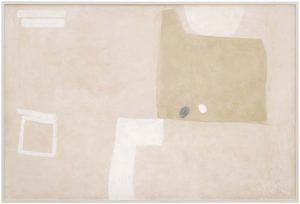
Untitled | Oil and Graphite on Gypsum Board | 48 x 72 inches | ca. 1957 | ©Agnes Martin/Artists Rights Society (ARS), New York, Photo: Bill Jacobson Studio, New York | Courtesy Dia Art Foundation
Carter describes Martin’s legacy as immense for other reasons as well. “She contained multitudes, which makes her such an enduring icon. She was not a Minimalist or Abstract Expressionist but was working in her own self-determined fashion. There are resonances with these other modes, but her work is deeply her own.”
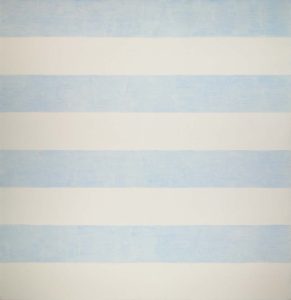
Untitled (Lovely Life) | Acrylic on Linen | 60.0625 x 60.0625 inches | 1993-1994 | Gift of the Artist. ©Estate of Agnes Martin / Artists Rights Society (ARS), New York, Photography courtesy of the Denver Art Museum, 1994.0011.0001
Referencing a year-long exhibition that opened in April at the Dia Beacon, Agnes Martin: Painting is not making paintings, Carter says he hopes viewers will understand that her art is not only about such visual elements as the geometry of grids or bands of etheric color. They are also about “the poetics of restraint. They teach us how to look, how to be present, and how to really find meaning in the quietness of gesture.”
After 30 years of writing about artists and other creatives, Gussie Fauntleroy remains fascinated by the life experiences and soul that intertwine in an individual and emerge as art. She has written for national and regional magazines, newspapers, museums, and galleries, has served as a book and magazine editor, and is the author of four books on visual artists.
No Comments