




03 Jul Western Landmark: Icon on the Bay
On a warm day in San Francisco, September 22, 1959, Senator John F. Kennedy delivered a convincing campaign speech to some 1,500 supporters at the Sheraton-Palace Hotel. Standing in the Grand Ballroom beneath Austrian crystal chandeliers, he spoke of a new frontier and the urgent need for national reform. Racial segregation and violence, he stressed, were tarnishing America’s reputation. Kennedy’s rousing admonishment was effective: Several months later he formally announced his candidacy for president.
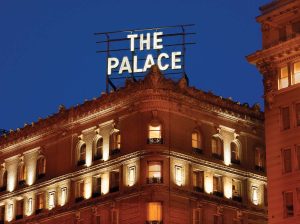
Its neon sign is a prominent feature of the historic downtown skyline. Photos courtesy of The Palace Hotel.
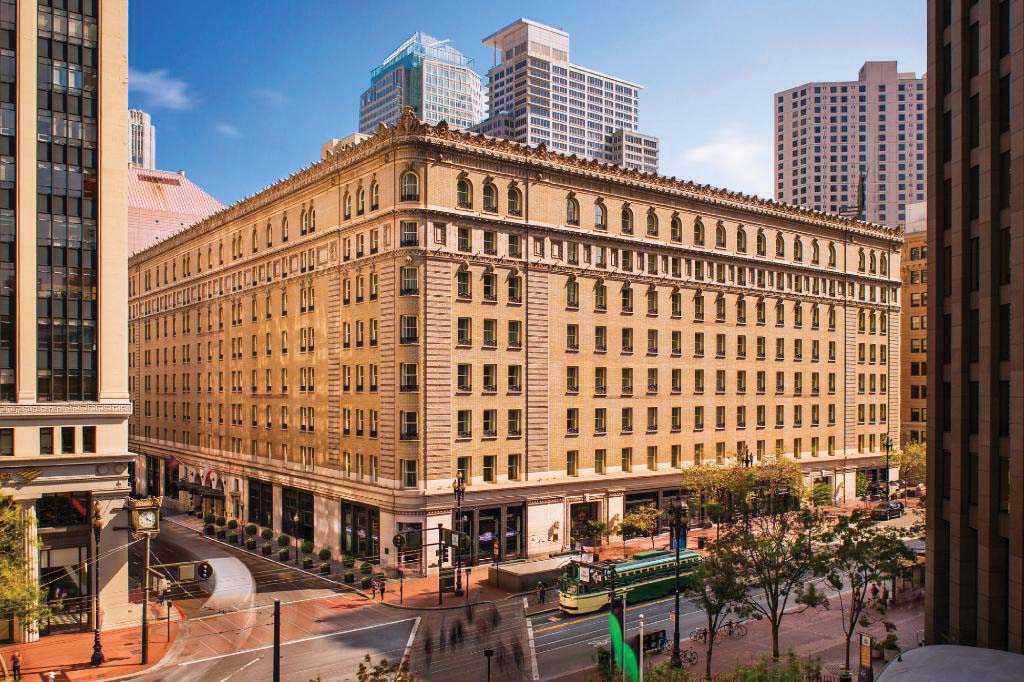
Affectionately known as The Palace, this icon has hosted more than a dozen U.S. presidents, plus royalty, celebrities, and captains of industry. With a pantheon of luminaries parading through, it is safe to say there has never been a dull moment. In 1887, French actress Sarah Bernhardt arrived with a tiger cub that allegedly escaped and then was found meandering down a corridor. In 1923, President Warren G. Harding died of a heart attack in the presidential suite right before the political corruption and bribery in his cabinet was fully disclosed.
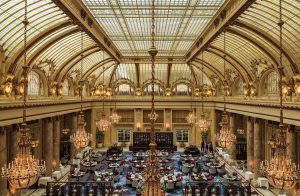
The Garden Court functions as a banquet space, restaurant, and party venue.
When it opened on October 2, 1875, the seven-story Victorian jewel built by silver magnate William C. Ralston for $5 million was hailed as the largest and most luxurious hotel of the Gilded Age. Ralston had hand-picked architect John P. Gaynor, known for adopting cutting-edge technologies, and flew him around the globe to investigate the most opulent hotels to make sure that Ralston’s Palace Hotel would exceed their grandeur. The Palace was among the first in the world to offer private toilets, fireplaces, and air conditioning in each of the 755 rooms. It was also the first in the West to provide hydraulic elevators, and a state-of-the-art intercom system that allowed patrons to summon hotel staff with the press of a button instead of having to ring a bell or shout down the hallway for assistance. Ralston’s passion and hubris led to financial ruin. Weeks before the opening of the hotel, he drowned during his regular swim in the San Francisco Bay.
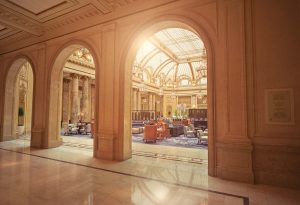
At dusk, sunlight streams through the dome, creating an intimate glow.
Ralston would have been proud of his opulent creation that took up an entire city block. He would have been heartbroken, however, decades later on April 18, 1906, when the great San Francisco earthquake and fire struck. In three days, the conflagration burned most of Ralston’s grand hotel to ashes.
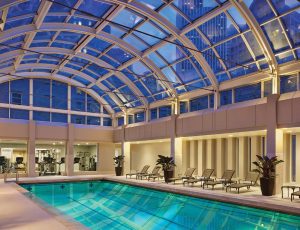
The pool’s curved glass ceiling hearkens to the Garden Court dome with a modern twist. Photos courtesy of The Palace Hotel.
On December 19, 1909, the new and improved Palace Hotel opened with fanfare. Ralston’s former business partner William Sharon had it rebuilt, this time for $10 million. The architectural team from Trowbridge & Livingston of New York took charge, figuring that Renaissance Revival architecture seemed more fitting than classic Victorian. The look-and-feel of extravagance remained. They replaced formal aspects of the old design, such as the Grand Courtyard where horse carriages came to drop off passengers, with the Garden Court. Instead of a simple glass ceiling in the old courtyard, the palatial space was crowned by a dazzling stained glass dome, 110 feet long and 85 feet wide and a little over 41 feet high. Such construction was an engineering feat.
Today, the Garden Court is listed with the City of San Francisco as Landmark #18, its only indoor landmark. When bellmen welcome visitors and open the wrought iron doors, travelers are mesmerized by the ethereal dome flanked by Italian marble pillars and stately trees. And via a complex cabling system, ten 700- to 750-pound Austrian crystal chandeliers that were original to the 1909 building, are suspended. In the daytime, filtered sunlight streams in through the panes, and at night, the chandeliers cast an amber glow.
Below the stunning panes of glass, Garden Court events have launched global headlines. In 1915, a lavish dinner honoring inventor and former telegraph operator Thomas Edison featured menus written in Morse Code, and guests had to tap their orders to the kitchen using tabletop telegraphs. In 1945, an inaugural banquet celebrated the formation of the United Nations.
And in 2026, in honor of May the Fourth, The Empire Strikes Back aired before a room packed with Star Wars enthusiasts. (Nationwide May 4th is nicknamed Star Wars Day and refers to the Star Wars line “May the force be with you.”) Clearly, that’s not as epic as an international union of countries, but these events prove the Garden Court will continue to be a beacon of joy and hope for present and future generations.
In 2017, a team of professional building cleaners spent six weeks wiping each of the 70,000 glass panes, front and back, with a foaming cleanser and the softest of terrycloth towels. After the cleaning was complete, the Garden Court dome offered a noticeable 30 percent more brilliance. The cleaners had to be hoisted up on a scissor lift; a photo of workers who appear to be gripping the dome, resembling acrobats out of Cirque du Soleil, can be found in the hotel’s onsite museum aptly named, Landmark 18.
Behind the scenes, General Manager Angie Clifton, stewards this two-acre historic property and its 556 guest rooms and suites, all while managing 433 employees. Clifton, who worked in management in 2017 and 2018, left, and returned in 2023 as the hotel’s top executive. As she explains, the care of a historic Marriott-managed property includes care for the associates, the customers, and the brand itself, but attending to the physical aspects of the hotel add another vital concern. “You must preserve what makes the Palace iconic,” she says. “It is this unique balance that makes the job incredibly rewarding.”
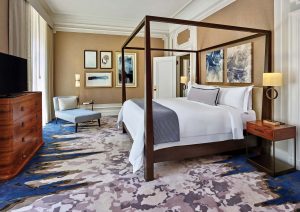
Staying in a one-bedroom suite with a separate living room is unforgettable.
This means making decisions to uphold historic prominence. The Palace, for now, does not use digital signage like other hotels. “We are trying not to overwhelm the beautiful architecture because the architectural elements remain central to the experience,” says Clifton.
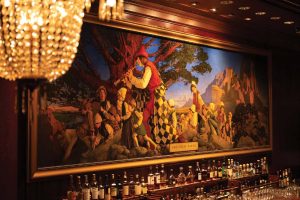
Maxfield Parrish’s The Pied Piper of Hamlin was almost auctioned off until the public demanded that it remain.
Safeguarding history also means that once or twice a year, professional polishers come to clean and buff the marble pillars and chandeliers. Sharing the Palace’s history includes displaying original china sets and early photos in public areas, along with a pair of throne-like chairs, gifted from the family of late King David Kalakaua of Hawaii who died of a long-standing illness in the hotel in 1891. His family was so touched by the kindness of hotel staff and management during his last days that they sent the chairs as a thank you. Meanwhile, the hotel’s Pied Piper Lounge features the 16-foot-long oil painting, The Pied Piper of Hamlin, commissioned in 1909 from American artist Maxfield Parrish. So beloved was that painting, that when the public found out it was to be sold at auction, the outcry was so vehement that the hotel kept it in its rightful place.
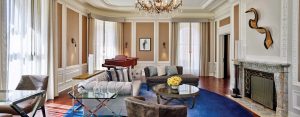
Celebrities and heads of state often book the presidential suite, which comes with a baby grand.
Modernization has come in phases. In 1989 after the epic Loma Prieta Earthquake, the hotel shut down for two years. It embarked upon a $150 million dollar restoration, which included updating the rooms with a new color scheme and furnishings, and installing a stunning indoor swimming pool with a glass dome atrium. Recently, Google Nest Hubs have been added to nightstands so guests can ask Google about services without having to call the front desk.
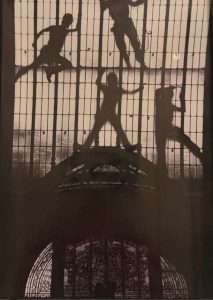
Cleaning the famous dome ceiling is like a Cirque du Soleil acrobatic feat. Photos courtesy of The Palace Hotel
What keeps customers returning, however, is not the hi-tech but the high touch. “We have a handful of employees approaching the 50-year mark,” says Clifton. “A hotel is a hotel is a hotel — it is the people who work here and the passion they have that makes it special.”
Clifton recalls a Palace employee’s encounter with a distraught visitor who had been wandering through the premises. Upon learning the woman was worried about her husband’s upcoming surgery, the staffer delivered a gift to her room. Afterwards, the guest sent a note saying that she had never been treated with so much kindness. “She called the other day and said that at every turn, there was a Palace employee who was pleasant and helpful,” Clifton adds. “Considerate things like this happen all the time. It’s not because we have to, nor is it done out of duty. It comes from the heart. Once people experience our service, they are fans for life.”
Reflecting on her career and her time at the Palace, Clifton says, “I am transformed every day I walk through these doors. When I speak to employees who have worked here almost 50 years, I am transformed. And the beauty of this place, it affects you. Everyone has to experience the beauty of the Palace. There is a reason I came back to the Palace. I do not want to leave; it is my home.”
Kathy Chin Leong is an award-winning journalist with works published in The New York Times, National Geographic Books, and many other publications. She lives in Sunnyvale, California with her husband Frank and daughter Gwen.
No Comments