




06 Mar Collector’s Eye: Seeing Eye to Eye
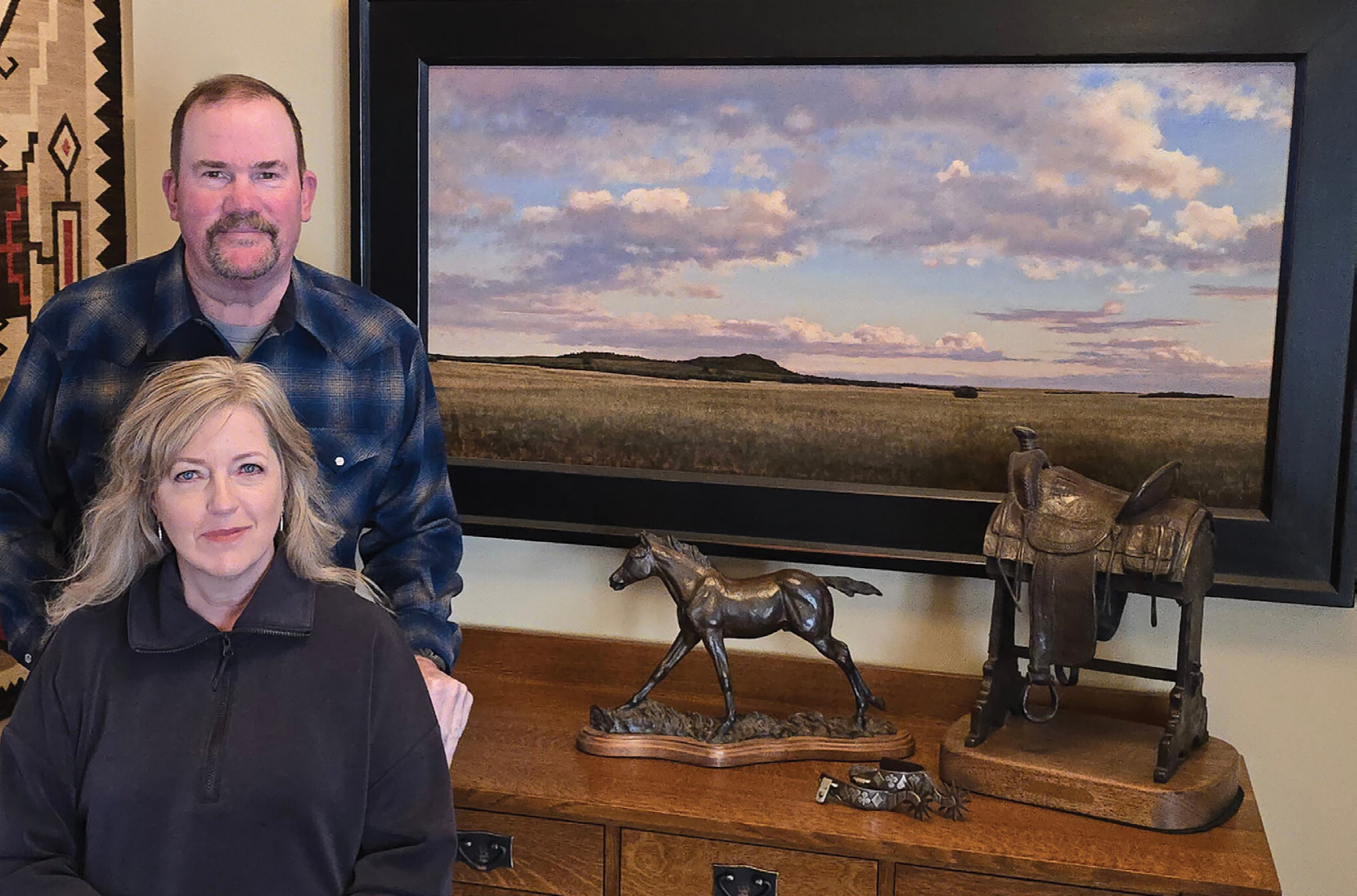
Jeff Ware started collecting Western art years before he met, by chance, artist Karmel Timmons. It didn’t take them long to realize a shared passion for art, which was just the start of a beautiful relationship.
We caught up with the busy couple who, when not traveling for art shows featuring Timmons’ intricate drawings, are often scoping out auctions and museum shows or happily chasing their granddaughter around their Sheridan, Wyoming, house that is chockablock with paintings, sculpture, and historic Western guns, blankets, tooled saddles, branding irons, and more.
WA&A: Jeff, you met Karmel at a Western art event, correct? Did you buy her art because you wanted to ask her out, or did you ask her out because you liked her art?
Jeff: True! We met at the 2013 Coors Western Art Exhibit & Sale. I was enjoying the buffet dinner, albeit standing up, when Karmel and her daughter, Chelsea, asked if I wanted to share their high-top table. Thus began a conversation about Western art that continues to this day. However, I wasn’t trying to acquire any of Karmel’s works that evening; my wish was to be the first name drawn for a Jeff Aeling oil painting of a landscape near Larkspur, Colorado. Karmel not only approved of my selection, but that was her first time being my good-luck charm; I was the successful buyer. We enjoy seeing that painting every day and remember the evening we first met.
Karmel: I recall asking to see his list of potential artworks, and I took no offense that I wasn’t on it. I quickly figured out that he liked landscapes, and when I learned he was a geologist, it all made sense to me. It’s true that of the 10 or so pieces he wrote down, the Aeling was my favorite, so that was a good sign for future collaboration on the collecting — and dating — front.
WA&A: What is it like to have an artist as your companion in life and collecting?
Jeff: Karmel’s knowledge, experience, and judgment are a wonderful skill set to have on hand, especially when there are multiple pieces of interest at a given auction, show, or gallery. Works must appeal to both of us, but her inside information can often tip the scales to one item or another, based on minute details that I don’t pick up on or artistic knowledge that I don’t have. That said, I managed to get by on my own for 15 years before meeting Karmel, so I would tell collectors, even if you don’t have a pro handy, don’t let that stop you!
Karmel: And Jeff’s knowledge has certainly been informative to me as an artist about how a collector might see a work of art or decide on why to buy something. That’s a perspective I hadn’t been exposed to during brief chats with potential purchasers at an art event. It hasn’t changed how I select my subject matter and create my art, but it has given me valuable insight into the view from the other side of the table.
WA&A: Do you two have guidelines or principles that steer your collecting?
Jeff: Karmel and I strive to acquire works that will bring lasting beauty and pleasure to our lives over the long term. And while we assume they will hold their value, too, we seldom buy primarily as an investment. If we admire a specific artist’s work, we may pay greater attention to opportunities involving that person, but generally we try to evaluate a piece on its own merits. Overall, works that offer natural, genuine glimpses of the American West dominate our collection. And we do our best to identify and avoid trendy fads or artists we believe are attempting to duplicate another true creator’s look.
Karmel: I will reiterate our desire to avoid artists that are derivative of an originator. As a student and practitioner in the field, I know who came first and must honor their trailblazing.
WA&A: As a couple, how do you reach consensus on pieces of interest? Do you have to agree?
Jeff: I typically review exhibition catalogues online first and highlight pieces that catch my eye. I then pass the list along to Karmel for her review. It usually doesn’t take us too long to settle on a handful of top choices. We never seem to have trouble finding pieces that we agree on, so the idea of pursuing anything that doesn’t speak strongly to both of us is a foreign concept. Ultimately, the proof is in the art itself. Reputable galleries or events will have things priced appropriately, and there is nothing better than a live auction to show you how much the market values a specific work.
Karmel: I’ve often marveled that we’ve never had any conflict about a certain piece. If I felt strongly about one, I’d make the case, but if he didn’t love it too, it’s probably not worth hanging in our house. We are running out of wall space as it is.
WA&A: How important is it to you to meet the artist?
Jeff: I really enjoy it when the artist can tell me a brief story that makes the piece more compelling and alive — something about the location, the circumstances, the people involved, anything. That said, we buy the art, not the story.
Karmel: From my perspective as an artist, I love meeting people who are interested in why and how I made a drawing. I honestly don’t get out a lot — we artists live such solitary lives — so I like meeting people who are truly interested in art.
WA&A: Karmel, you know many artists. Do your friendships drive collecting in any way?
Karmel: I think I’ve built stronger friendships with some of my fellow artists because of Jeff; he’s very good about keeping in touch with people, and I am terrible at it; I’m busy drawing. We don’t buy artwork just because it was created by a friend, but we certainly enjoy acquiring a quality piece that comes from people we know and like, and life is just better for all when it works out that way. It certainly gives a piece more meaning to us when it comes from the mind, heart, and hands of a friend.
WA&A: Do you have any tips or advice to share with our readers who want to start collecting fine Western art?
Jeff: Attend quality events and visit galleries without feeling obliged to buy — just go to enjoy and absorb knowledge. When ready to purchase, stay within your means, buy something you truly like, and display it where you can see it daily. Plan future purchases by considering what appeals to you in the long term, and find pieces that fit your life, space, and budget. Purchase and display items you can appreciate every day, and if you enjoy collecting, gradually increase your budget. Investing in beauty is fulfilling, and gifting art is rewarding. Finally, be sure to tell your kids what you’re doing and why.
Ann Glaser is a Colorado art advisor and writer focusing on contemporary artists of the American West.
No Comments