


06 Mar In the Studio: Where There is Fire
Chaos.
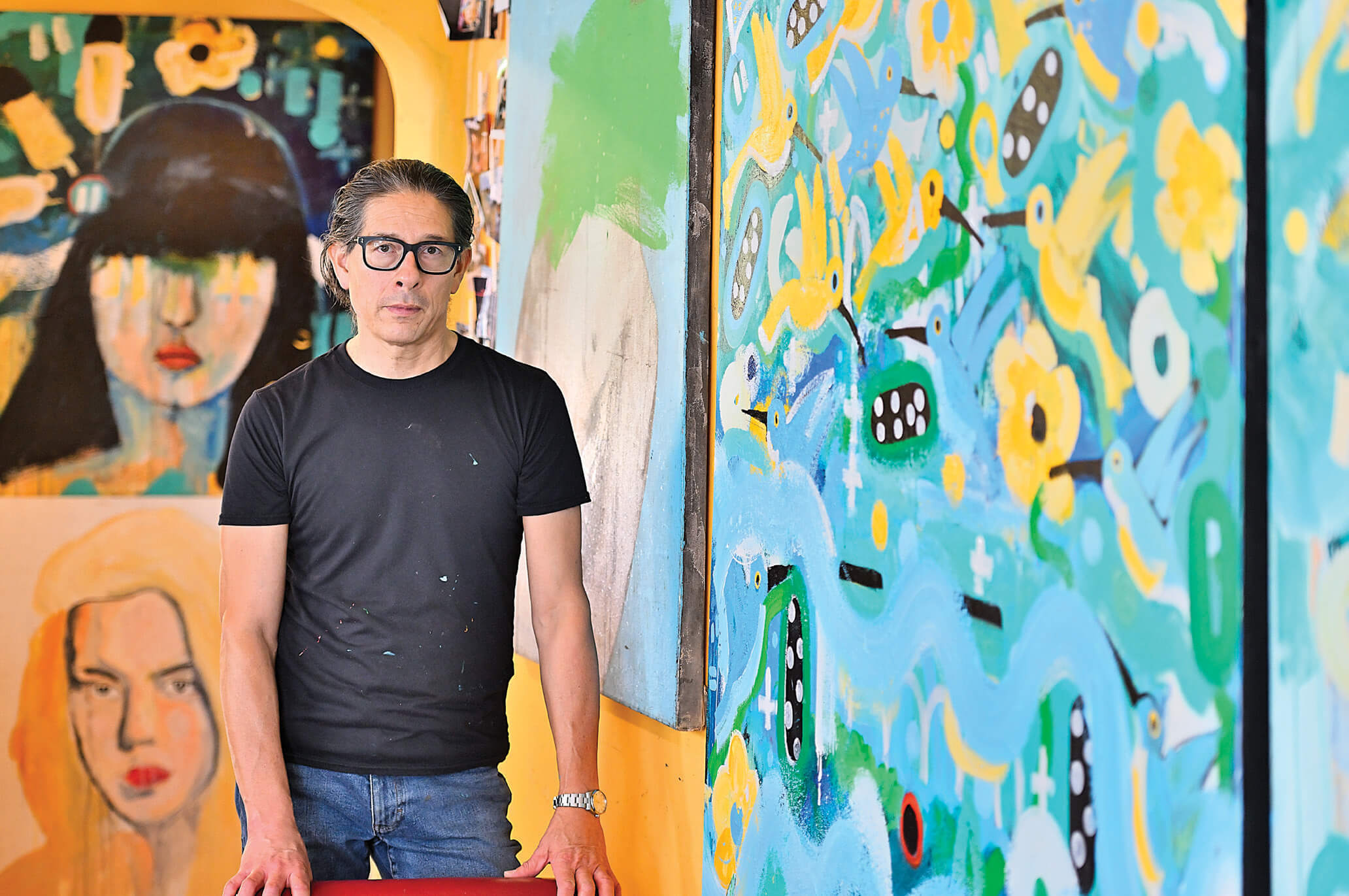
That’s what comes to mind in painter/woodcarver Gregory Lomayesva’s living room — aka studio — in the South Capitol neighborhood of Santa Fe, New Mexico. Even Lomayesva calls his routine chaotic, complete randomness. “You bounce around a bunch of things and suddenly it’s, ‘I’m going to do this.’ That, and massive amounts of coffee.”
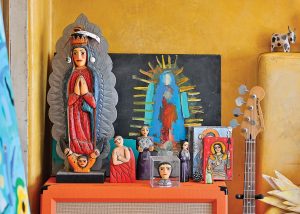
A shrine dedicated to his mother, Marie Romero Cash, contains some of her artwork.
It’s especially chaotic on this cold winter morning. The heating unit has gone out, so Lomayesva, coffee cup in hand, warms himself by the fireplace in the living room that has doubled as his studio since 2008.
The room’s certainly colorful, about 25 by 14 feet in a 1940s house of roughly 1,625 square feet. Paintings and wooden carvings fill the space along with a collection of artwork from Lomayesva’s mother, renowned santera Marie Romero Cash. Acrylic paint is everywhere, including spots on the hardwood floors, even surrounding the “highbrow electronic stuff” he bought for his musical career (he plays keyboards). “I didn’t have the money to buy a vacuum tube to record like the Beatles, the good stuff,” he says, so he taught himself, funding that obsession with sales from his artwork.
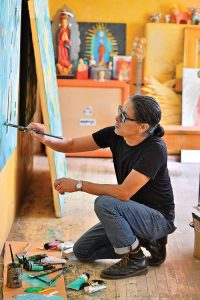
“This is how I do work,” Lomayesva says. “I plop a painting on the floor and go at it.”
“I don’t do any messy stuff, other than painting, in here,” he says.
Well, he did tear out his kitchen, and sometimes paints there, too. Woodcarvings and grinding are done in the garage, off limits on this day. “It’s under a mountain of sawdust,” he explains.
It wasn’t always this way. Born into an artistic family (his father is Hopi artist Bill Lomayesva) in 1971, Lomayesva dropped out of high school after his sophomore year and headed to California, working in an art gallery before returning to Santa Fe to make his mark in the city’s competitive art world. He rented a 2,000-to-3,000-square-foot studio on Baca Street before a sellout show at Peyton Wright Gallery earned him enough money to make a down payment on this house in 2006. “That was the one good thing,” he said of his don’t-think-things-through decision-making process. “And not buying a Porsche.” The Pueblo Revival home sits on a dead-end, narrow street, typical of Santa Fe, with adobe walls, coyote fences, and minimal spaces for parking. Major, an “eccentric” hybrid pitbull Lomayesva adopted three years ago, is in the back yard, waiting to come inside. “A lot has gone on in this room, from love to loss, happiness, darkness,” Lomayesva says. “It’s been nice to have this smaller, more intimate space. My [Baca Street] studio was industrial, and it’s a totally different vibe being here. And being able to have a cup of coffee that you made in your pseudo-den and walk back in … that’s been nice.”
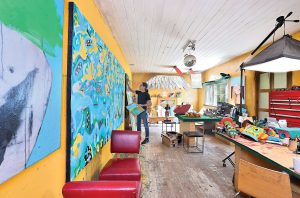
Lomayesva makes paintings and paints woodwork in his studio with a disco ball and music equipment on hand.
So is a relaxed pace. “My career started with artists my age,” he recalls. “It was always heavy competition … ‘I’ve got this museum show.’ It’s so nice now that all of that is irrelevant and instead of competition, it’s finding out who you are. At least, for me.” He’s still finding out.
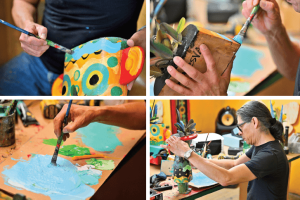
Mixing his paints, aqua blue, disco green, cerulean blue; at work on a small-to-medium mask for a museum gift shop. Lomayesva’s “pre-manicure phase” on a wooden doll; and working on a woman doll. “I’m starting more to treat my woodwork like paintings,” he says, “not decorated dolls, but with strokes of paint.”
“Most artists, Native American included, when they find something that wins, they stick with it. I just can’t, just can’t do that. I’m always asking that horrible question of Why?” His woodwork, sold mostly at museum shops, are more abstractions that represent Hopi and different Pueblo tribes, he says, while his recent postmodern acrylic-on-canvas paintings have focused on women’s faces. “It was just what came out,” he says. “I think I was trying to impress this girl.”
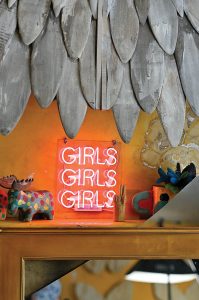
Wings, an early 2000s carving “combines influences from Spanish Colonial saint-making with Native American eagle wings,” he says, and hangs over Lomayesva’s beloved fireplace.
What’s next? “I’m by no means a realist painter,” he says, “but I think that’s what I’d like to do, teach myself.”
After all, Lomayesva’s career has always been partly rediscovering himself. “I used to change my style for every show,” he says, “so every show would be different. I don’t know what I want to do quite yet. I don’t want to be a Native artist all the time.”
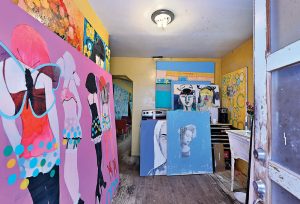
Cupcake Girls, left, and other paintings are stored in “what’s supposed to be a kitchen, but it’s not yet.”
One thing is certain, though. The living room, or what’s left of a living room, has become what he calls “my little reservation in the middle of Santa Fe.”
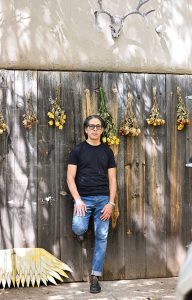
Lomayesva stands in front of the doors to the studio, with a smaller version of Wings at his feet and flowers drying out behind him. “I love flowers,” he says.
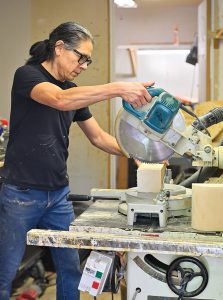
At work with a table saw in his woodworking shop, aka the garage, where “all the other goodies are.”
“There is just something about morale and the fire — and the fireplace,” he says. “That’s why they always say about survival: ‘Build a fire.’ Alright, now you have fire, so now where are you going? I love working by my fire.
“No matter what I do with my life, this room will always have to be my studio,” he adds. “The light, when it passes through, it’s a wonderful place to work.”
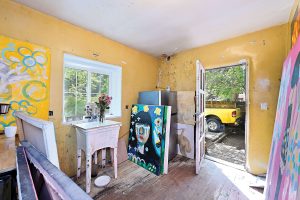
Another view of the kitchen, “the room where I paint the most,” he says.
Where all that chaos disappears.
Santa Fe writer Johnny D. Boggs has won a record nine Spur Awards from Western Writers of America and been called by Booklist magazine “among the best western writers at work today.”
Based in Santa Fe, New Mexico, photographer Daniel Nadelbach’s clients include Smithsonian, Whole Foods, Vogue Australia, Auberge Resorts, and Head Sportswear, among many others.
No Comments