


06 Mar Perspective: An Immersive Experience
Bailey Placzek, curator of collections for the Clyfford Still Museum in Denver, was relaxing at home one day a few years ago, listening to instrumental, ambient music with her eyes closed. “All of a sudden, one of Still’s paintings popped into my mind. I wondered, ‘Why this particular painting?’” recalls Placzek, who has been involved with the art of Abstract Expressionist painter Clyfford Still since before the museum opened in 2011.
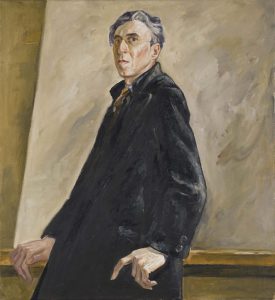
PH-382 (Self-Portrait) | Oil on Canvas | 41.5 x 38.125 inches | 1940 | Clyfford Still Museum, Denver, CO. ©City and County of Denver / ARS, NY
Other questions quickly followed. If a piece of abstract music/sound brought a specific painting powerfully to mind for her, what about the other way around? How might professional sonic artists use abstract sound interpretations to express their response to abstract visual art? This was the genesis of an idea that became the exhibition Still in Sound, opening May 16 at the Clyfford Still Museum and running through Jan. 10, 2027. Co-curated by Placzek and British multidisciplinary artist Ben Coleman, the show features sound creations by five internationally acclaimed sonic artists, paired with paintings by Still.
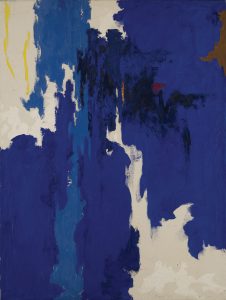
PH-160 | Oil on Canvas | 49 x 37.125 inches | 1957 | Clyfford Still Museum, Denver, CO. ©City and County of Denver / ARS, NY
When the Clyfford Still Museum was established, it was with the explicit mandate, expressed in the artist’s will, that it house only works by Still. Since its opening, the museum’s director and staff have sought out innovative ways to engage the public and present a single artist’s creations through fresh perspectives. Among other approaches, external scholars and such artists as painter and filmmaker Julian Schnabel have been brought in as guest curators.
Placzek’s concept of sound interpretations turned out to be an especially fitting way of presenting the work. The painter himself aspired to invoke an encompassing and completely subjective experience in the viewer, especially with his large-scale works, Placzek says. He firmly believed each individual’s response to his art was equally valid, with no interpretation more legitimate than any other. It was the mindset of an artist who took his job, and the role of art in the world, extremely seriously, holding himself and fellow artists to exceptionally high standards.
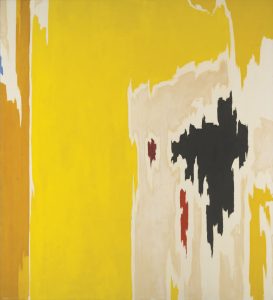
PH-1074 | Oil on Canvas | 114.625 x 104.625 inches | 1956 | Clyfford Still Museum, Denver, CO. ©City and County of Denver / ARS, NY
Clyfford Still’s strong work ethic and intense dedication to his art arose, at least in part, from his early 20th century farm upbringing. Born in 1904 in North Dakota, he was raised in Spokane, Washington, and southern Alberta, Canada. In 1925 he briefly attended the Art Students League in New York before continuing his art education at Spokane University and then obtaining his MA from what is now Washington State University. There he began his teaching career.
He was a highly influential professor who also taught at the California School of Fine Arts in San Francisco (now the San Francisco Art Institute) and in Virginia. “He was a catalyst for his students. He inspired them by how steadfast he was and by his ideals,” Placzek says. He was also known as eccentric. “We hear accounts from his students of times when he’d come to the front of the room and just start talking about philosophy, big subjects, and then pick up his coat and leave,” Placzek says.
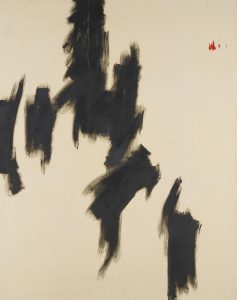
PH-63 | Oil on Canvas | 83.875 x 66.75 inches | 1962 | Clyfford Still Museum, Denver, CO. ©City and County of Denver / ARS, NY
Yet Still was fully dedicated to the mastery of his craft and to following where inspiration led. As early as the late 1930s, he moved away from representational painting and into abstraction. During the early 1940s, as he was teaching in San Francisco, he began developing what became his signature abstract style. This placed him at the leading edge of Abstract Expressionism, whose best-known artists including Jackson Pollock and Mark Rothko did not entirely abandon figurative elements until several years later.
In the 1940s and ’50s Still moved several times between the East and West coasts, living in New York City for most of the 1950s during the height of the Abstract Expressionist movement. Along with Pollock and Rothko, his contemporaries included Willem de Kooning, Lee Krasner, Joan Mitchell, Robert Motherwell, and Grace Hartigan. While in New York, he became associated with the two galleries at the heart of the movement, Peggy Guggenheim’s Art of This Century and the Betty Parsons Gallery.
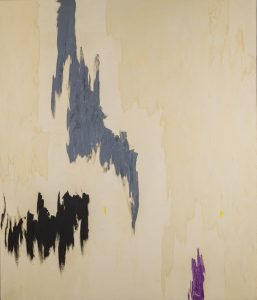
PH-1161 | Oil on Canvas | 107.75 x 92.125 inches | 1960 | Clyfford Still Museum, Denver, CO. ©City and County of Denver / ARS, NY
But in the early 1950s, even as he was becoming known in the modern art world, Still was growing increasingly critical of that world. While he saw his elevated standards as a model for others, he witnessed artists being critically recognized and commercially rewarded for work he did not believe met those standards. “I think he believed so highly in the potential of what art could achieve that any time it was used for less lofty means or anything less than pure, genuine reasons, he was disgusted,” Placzek says.
From 1952 to 1959 Still removed his art from commercial galleries and declined all public exhibitions, although he continued to work with some dealers and collectors. In 1959 he relaxed his stance, allowing the Albright-Knox Art Gallery in Buffalo, New York, to host the first comprehensive retrospective of his work. Other exhibitions followed over the years at institutions including the San Francisco Museum of Modern Art and New York’s Metropolitan Museum of Art. Yet Still kept his distance from the modern art scene, leaving New York in 1961 and moving with his wife to a farm in rural Maryland. A few years later the couple bought a home in Windsor, Maryland, where he remained until his death in 1980.
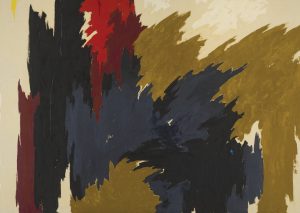
PH-389 | Oil on Canvas | 113 x 159 inches | 1963–66 | Clyfford Still Museum, Denver, CO. ©City and County of Denver / ARS, NY
In the artist’s will, written in 1978, he offered to bequeath his entire body of work and archives (aside from what he left to his wife) to any American city that would build or acquire a space to permanently house his collection, and only his work. He also mandated that none of his art would be sold, given away, or exchanged, but would remain in perpetuity for exhibition and study. Denver offered to be that city, and in 2004 Still’s widow agreed. Brad Cloepfil of Allied Works Architecture designed the cast-concrete contemporary art space, and the independent nonprofit Clyfford Still Museum received some 825 paintings and 1,575 works on paper, along with extensive archival materials including the artist’s complete record collection.
Placzek points out that with any exhibition and on an ongoing basis, Still’s art is presented in ways that highlight its visual and visceral impact. “I’m still amazed by how his work seems to change when you view it over time,” she says. “I notice new things about it every time because it’s not tied to one interpretation — it depends on the day, how I’m feeling, the light in the gallery.” This quality, she believes, lends itself well to pairing his paintings with sound. For Still in Sound, she engaged Coleman as co-curator, knowing of the Denver-based artist’s familiarity with both the sonic art world and the complex technological requirements of such an undertaking.
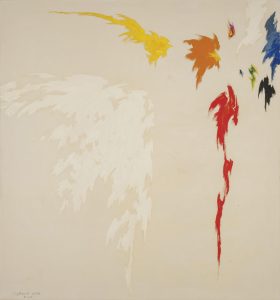
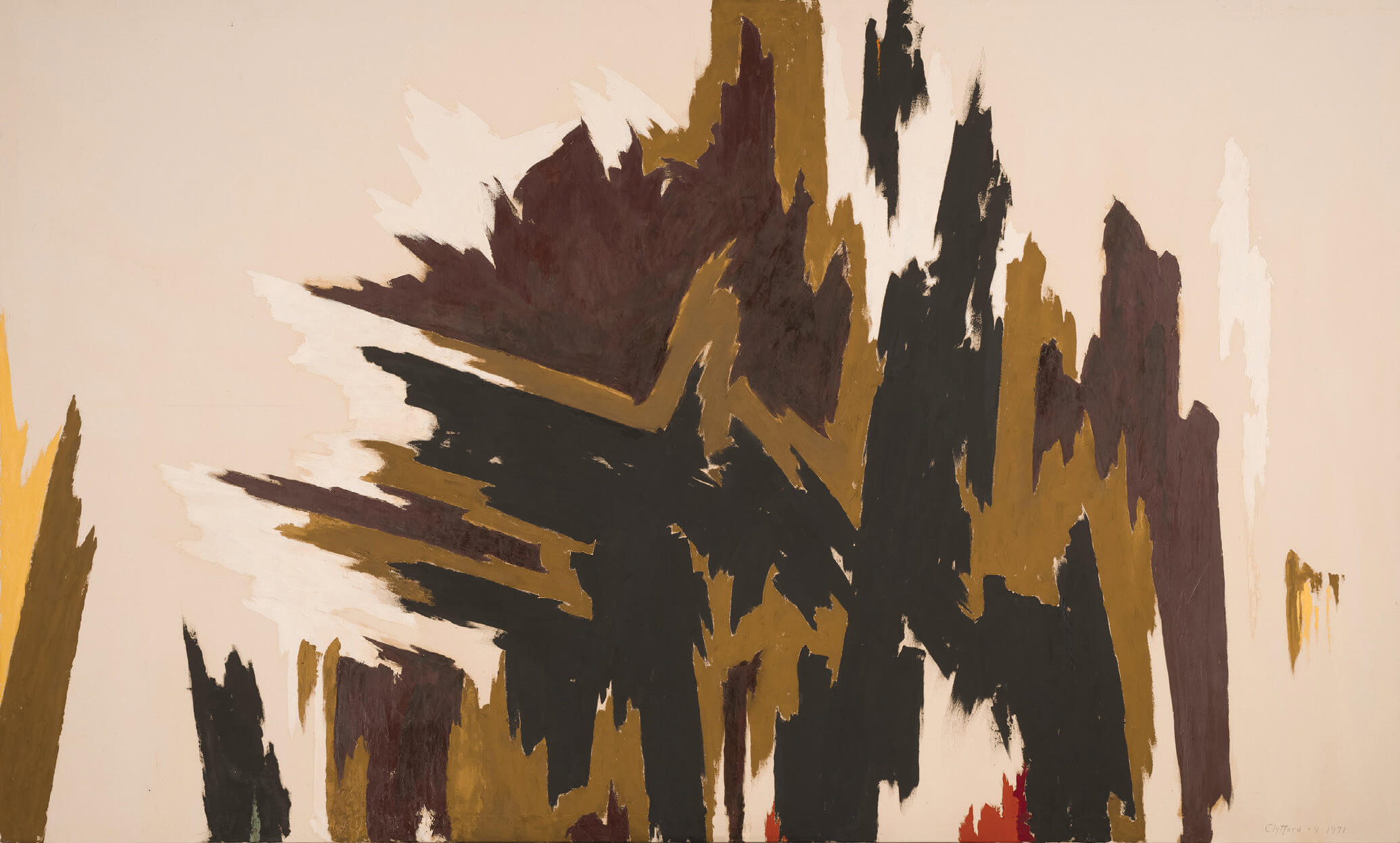
PH-712 | Oil on Canvas | 83.75 x 78.125 inches | 1970 | Clyfford Still Museum, Denver, CO. ©City and County of Denver / ARS, NY
Coleman began by selecting five of his favorite sonic artists representing a broad range of styles, techniques, and source materials. The artists were invited to the museum, each choosing one painting from a few dozen preselected by Placzek. They spent long stretches of time with the painting. They dug into the Still archives, which along with the painter’s music collection contains such treasures as recordings of Still on his typewriter, playing a piano, and laughing with his wife on the phone, sounds the artists were free to weave into their creations.
Coleman notes that there were no restrictions placed on the artists. Some of the interpretations lean toward the percussive while others are more traditionally jazzy, reflecting Still’s taste in diverse jazz forms. One artist with a background in rap combined snippets of Still’s voice with her own. Another recorded bird songs in Denver and incorporated them into her piece.
Part of Coleman’s role was to engineer a soundtrack system using overhead speakers in the spaces where a featured painting is paired with its sonic interpretation. Then he choreographed the totality of the sound experience, shuffling the tracks “in a very dynamic, playful way,” he says. Although for the most part only one composition is playing at a time, the museum is very open, meaning sounds from other rooms are audible to some extent throughout the space. “There are occasional points of sonic overlap,” Coleman says, “but they’re infrequent and actually very delightful when they happen.”
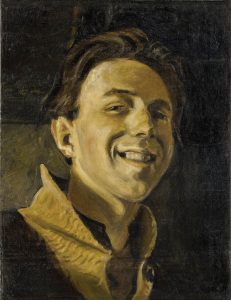
PH-752 (Self-Portrait at 19) | Oil on Canvas | 16.875 x 13 inches | 1924 | Clyfford Still Museum, Denver, CO. ©City and County of Denver / ARS, NY
In a nod to Still’s resolutely independent spirit, the visitor experience is also completely non-guided, Coleman says. Some may choose to follow the sound by moving between galleries according to which one has a sonic piece playing. Or they may be visually drawn to a particular painting and spend time with it, even if its companion soundtrack is not playing at that moment.
For her part, Placzek observes that what she responds to in Still’s art is “how full-body and immersive it can be, stimulating emotions, feelings, sensations. I think there’s this sense that the works can’t be explained in words.” She adds that the artist himself was continually searching for ways to help people understand that the meaning behind the work is the experience itself. As such, Coleman says, “I think he would be into the spirit of this show.”
Still in Sound can also be accessed via the Bloomberg Connects app, offering anyone access to the sonic compositions in their entirety, along with interviews with the sound artists and images of Still’s art at clyffordstillmuseum.org.
After 30 years of writing about artists and other creatives, Gussie Fauntleroy remains fascinated by the life experiences and soul that intertwine in an individual and emerge as art. She has written for national and regional magazines, newspapers, museums, and galleries, has served as a book and magazine editor, and is the author of four books on visual artists.
No Comments