

06 Mar Rendering: Enduring Legacy
Since opening his firm, Tryba Architects, in 1988, David Tryba has had a lasting and profound influence on his hometown of Denver, Colorado, and beyond.
After graduating in 1981 from the University of Colorado Denver College of Architecture and Planning, Tryba began professional practice in the Denver office of Gensler, one of the largest firms in the U.S. He then moved to New York, where he worked for five years as a design architect with Beyer Blinder Belle (BBB), a firm known for its commitment to preservation and adaptive reuse of historic buildings. By then, James Marston Fitch, the founder of the first program in historic preservation at Columbia University and the acknowledged leader of the American preservation movement, was also a partner at BBB, so as a young architect, Tryba gained an early grounding in preservation and the long-term cultural value of the built environment.
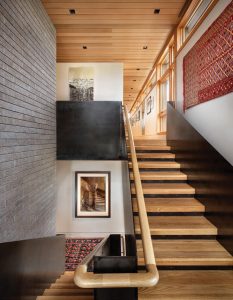
Gallery proportions and carefully controlled daylight organize movement through the house, guiding the experience through art, light, and views.
Yet Tryba’s heart remained in the endless expanse of the West, especially Colorado, where vistas from the Rocky Mountains to the vast prairies and high deserts are a fundamental element of Western architecture.
Upon returning to Denver, he opened his eponymous firm in the historic Daniels and Fisher Tower. The country was recovering from a deep recession — no one had the money for new builds — so much of his work involved repurposing historic buildings. In the ’70s and ’80s, a large swath of historic downtown Denver had been razed for urban development; by the time Tryba returned, that development had come to a standstill. This widespread demolition of old buildings only to be replaced by modern, international-style buildings was not unique to Denver, nor was the resulting erasure of years of beautiful architecture in so many downtowns across the country. Modernism — as opposed to contemporary design — Tryba believes, had gone from a revelation to monotonous conformism.
Seen from across the lake, the residence reads as a series of volumes oriented toward the water. Photos: Gibeon Photography
The entry is conceived as a processional sequence rather than a single moment. The approach introduces art and light, orienting movement through the landscape toward the home, the courtyard, and lake.
“It’s not about conformity and throwing everything away, which is what Modernism did,” Tryba says, pointing to standout buildings that were both modern and beautiful. “Frank Lloyd Wright designed the Guggenheim Museum. You can walk for miles up and down Fifth Avenue, and all the buildings form a singular street wall. They all defer to one another in that wonderful way that makes Fifth Avenue powerfully coherent. But then Wright inserted a radically different, circular form into the urban fabric, and it was brilliant. It’s absolutely perfect.
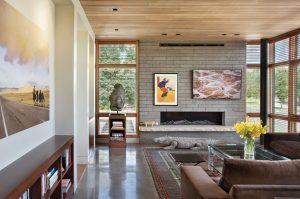
The residence is shaped by its relationship to the lake and to the central courtyard. These anchors organize light, views, and daily movement, reinforcing the connection between interior and nature.
“In more advanced cultures, there is an understanding of how new buildings relate to the whole of a city. Walking through Paris, London, Boston, or Philadelphia, you perceive and understand the incredible importance of continuity. There are extraordinary exceptions, like in Paris, the Eiffel Tower, or Notre Dame, but there’s a continuity and respect for urban coherence that allows incredibly special moments to happen.”
Of course, Tryba points out, you don’t want an entire street of exceptions. “We have to be careful that we don’t build cities out of Guggenheims, but that’s what has happened in the contemporary city. And that’s why it’s important for the balance of historic preservation, to bring old buildings to life in a new way so they can hold together the object-driven architecture that has severely fragmented the contemporary city.” And he adds that this trend in the United States has led to the Westernization of much of the world. “It doesn’t matter if you’re in the Middle East or China; it’s often mostly the same. A constant ‘Look at me’ architecture.”
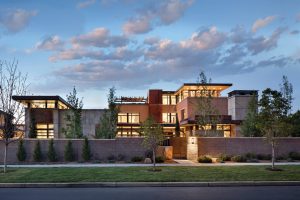
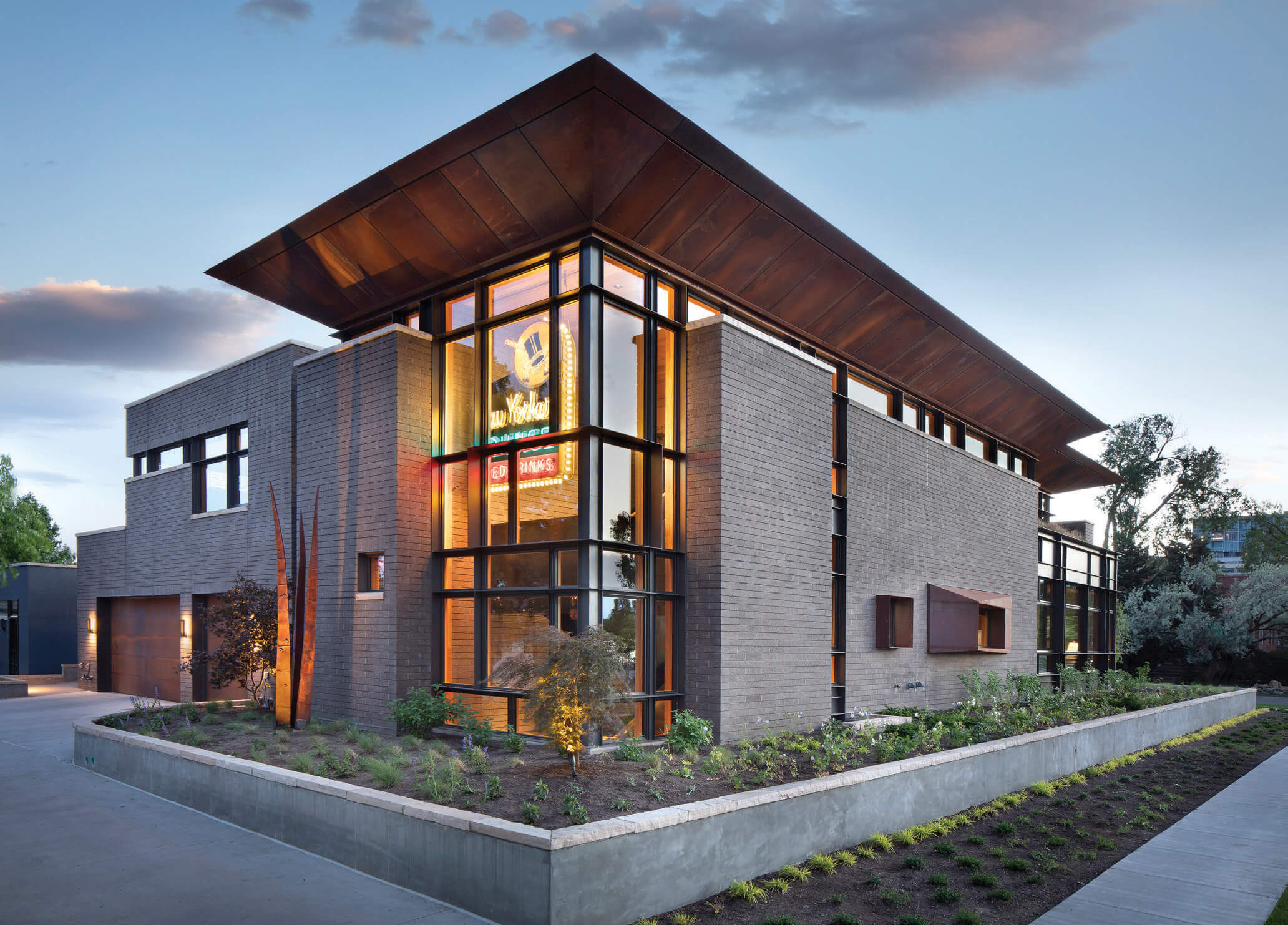
The 14,300-square-foot Western Residence & Gallery is organized around a central courtyard that unites private living spaces and art gallery areas. The project steps in height to upper levels, where rooms and terraces are oriented toward views of the Rocky Mountains.
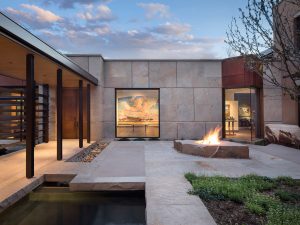
From the point of arrival, visitors move across the courtyard toward the gallery, passing over water, alongside fire, and beneath open sky, a sequence that prepares entry into the art collection and its themes of the American West.
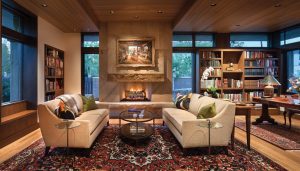
The living and library space is anchored by a locally sourced stone hearth, with layered views through the windows to a native grove of aspen.
Over nearly four decades, Tryba Architects has developed and demonstrated an architectural and urban language capable of making bold insertions into the urban fabric while strengthening the coherence of the city as a whole. “The professional part of being an architect,” Tryba says, “is very much like doctors who take the Hippocratic oath — first, do no harm. And I think we’re dangerously close to losing that responsibility as a profession.”
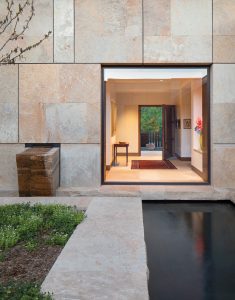
The courtyard’s stonework and fountain introduce a quiet sense of compositional movement. Photos: Gibeon Photography
Across a body of work in the American West that includes both private residences and public buildings, Tryba has applied the same set of ideas to new construction as to preservation: close attention to context, regional materials, and the relationship between individual buildings and the larger urban fabric. “There’s a gravitas that is embodied in the language of architecture,” he says. “And because the West has so much space, our ability to connect with nature is immediate. That’s one of the things that distinguishes Western art and architecture. And so, just the opportunity to be in tune with that has everything to do with entry, arrival, procession, and the transformation of a person’s experience as they walk through the door.” Whether in public buildings or private homes, Tryba returns to these ideas of entry, procession, and transformation as central elements of the architectural experience.
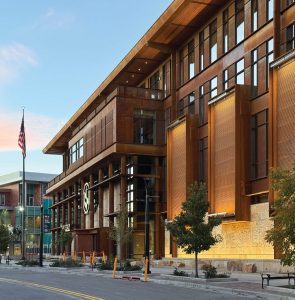
Composed of durable materials associated with the working landscapes of the West, the building’s exterior emphasizes solidity and longevity, aligning the new construction with the historic.
“Almost everything we do is organized around the courtyard and open space,” he explains. “That’s one of the themes, connecting the inside with the outside and having natural light for at least two, if not three, sides of every room. So, you’re really feeling the day, the season, and the connection to nature.”
“Entrance,” he adds, “always relates to a larger concept of the site and the entry itself is only a small component of the whole idea of arrival and procession. In Manhattan, you walk up a set of stairs from the sidewalk, and there’s a two-foot-deep recess, then you open the door. It’s that turn-of-the-century stone threshold that makes you feel like you’ve gone from one world to another. In the West, where we have a lot of space — and space relates to time — so the idea is to take the time to go from one world and prepare yourself to enter the next world through the door of your home or civic buildings.” This principle is well illustrated in his redesign and revitalization of Denver’s Union Station as a monumental entry threshold/gateway to the city.
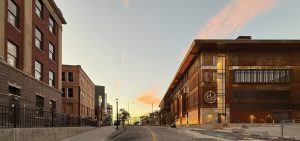
The Legacy was designed in direct response to historic Livestock Exchange buildings built from 1898 to 1919. Its scale and material palette reinforces continuity across 120 years of Western heritage. Photos: Tryba Architects
The firm works from a set of six design principles that guide projects across scales, starting with the generous use of light and the delicate arrangement of the program around light and views to the site, the time of day, and the seasons. “At the same time, defining the structure, columns, beams, and walls shapes how the building serves the program,” he says. “The careful choreography of weaving circulation through time and space animates the static components of site, program, and structure. And finally, the importance of meticulously crafting the building exterior envelope with transparency or enclosure to reveal, frame, or protect the interior program. When these principles are fully executed, and in harmony with each other in three dimensions, architecture is transformed into art.”
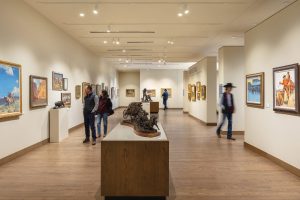
The Katherine and J. Robert Wilson Art Gallery is a permanent home for the National Western’s art collection. The gallery supports year-round public access and accommodates both permanent installations and rotating exhibitions. Photo: James Florio
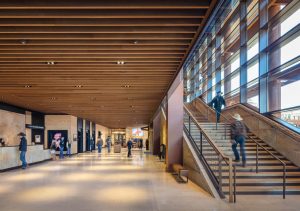
Opened in 2026, the Legacy is a 115,000-square-foot home for the Western Stock Show Association, at the heart of the National Western Center in Denver, Colorado. The ground floor includes the Legacy Saloon, the Wold Family Heritage Center, and the Katherine and J. Robert Wilson Art Gallery. Photo: James Florio
As to what makes a good design, Tryba says, “Certainly listening to the client, but also to the site, hearing what the site or the context might reveal throughout the day and throughout the seasons. What are the aspirations of the client and those he or she may not be able to express or conceptualize? This is the responsibility of the architect, whether it’s a public or private project.
“All of this is important in the creation of a poetic experience,” he says, citing the level of craft and detailing found throughout his firm’s projects. “Ultimately, all of this was embodied in our work at the new Legacy Building,” he says of the recently completed home-like centerpiece for the National Western Stock Show Association. “The charge was to create a new landmark building for the next 100 years,” Tryba continues, “designed as a civic home that reflects the values and serves the current and next generations of Western agricultural and ranching communities.”
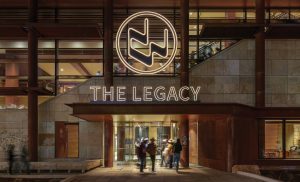
The front entrance is defined by a broad stair and layered enclosure that responds to the arrival sequence from the center of campus. The building’s structure, circulation, and light work together to guide visitors from the threshold into ground-floor public spaces and up to galleries, event rooms, offices, and terraces above.
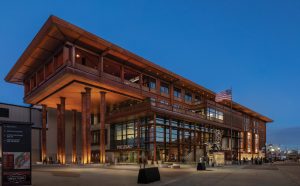
The building is organized across four levels, combining public, civic, and administrative uses. The upper floor includes the National Western Club and the Coors Family Western Terrace, extending dining and gathering spaces outdoors and providing direct visual connection to the campus, city skyline, and the Rocky Mountains beyond. Photos: James Florio
It’s a building he’s especially proud of, but it’s just one amid the impressive portfolio that has cemented Tryba’s enduring legacy across the West.
Laurel Delp is a frequent contributor to Western Art & Architecture and other magazines and websites, including Town & Country, Departures, Sunset, and A Rare World.
No Comments