


30 Apr Perspective: Frank Mechau [1904-1946]
In 1944, Frank Mechau’s painting, Tom Kenney Comes Home, was part of an exhibition at the Art Institute of Chicago and included in a catalogue for the show. When Mechau received the catalogue, he got on his horse and carried it six miles down the valley from his home in Redstone, Colorado, to show it to a friend. The friend was Tom Kenney, a cowboy, prospector, and the painting’s subject. “What do you think, Tom?” Mechau asked. True to the taciturn nature of a solitary cowboy, Kenney replied, simply, “That’s purty good, Frank.”

Rodeo-Pickup Man | Oil on Canvas | 31.75 x 39.3 inches | Circa 1930 | Denver Art Museum: Gift of Anne Evans, 1935.9. ©Frank Mechau. Photography courtesy of the Denver Art Museum
It may seem like an underwhelming response to what has become one of Mechau’s most well-known and celebrated paintings, but it was reflective of qualities that had drawn Mechau (pronounced may-show) back to his home state after living and traveling in other parts of the country and abroad. His heroes were Western men, independent thinking, strong, born for the rugged landscape he loved so much. And while Mechau was only 42 when he died, the arc of his relatively short career expressed his own independent spirit. He had explored the Modernism of New York and Europe in the 1920s and early 1930s. He had gained notice and been included in important national exhibitions at such institutions as the Whitney Museum of American Art in New York City. Then he made the decision to step away from a rising art movement and return to a more naturalistic style and regionally oriented approach — the opposite trajectory from most of his peers.
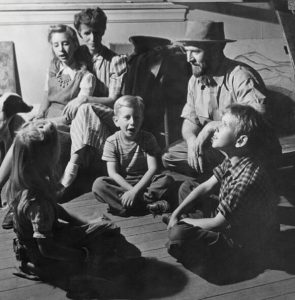
Frank and Paula enjoying their four children singing. Photo courtesy of the Mechau family
“American Western art at the time did not curry favor with the art world of New York or the Coast,” notes Denver-based collector Rob Lewis, an advisory board member for the Petrie Institute of Western American Art at the Denver Art Museum. “An artist could follow the herd and be recognized in those regions or head out on his own and define himself. It takes some courage to peel off from the herd and say you’re going to do things your own way.”
Mechau, who was raised in Glenwood Springs, Colorado, in the early 1900s, grew up fascinated with stories of Native Americans and pioneers. A drawing he did at 12, which the family still has, depicts a Native American on horseback, holding a rifle and gazing toward a covered wagon. “It’s a fine little piece,” remarks Mechau’s younger son, Michael Mechau, adding that he finds it significant that his father drew it from the Native man’s perspective.

Football Abstraction | Oil on Canvas | 27 x 68 inches | 1932 | Private Collection
The future artist was entranced as well by the forested mountains, canyons, seasonal changes, colors, and expanses of the sparsely populated Roaring Fork Valley. He was athletic, competing in several sports and especially excelling in boxing. It was through boxing that he earned a scholarship to the University of Denver, where he studied art and literature. He also briefly attended the Denver Art Academy of Fine and Applied Arts and the Art Institute of Chicago. Lewis notes, however, that Mechau felt creatively restrained by these art departments at the time, so his formal art studies were short-lived.
Even in his earliest works, he was beginning to incorporate curvilinear forms, signaling his interest in a new, more modern approach. In 1926, his illustrations for a book of verse by Richard Aldington were inspired by the graceful, finely detailed Art Nouveau style of the English illustrator Aubrey Beardsley. Shortly after that, Mechau won $50 dollars in a boxing prize fight in Denver and used the money to move to New York City. There he met American and European artists who were also exploring Modernist styles.
In 1929, Mechau and his wife, Paula, set off for a three-year sojourn in Paris. While there, Gertrude Stein’s brother, the collector Leo Stein, guided Mechau in expanding his knowledge of the modern art movement and its leading artists. Stein also encouraged him to go to Italy, where Mechau was inspired by the works of early Italian Renaissance painters. The Italian Primitives, as they are sometimes called, were beginning to understand linear perspective, and Mechau borrowed their use of architectural elements to structure space and create the illusion of depth.

Tom Kenney Comes Home | Tempera on Board | 31 x 48 inches | 1944 | Private Collection
“A lot of this work feels like Mechau is experimenting with space and movement,” notes Lauren Anuszewski, exhibitions and events manager at the University of Denver’s Vicki Myhren Gallery and a research fellow for the University Art Collections. Football Abstraction incorporates abstracted figures of football players and architectural elements in an incongruous way. “It’s outdoors, but what are those walls?” asks Lewis, who owns the painting. “Then you look at the figures and see this serpentine movement, and then the sky. To me there’s an Asian feel of the wave created by these individual figures.”
Yet by the early 1930s Mechau was becoming weary of what he later described, in a letter to a student, as the “fashionable tizzy” of modern art. He was ready to return to the American West, not only as home but to a more naturalistic yet still somewhat abstracted painting style. In 1932 the family moved to Denver and Mechau was invited to teach for the summer at the Kirkland School of Art. He soon opened the Mechau School of Modern Art in Denver, but the Great Depression forced its early closure.
One consequence of the Depression that greatly benefitted Mechau was a series of mural commissions produced for the federal Public Works of Art Project, which paid artists to create public art. His first mural, Horses at Night for the Denver Public Library, is considered one of his most important works. The horses are abstracted and without eyes, reduced to their essence through strong lines and color. The image is filled with movement, yet as if stopped in time, Anuszewski says.
Mechau created murals for a number of post offices and government buildings around the West and in Washington, D.C., focusing on themes relevant to each location’s region. He brought on some of his most talented art students from Denver as assistants. One mural, Dangers of the Mail, provoked a measure of controversy at the time of its unveiling and again decades later. Viewers in 1935 were disturbed by unclothed female figures and by what they considered historical inaccuracy in the depiction of a violent attack by Native Americans on a mail stagecoach’s occupants.

Rodeo #1 | Oil on Canvas | 39 x 84 inches | 1934 | Denver Art Museum: Museum Purchase, 1972.50. © Frank Mechau | Photography courtesy of the Denver Art Museum
Mechau defended the image, saying his intention was to create “an imaginative reconstruction” how such an attack might unfold. In the early 2000s the painting again came under fire, this time by Native American and other employees in the federal building housing it, who said it created a disturbing and uncomfortable work environment. Others wanted to preserve it as a historical record of “an amazing moment in American history when artists and arts were valued,” Anuszewski says. Eventually the painting was covered by a screen. Yet regardless of public response to Dangers of the Mail, Anuszewski points out that Mechau’s murals marked an important shift into greater complexity and detail in his art, including the use of a predella, a series of small scenes along the bottom of the mural.
In the summer of 1937, Mechau drove with his wife up into the mountains to show her the small town of Redstone, Colorado. The wealthy owner of a coal processing plant had it built in 1900 as a model community to house workers, but it was mostly abandoned by the time of the couple’s visit. Michael Mechau, who was eight when his father died suddenly of a heart attack, recalls stories of his mother instantly falling in love with Redstone and wanting to raise their children there. Her husband was taken with it as well, even though he knew as an artist he would not be able to make a living there.
Indeed, Mechau spent much of his time living and teaching away from home, including at the Colorado Springs Fine Art Center and at Columbia University in New York City. He returned to Redstone as often as possible in a time of slow, overland travel, and was passionate about being there with his wife and four children and painting familiar landmarks and Western subjects. “He wanted us to love that valley as much as he did,” his son says. “He was always pressed for time to devote himself to the things he cared about and loved.”
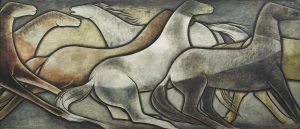
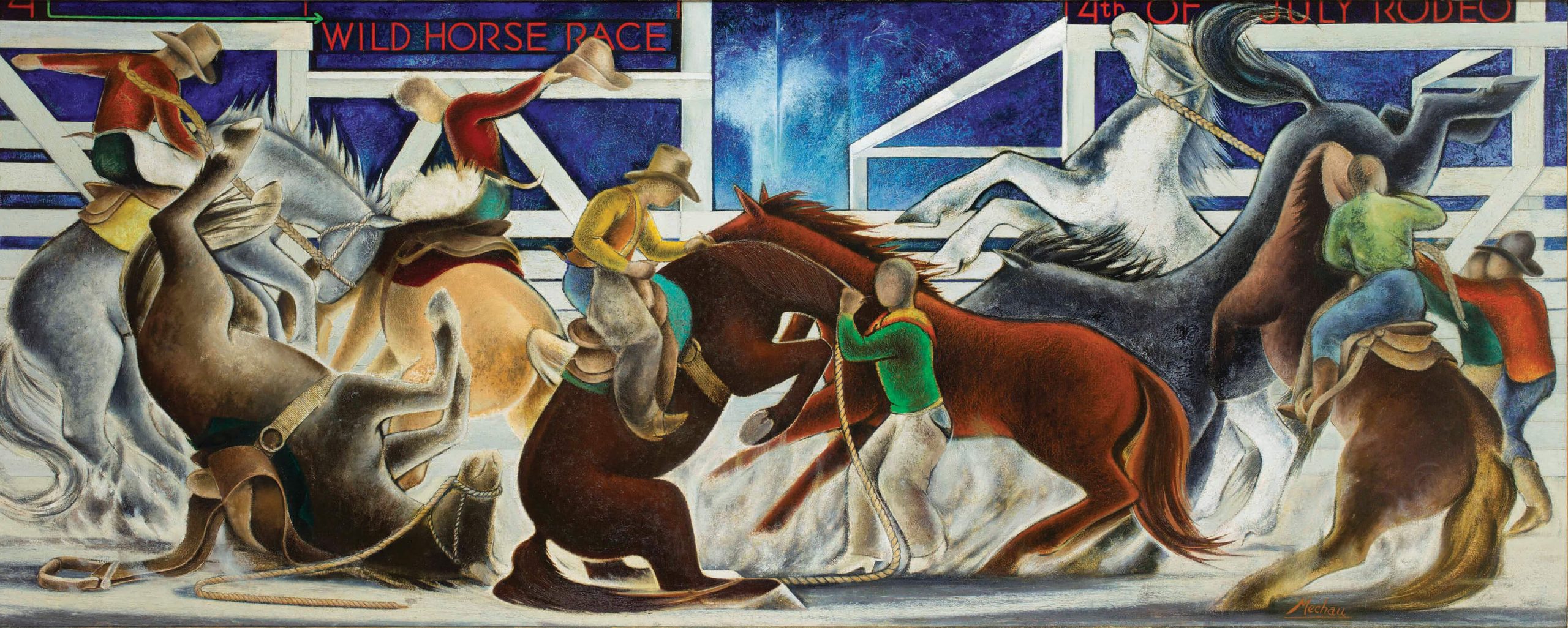
Wild Horses (one panel of the 60-foot-long fresco at the Colorado Springs Fine Art Center) | Tempera Paint on Plywood | 39 x 84 inches | 1934 | Denver Art Museum: Gift of Mrs. Frank Mechau, 1972.27F. ©Frank Mechau. Photography courtesy of the Denver Art Museum
After being commissioned by the U.S. War Department and spending several weeks painting scenes of Army bases and troop activities in the Caribbean and eastern Pacific during World War II, Mechau left his teaching position in New York, returning to Redstone to focus on painting. Tom Kenney Comes Home, with its barren landscape and solitary homecoming figure, may in part reflect the artist’s response to what he saw during the war, Lewis says. Anuszewski calls it “an exquisite painting,” with its gracefully flowing movement reminiscent of Chinese landscape painting, feeling of melancholy, and tiny, delicate flowers at the bottom of the scene.
Carolyn Servid, wife of the late Dorik Mechau, the artist’s elder son, never met Frank. Yet family stories she’s heard for decades have created a clear picture of him: a man with an irreverent sense of humor and a twinkle in his eye, who was “completely in love with life, every aspect of it.” He was as imaginative and skilled in writing as he was with paint, she says, citing a tall tale he wrote based on rumors of a “riproarious” bar fight involving his friend Tom Kenney. Published in Esquire magazine, it ends with Kenney admitting to Mechau that “the story as told, while not all facts, was true.”
Servid also remembers Paula referring to her husband as a “perfect human specimen,” very active, capable, and strong. “It’s unfortunate that he passed away at such a young age,” Anuszewski says, reflecting on how the artist might have built on his already masterful skills had he lived longer. “He was still exploring his art, still finding the things he loved.”
After 30 years of writing about artists and other creatives, Gussie Fauntleroy remains fascinated by the life experiences and soul that intertwine in an individual and emerge as art. She has written for national and regional magazines, newspapers, museums, and galleries, has served as a book and magazine editor, and is the author of four books on visual artists.
No Comments