






30 Apr A Visual Language
When thinking of important American photographers and their iconic images, names like LA Huffman, Dorothea Lange, and Ansel Adams come to mind. But did you know that many Indigenous people were making photographs at the same time? In the new book, In Light and Shadow: A Photographic History from Indigenous America, co-authors Brian Adams and Sarah Stacke trace the work of Indigenous photographers from North and South America and Hawai’i, dating back more than 150 years. Together, they chronicle techniques Indigenous artists used, from glass plate negatives and Polaroids to digital and multimedia, but the true brilliance of their research lies in telling the stories of the vastly overlooked photographers themselves, who made pictures of everyday life from their unique and intimate vantage points.

TAFOS | TAFOS (Talleres de Fotografía Social) operated in Perú from 1986 to 1998, providing photographic equipment and training to farmers, miners, women, youth, and urban communities across the country. The work was risky. The country was at war, and documenting atrocities or spreading Indigenous culture could make someone a target. The Ayaviri workshop ran from 1988 to 1992, coinciding with the years that Ayaviri, a Quechua-speaking community, began reclaiming control of its ancestral lands from the state. What TAFOS understood was that citizens needed the tools and means to further claim and realize their own empowerment. The archive is now held at the Pontifical Catholic University of Perú. | Ayaviri workshop, Puno Region, Perú, September 1989. Community members during the sheep and camelid vaccination campaign, likely near the town of Selque | Photograph by Melchor Lima

Jeremy Dennis | Jeremy Dennis, Shinnecock, lives on the Shinnecock Indian Nation, whose 837 acres sit adjacent to the Hamptons on Long Island’s East End. “We’re this inconvenient truth,” Dennis has said. “You can have a nice Hampton home, you can party on the beach, but it’s on stolen land, and we’re right next door.” I Could Stand Here All Night is part of Dennis’ series Rise, which replaces the zombie apocalypse figure with the American Indian, “whose simple presence causes terror.” Dennis comes from a family of artists. His uncle is Herbert Randall, the acclaimed civil rights photographer. “A lot of my work,” says Dennis, “is just answering the question, or stating, that we are still here.” | I Could Stand Here All Night | 2021 | Photograph by Jeremy Dennis
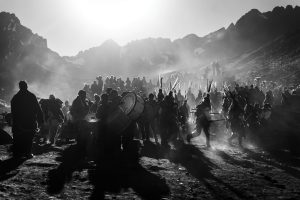
Jero Gonzales | Jero Gonzales, Quechua, is based in Cusco, Perú, where his work centers Indigenous communities in celebration and ritual. The series Pukapakuris documents an annual pilgrimage continued for more than 140 years by the Pukapakuri Wayri, a group of dancers from the Quechua-speaking community of Urcuspampa. Alongside tens of thousands of other pilgrims, they travel to the Sinakara Valley as part of Qoyllur Rit’i, the Snow Star Festival, where they celebrate the stars, honor the local glacier, and thank the Creator for sending sacred waters. For Gonzales, dance is one of the deepest forms of cultural expression. Its enactment over thousands of years is a living testament to Quechua legacy and survival. | Pukapakuri Wayri de Urcuspampa from the series Pukapakuris | 2018 | Photograph by Jero Gonzales
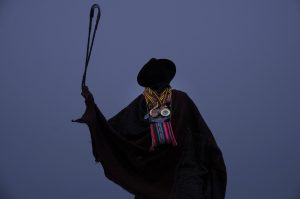
Sara Aliaga Ticona | Sara Aliaga Ticona, Aymara, grew up in La Paz, Bolivia. Water for everyone and for nobody shares the Andean worldview of water as a living being with feelings and reactions. The image documents an ancient ritual at La Cumbre, a mountain pass where guerreros fight to tame destructive manifestations of water. A faceless figure silhouetted against a darkened sky represents the legend of the guerreros and all those who still fulfill this honorable role within highland Andean communities throughout Bolivia. Executing the image, Ticona and her collaborator nearly died. Thick fog, freezing hail, and frosty winds enveloped them. Escaping on a motorcycle, they crashed into a ditch. “Water floods the image,” says Ticona. “It’s a sensation, it’s fear, it’s cold, and it’s well-being. In the end, we lived the experience of a guerrero.” | Water for everyone and for nobody | March 24, 2022 | Photograph by Sara Aliaga Ticona
The book is illustrated with more than 250 photographs from 80 practitioners and collectives whose work, the authors say, offers a “sense of kinship — of the camera held by someone with a stake in what they are documenting.”
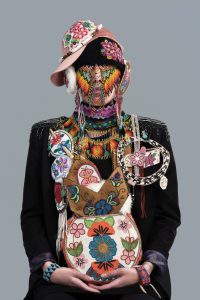
Dana Claxton | Dana Claxton is a Vancouver-based artist whose work urges viewers to consider how Indigenous women have long been represented as the anonymous makers of cultural belongings. Headdress—Jeneen counters that erasure. The portrait features Jeneen Frei Njootli, a Vuntut Gwitchin First Nation artist, lavishly adorned with beaded hats, bags, barrettes, necklaces, and bracelets from her own collection. “The beadworks are cultural belongings,” says Claxton, “and the womxn are cultural carriers.” Rooted in her Hunkpapa Lakota culture, Claxton’s aesthetics are acts of continuance that celebrate the ways Lakota people understand the world and themselves. | Headdress—Jenee | 2018 | Photograph by Dana Claxton
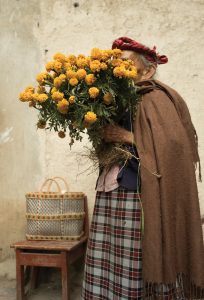
Luvia Lazo | Luvia Lazo, Zapotec, is from Teotitlán del Valle, Oaxaca, where this photograph of Soledad Chavez was made on Día de los Muertos. When Lazo’s grandfather died, his last word to her was “kanitlow” — I’m losing your face. She began searching for fragments of him in the Elders of her village, visiting them in their homes and at the market. In the resulting series, Kanitlow, she asks her sitters to turn away or cover their faces, both an ethical choice about who should show certain faces, and a way of transforming personal grief into the universal. For Lazo, people, cultures, and ways of life all vanish, because everything undergoes transformation. Some of us, she has said, will leave reminiscences of our being. | Soledad Chavez | Teotitlán del Valle, México | November 1, 2022 | Photograph by Luvia Lazo
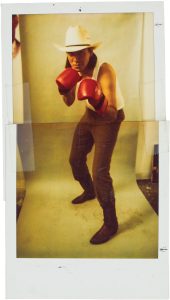
Kimowan Metchewais | Kimowan Metchewais, Cree, Cold Lake First Nations, began generating a wide-ranging Polaroid collection in the 1990s, organizing the images by topic and alphabetizing them in handmade boxes. He incorporated the Polaroids into his collages and paintings, relying on this personal, evolving archive for reference and source material, rather than institutions or any outside sources. Before his death at 47, he willed nearly 1,000 Polaroids to the National Museum of the American Indian. “Where does your art come from?” he asked his colleagues. “I want my art to be innovative, to move our voices forward, but I have to know, if I take it home to my Nation, that they can see that it carries on a long tradition.” | Untitled | Albuquerque, New Mexico, 1997 | Kimowan Metchewais [McLain] Collection, NMAI.AC.084 | National Museum of the American Indian Archive Center, Smithsonian Institution
Brian Adams, an editorial and commercial photographer based in Anchorage, Alaska, brings his Iñupiaq heritage to the project. He met Sarah Stacke, a photographer, writer, and archival researcher based in Brooklyn, New York, at a photography summit in Washington, D.C., which is where the kernel of an idea for this book took root.

Martín Chambi | Martín Chambi, a Quechua photographer and noted figure of the Cusco School of Photography, encountered the medium as a young man at the mine where his father worked, through a chance meeting with the company photographer. Chambi’s portraits and archeological images circulated throughout Latin America and the United States in exhibits and the press. His distinguished career gave way to three generations of Chambi photographers, creatives, and archival stewards, whose family-founded Asociación Martín Chambi preserves and promotes his work. Chambi’s son Manuel once described his father’s capacity to make a photograph look “old and new at the same time.” | Social celebration of the Cusco Carnival | c. 1926 | Photograph by Martín Chambi | Courtesy of Asociación Martín Chambi

Shelley Niro | Shelley Niro is a member of the Turtle Clan, Bay of Quinte Kanyen’kehà:ka (Mohawk) Nation, Six Nations of the Grand River. Dressing Warrior is a humorous mixed-media image in which Niro considers the differing identities that Native people inhabit and the ways they are presented outwardly in the world. Her use of irony and social critique challenges viewers to engage with serious issues. “The warrior has to embody changes in attitudes, politics and generally tries to make his own psyche bend to those devices in order to survive and live life fulfilled,” says Niro. “It’s a constant struggle.” | Dressing Warrior | 2012 | Photograph by Shelley Niro
The artists and images they chronicle resist easy categorization. “But what they share,” Stacke says, “is authorship. They decide what gets made and why.” In this art form, she adds, they also share “a visual language rooted in the storytelling and imagery of their forebears.”

Jennie Ross Cobb | Jennie Ross Cobb, Cherokee, the earliest known Indigenous American woman photographer on record, began experimenting with photography in Cherokee Nation around 1895. Her camera gravitated toward women — friends and community members at school, at leisure, and promenading in fine attire. Intimate and spirited, her images pushed back against prevailing stereotypes of Native women at the time, picturing them as poised, self-assured, and fashionable. Cobb understood her photographs as part of a larger historical record of Cherokee life. | Woman in front of an unidentified house, likely near Park Hill, Indian Territory (present-day Oklahoma) | c. 1896–1905 | Photograph by Jennie Ross Cobb | Jennie Ross Cobb Collection, Oklahoma Historical Society | Collection Number 2013.626.28
The work of many Indigenous photographers from across the Americas has been archived. Yet, Stacke and Adams say, “The archives raise new questions about what has been overlooked, miscredited, or lost.” Ultimately, through this book, the authors seek to contribute to the understanding that Indigenous Americans have been creating a photographic canon shaped by ancestral memory, imagination, and continuity since the medium’s earliest days.
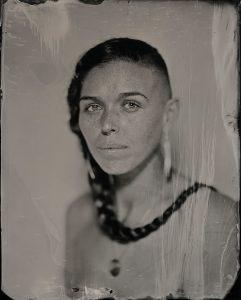
Kali Spitzer | Kali Spitzer, Kaska Dena and Jewish, is a Vancouver-based photographer whose work is informed by the desire to rewrite the visual histories of Indigenous bodies beyond a colonial lens. Her father is a Survivor of Canada’s residential schools. “Coming from two groups of people where genocide was committed against us,” she says, “I just came out fighting.” Working with a large-format 8-by-10-inch camera and wet-plate collodion process, Spitzer makes tintypes that one curator described as an “exchange of trust.” Grieves, photographed here in 2021, wrote of the experience: “For the first time, I feel like I am truly witnessing my own Indigeneity.” | Larissa Lorraine Grieves, Nisga’a, Gitxsan, Métis, Swedish, Irish, and Scottish | Made in 2021 on the Unceded Lands of the Musqueam, Squamish, and Tsleil-Waututh Nations | Photograph by Kali Spitzer
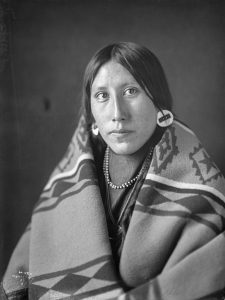
Richard Throssel | Richard Throssel, of Cree heritage, lived among the Apsáalooke in Montana. Trained as a painter, his eye for gesture and light and the genuine relationships he formed on the reservation characterize his photographs. Women appear unguarded in many portraits and candid moments. Apsáalooke artist Wendy Red Star, whose great-great-grandmother appears in Throssel’s archive, has said his portraits of women are extraordinary. After leaving the Apsáalooke Nation, Throssel opened the Throssel Photocraft Company in Billings and served two terms as a Montana state legislator, advocating for the Apsáalooke. | An Apsáalooke woman | Apsáalooke Nation | c. 1905–11 | Photograph by Richard Throssel | Richard Throssel Papers (2394) | American Heritage Center, University of Wyoming
The following is a survey of their research.
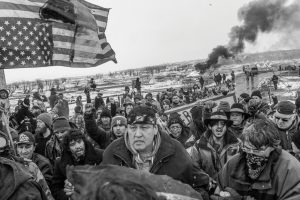
Josué Rivas | Josué Rivas, Mexica and Otomi, spent six months at Standing Rock photographing the Water Protectors and camp life, right up until the activists’ eviction in February 2017. This image was made minutes before a law enforcement curfew on the final day. An upside-down American flag, a signal of distress, anchors the left of the frame. Dozens of Water Protectors in hats and coats fill the scene, many with raised fists, while a tipi sends plumes of black smoke skyward. “I was experiencing the ending of something,” Rivas recalled, “but the beginning of something else.” His intention, he said, was for the Water Protectors to remember, “This is what you looked like as you were exiting and not being taken, not being defeated.” | People peacefully leave the Oceti Sakowin Camp, Cannon Ball, North Dakota | February 2017 | Photograph by Josué Rivas
In Light and Shadow: A Photographic History from Indigenous America, by Brian Adams and Sarah Stacke, is available to order at your favorite bookstore or online at hachettebooksgroup.com. An exhibition of photographs from the book opens August 14, at Obscura Gallery, Santa Fe, New Mexico, with an opening reception and book signing, August 15.
No Comments