

30 Apr The Shape of Things That Matter
There is a nine-foot-long parade of rabbits in Dan Ostermiller’s Loveland, Colorado, studio right now — 12 chubby, precocious characters, each with a different personality, doing something entirely its own: leaping, napping, playing, scratching. The piece, A Good Hare Day, is one that Ostermiller has been working on for the past three years; he’s been in no hurry to release it into the world until now.
This fall, Nedra Matteucci Galleries in Santa Fe presents Dan Ostermiller: Animalier, a landmark exhibition celebrating 50 years since the sculptor cast his first piece in bronze. The show will be part retrospective, part revelation — drawing from Ostermiller’s private collection of sold-out work he’s been holding onto, some for years, alongside a group of bold new pieces that suggest an artist not coasting on legacy but pressing forward with the energy of someone half his age.

The Greeting Party | Bronze | 9 x 5 x 18 inches | 2002
That energy, it turns out, is not merely figurative. Over the last year, Ostermiller has lost some 70 pounds, taken up working out three days a week with a trainer, and, by his own account, feels better physically than he has in decades.
“I feel like I’m 30 or 40 years old again,” he says. “I have no back pain, no knee pain. And so I anticipate just getting on with what I do and making more and more sculpture.”
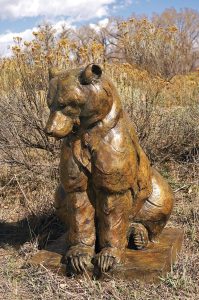
Contemplating Hibernation | Bronze | 60 x 27 x 32 inches | 2026
For those familiar with the arc of American wildlife sculpture over the last half century, Ostermiller’s name carries singular weight. Born in Cheyenne, Wyoming, and long based in Loveland — a city that became a center for sculpture in no small part because of artists like him — Ostermiller grew up in the taxidermy business run by his father, Roy Ostermiller, one of the largest commercial taxidermists in the country. The experience gave him something few sculptors ever acquire: an intimate, anatomical understanding of animals developed not from books or photographs but from years of actual hands-on study.
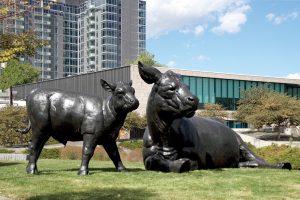
Scottish Angus Cow and Calf | Bronze | 32 x 28 x 13 feet | 2006
But the best benefit of working for his dad, Ostermiller says, was making connections all over the world. “I could get out into habitats and spend time with the actual animals instead of dead ones.”
That access to wildlife in its natural state, observed in its own territory, became the foundation on which everything else was built. Today Ostermiller’s work resides in the permanent collections of Crystal Bridges Museum of American Art in Bentonville, Arkansas; the National Museum of Wildlife Art in Jackson, Wyoming; the C.M. Russell Museum in Great Falls, Montana; the Leigh Yawkey Woodson Art Museum in Wausau, Wisconsin; and, most visibly, on the grounds of the Denver Art Museum, where his Scottish Angus Cow and Calf — five tons of sand-cast bronze — stands as one of the most recognized public sculptures in Colorado. The piece, commissioned originally for a private ranch by collector Leo Hendry, was moved to the museum in the middle of the night, requiring the closure of Interstate 25 to accommodate its transport.

A Good Hare Day | Bronze | 46 x 43 x 109 inches | 2026
“Leo always told me, and it was a handshake thing, that if he sold his ranch he would donate that piece to a really good institution.” Ostermiller had no idea Hendry chose the Denver Art Museum until he got a call from a curator saying they needed to talk to him about moving the big cows. “I said, ‘Do you want me to help?’” Ostermiller recalls. To his great relief, they said they didn’t need him.
That monumental sculpture truly has become an iconic piece of public art that seems to encourage selfies, as well as some cool, albeit, odd wedding photos. “I remember seeing this wedding party in front of the cows, with the sun setting in the background, and I thought, ‘Oh, wow — that’s pretty wild for a wedding picture.’”

Camille | Bronze | 8 x 9 x 5 inches | 1990
Scale has never intimidated Ostermiller. He attributes this to his upbringing. Working life-size was simply what you did when your father needed museum-quality mounts. But what distinguishes his monumental work from mere enlargement is the degree to which his vision evolves as a piece grows. He describes the enlargement process as an active sculptural act in itself — cutting, adjusting, lengthening, shortening — never simply digitizing a small model and scaling it up.
“Once you enlarge something, it’s got to change,” he says. “Your viewpoint changes, or maybe you just didn’t sculpt it very well when it was little, and so you’ve got to change it when you enlarge it.”
For Scottish Angus Cow and Calf, Ostermiller used a sand-casting process at Tallex Foundry in New York, which allowed the piece to be assembled in just 10 or 11 sections rather than hundreds of small panels required in traditional casting. Six-hundred-pound panels were poured and shipped back to Loveland for final assembly. “You just have to be very careful when you’re handling pieces of bronze that heavy,” he says. “It becomes a safety issue.”
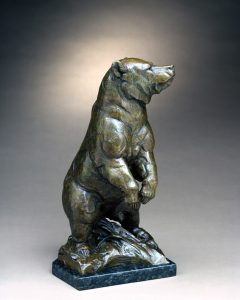
Ursus Rising | Bronze | 18.5 x 8.5 x 9 inches | 2005
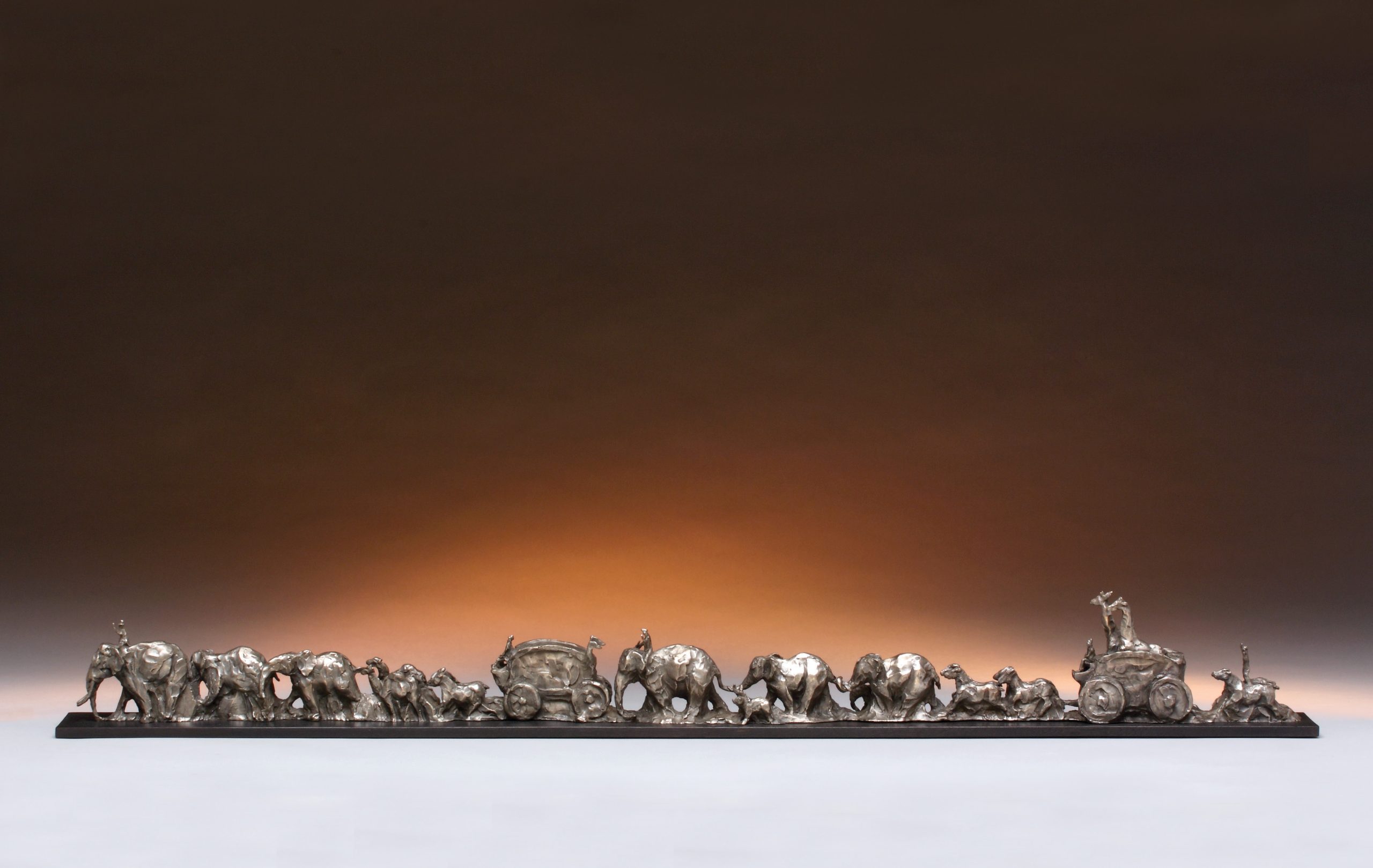
One of the retrospective pieces, Greeting Party, grew from a trip to Antarctica, a journey he describes as among the most visually and spiritually striking of his life. “I thought Antarctica was one of the most inspiring places I’ve ever been,” Ostermiller says. “It’s pristine. The atmosphere is just so clear. It’s beautiful.” The piece captures a procession of penguins moving down one of their ancient trails toward the water — multiple impressionistic figures in motion, reminiscent of another older work that will be in the show, Circus Parade.
Circus Parade is an impressionistic interpretation of the circus he’d watched unloading from a train in Denver. At four and a half feet long, four inches wide, it makes for a delightful conversation piece down the center of a dining table. “Your guests would have so much fun exploring,” he says. “There are wagons with draft horses sticking their heads out. There are clowns and people walking with bears, and girls riding Roman-style on horses.”

Saguaro Shade | Bronze | 5 x 5 x 16 inches | 2026
Contemplating Hibernation, another significant piece headed for the show, features a bear on the brink of his seasonal sleep, suspended in a moment of philosophical hesitation. “He is thinking about when he should actually commit to hibernation,” Ostermiller says. “I think this sculpture is a definite culmination of all my thoughts, the way I am, my personality. And the same is true of Good Hare Day; each rabbit has a different personality and each has a little bit of me.”
The question of voice and adding his own personality to his work — of when and how an artist’s inner life becomes visible in the surface of bronze — is one Ostermiller traces to a single defining year: 1990.
“I fell in love with Francisco Zuniga’s work,” he says. “That’s when I started doing some of the big, heavyset bears. I loved the way he handled form and mass with his big Mayan women. And I thought, ‘God, I’d love to apply that to animals.’”
Before that pivot, Ostermiller’s work carried the marks of his taxidermy training — exacting, detailed, authoritative, but ultimately in service of someone else’s vision of what an animal should look like. “When I came out of the taxidermy business, all I knew was detail,” he says, “and it was never very appealing to me because everything looked so deliberate; you’re trying to make something look real, and you didn’t get to own it. You weren’t making your own animal.”
The shift that followed was one of the most consequential stylistic evolutions in his career. Ostermiller began exaggerating mass and simplifying surface, letting form speak before detail. He found in Zuniga’s treatment of the human figure a grammar he could apply to animal subjects such as bears, rabbits, elephants, with exhilarating results. The gallery sold it. The public responded. And Ostermiller, who by his own description is not someone who enjoys selling himself, found that he didn’t have to.
Much of that freedom can be traced to a relationship forged 45 years ago with gallerist Nedra Matteucci, who encountered the then-young sculptor working on a group of large rabbits; she has represented him ever since.

Inquisitive Doe | Bronze | 19 x 5 x 13 inches | 2026
“I decided, when I met Nedra Matteucci, that my job wasn’t to sell artwork,” Ostermiller says. “My job is to make artwork. Her job is to sell art. I just stepped out of the way.”
The arrangement has allowed him considerable creative latitude. Matteucci has never asked him to repeat a formula or stay safely within his best-selling subjects. “If I do something that’s totally different from what I’ve done in the past, she’s always welcomed it,” he says. “We know each other so well and trust each other enough to know that if I am going to go a different direction on something, she’ll support it.”
Style, Ostermiller argues, is not something you design. It is something you excavate, slowly, through continuous self-examination, a process of keeping what works, discarding what doesn’t, and following curiosity wherever it leads.
“You should be constantly evolving as an artist,” he says. “Eventually you get to a point where it’s all yours, where somebody from across the room can sit there and go, ‘That’s a Dan Ostermiller.’”
That recognition, he is quick to note, comes with its own risks. Imitators have tried to adopt his style. Some have attempted to copy it digitally. He is philosophical about this, if watchful. “The way that you survive is just to stay ahead of the game, constantly reinvent yourself and explore new subject matter; do it differently than anyone else.” He reaches for a sports analogy that, from a sculptor, somehow fits: “Why was Michael Jordan such a great basketball player? It’s because he approached basketball differently than anybody else. And it’s really almost impossible to duplicate that because in order to duplicate it, you have to steal his DNA; it’s the way you think.”
The animating spirit behind A Good Hare Day, the piece Ostermiller held back three years specifically for this show, illustrates exactly that. Twelve rabbits. Twelve distinct personalities. Each one doing something different with its eyes, its ears, its posture. “I sculpted things that made me feel really good,” he says.
The photographer who shot the piece, Marsha Ward, told him it made her want to cry — in the good way — because, in the middle of this particularly difficult cultural moment, it gave her something she’d been looking for in art. “She told me she wanted art to make her feel good because everything is so weird right now,” he recalls. “And that’s what I want for my work: I want somebody to relate to it and enjoy it and walk away from it feeling good.”
Ultimately, that is what Ostermiller has always been after. Not critical recognition, not the kind of self-promotion he has always found draining. Something simpler, yet more difficult to achieve.
“The most important things to me when I make my work are, first, that I’m happy with it,” he says. “Second, I want people to feel the same things I was feeling when I created it. And if they do that, I was successful.”
Sidebar:
Dan Ostermiller: Animalier opens June 26 at Nedra Matteucci Galleries, Santa Fe, New Mexico. For more information, visit nedramatteucci.com or danostermiller.com.
No Comments