

03 Jul Artist Spotlights: Balancing Act
Donna Howell-Sickles is known throughout the Western world for her vibrant, joyful paintings of cowgirls. Bursting with color and life, they are also layered with meaning, embellished with spiritual references and representations of ranch and farm life that symbolize the multiple facets and complexity of roles in a cowgirl’s reality. A Cowgirl Hall of Fame inductee, and the subject of a book and multiple exhibitions, Howell-Sickles has had a voracious audience for her work for four decades. So it might surprise some to hear that the artist is also a gallerist.
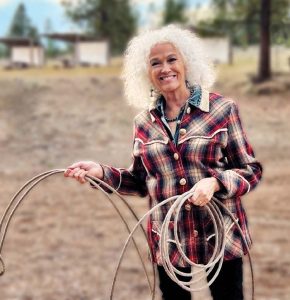
Donna Howell-Sickles stays in touch with her Western roots in the small, historic town of St. Jo, Texas.
“It was never a goal of mine,” she says. “I’ll tell you that right up front. It’s just something that happened.”
In 2010, Howell-Sickles and her husband, John Sickles, founded a fine art gallery in Saint Jo, Texas. Though the small town on the Chisholm Trail in the Red River Valley is now a thriving destination for history buffs, weekenders from Dallas and wedding parties, 26 years ago it was … not.
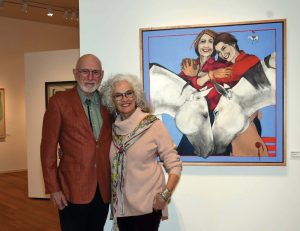
The artist and her husband John Sickles with her piece Horse Talk.
Back then, Saint Jo had a charming, well-preserved historic town square, but two-thirds of the approximately 40 buildings surrounding it had empty storefronts. The couple saw the potential and bought three late-19th-century buildings, which Sickles planned to renovate. As soon as the first was ready, Howell-Sickles launched Davis & Blevins Gallery. They now own five buildings, and their work has been recognized with a Historical Restoration Award from Preservation Texas.
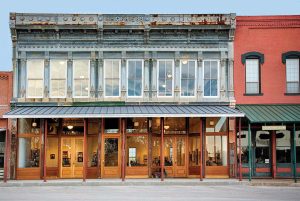
The couple purchased and renovated five late 19th-century buildings in St. Jo, a stop along the historic Chisholm Trail. The Frie Building houses the gallery after a three-year renovation.
Their bold move a quarter century ago helped catalyze the revitalization of the entire community. Most of the vintage buildings in Saint Jo have been purchased and restored; scores of other small businesses have sprung up within the town limits and beyond, with bed-and-breakfasts and wineries attracting a steady stream of first-time visitors. “Restoration is continuing,” Howell-Sickles says. “There’s a charcuterie board restaurant, a realtor, and a coffee shop, all in restored buildings. There’s a beautiful historic white house with a commercial kitchen for events. On the west side, an investor bought five buildings and has done a beautiful job with stores and a coffee shop. The bank has been restored. There’s a burger restaurant in the old hardware store and a music venue in the old lumberyard. There’s stuff popping up all over the place. It’s quite an energetic little town; people visiting can feel the energy and the potential,” she says.
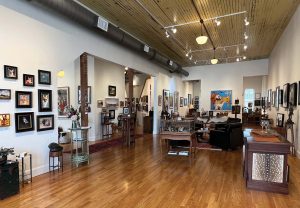
The thoughtful, appropriate and historically accurate restoration work has been recognized with a Historical Restoration Award from Preservation Texas.
In contrast, when Carrie Wild founded Gallery Wild in 2019, Jackson, Wyoming, was already an internationally-recognized destination, thanks to its picturesque antler-arched Town Square, world-class skiing, nearby Grand Teton and Yellowstone national parks, and the iconic silhouette of the Tetons towering over it all. The town had long been known as a major destination for Western art. In addition to many fine art galleries, Jackson was home to a world-class wildlife art museum overlooking the famed elk refuge.
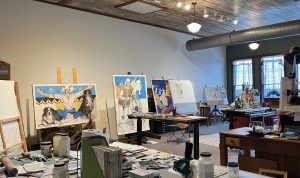
Howell-Sickles’ studio is located on the second story of the Frie Building overlooking the Square in St. Jo.
Wild had grown up with horses, and as a kid she was always drawing. But while she knew she was meant to be an artist, she recalls, “In the Midwest, people assume that if you’re an artist you’re a starving artist. It was something I believed I could do, but didn’t believe I could make a living at. From a very early age I was drawing horses and telling my parents I was going to be an artist when I grew up. But they wanted me to have a backup plan.”
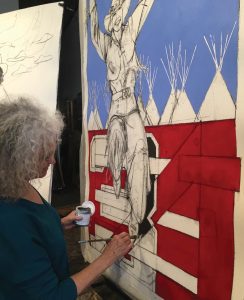
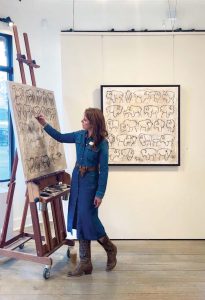
During openings at the gallery, she will often do a painting demonstration to show visitors how she brings her works to life. She might start several pieces this way then continue the creative process upstairs in her studio.
Wild enjoyed a career in graphic design for more than a decade while always pursuing her art. When she went west in her 20s, her style evolved. “My art in Michigan had been more traditional. When I moved west, I was inspired by the dust, farm fields, and wide-open spaces. I started to see the landscapes in a more abstract way, in fractal light, seeing animals far away and only having so much detail. I started thinking about my art differently, and I wanted to figure out how to put that into my work.”
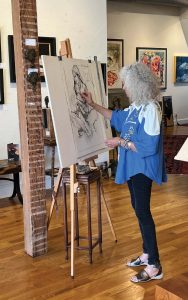
Howell-Sickles at work on an image for the Pendleton Rodeo. She was the first female artist selected to create the artwork for the event’s iconic poster.
A wildlife photography trip to Jackson had her wandering the galleries in town. Wild hadn’t planned to introduce herself as an artist, but after a gallery owner asked about her own art she was offered representation for work in her newfound contemporary style. The following summer, in 2011, she returned to Jackson and never left.
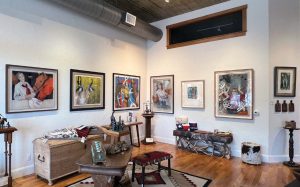
A designated section in the Gallery (“Donna’s Nook”) highlights Howell-Sickles’ new and revolving artwork.
After some years being represented by galleries, Wild had learned a lot. She had also discerned an opening in the market for more contemporary Western works. In 2019 she opened Gallery Wild on a busy corner in downtown Jackson. Her intention, she explains, was to represent a tight-knit, mutually supportive group of artists whose work was complementary to her own. “My vision for Gallery Wild was to curate a collection of Western art that felt different from what already existed in Jackson Hole — more color, more contemporary energy, a gallery space that was light, bright, and genuinely inviting. A place to breathe and just enjoy the art. At the time, the market leaned heavily traditional. Contemporary Western art was a small slice of what was available in Jackson Hole. Gallery Wild filled that space, and the response from collectors and visitors made clear there was real appetite for it. When we see people walk in and take a breath it’s the best feeling ever. That’s what art is supposed to do, put you in a relaxed euphoric state. And that’s what makes my job so fun.”
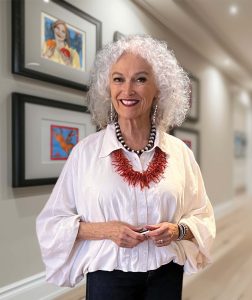
Howell-Sickles at home in the West.
These two Western women have now extended their success as artists to success as gallerists, in two distinct destinations that couldn’t have been more different. But how, we asked, can these artists run galleries, with their endless demands and constant interruptions, while still creating powerful, moving works of art?
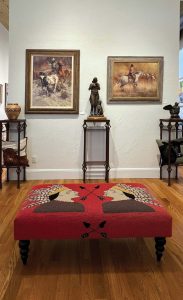
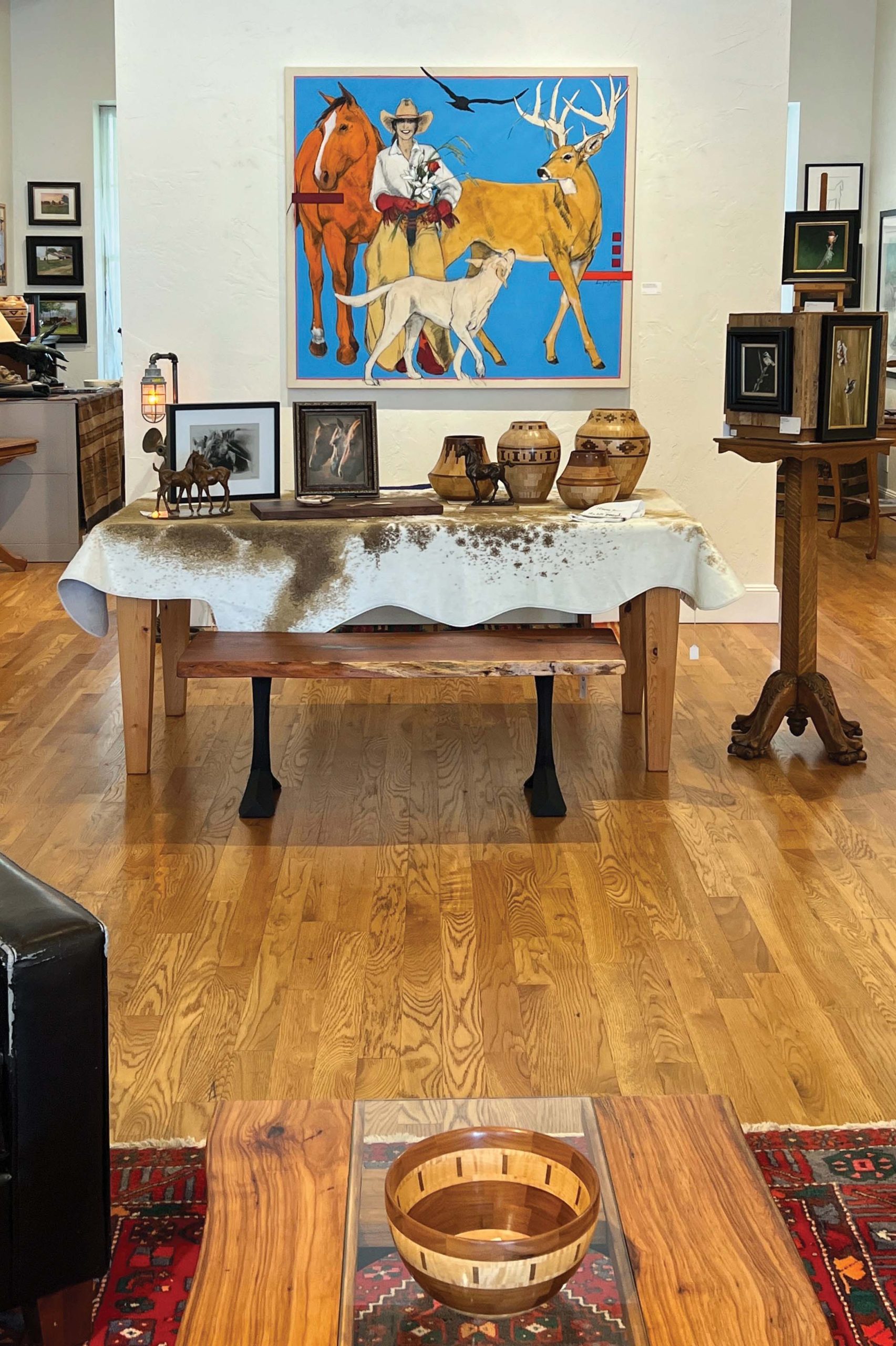
A mixture of fine art, sculpture, and hand-crafted furniture blends well in the gallery, which represents 30+ artists from across the country, including painters, watercolorists, sculptors, photographers, furniture makers, and wood turners.
Somehow they do it all and they do it well. And the Western art world is all the more colorful for it.
WA&A: In a way it’s a selfless thing to create a gallery and represent so many other artists; it means less time for your own work, both in the creation and the marketing. What keeps you in it, happy, inspired, and not frustrated when you might be interrupted while making art?
DHS: I’ve always loved the galleries and the gallery people that have supported me along my career, so returning that favor to other artists is so satisfying. I always worry we can’t do enough. We’re still in an area without a lot of walk-in traffic, so it’s a struggle and I always wish our art sales were greater. But I still think what we’re doing here is important. Important to the city, important to me as an artist, and important to the artists we get the privilege of representing. In the last two years, an added bonus has been working with my daughter Katie Sickles-Rust. She has taken on the roles of gallery director and artist liaison while maintaining our social media presence and website performance, and that allows me the freedom to be in my studio, in my element, and in my creative realm.
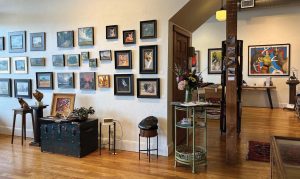
A salon-style wall at the Davis & Blevins Gallery.
CW: Working with my artists and connecting their work to collectors so that they can be successful in their art careers is just as satisfying and inspiring to me as creating my own art. Running a business definitely takes away from my own work, but I love the challenge, so putting down my brush often is just part of it. Most of my work is created in my studio within Gallery Wild, but if I need to work on something without interruption, I have a home studio to retreat to.
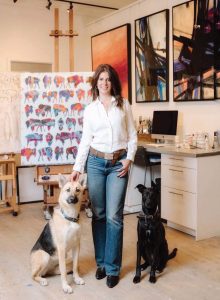
Artist Carrie Wild, pictured in her studio with her dogs Nola and Lily, opened Gallery Wild in Jackson, to offer “more color and more contemporary energy.”
WA&A: How do you think your own creative work has been influenced, changed, or evolved since representing other artists?
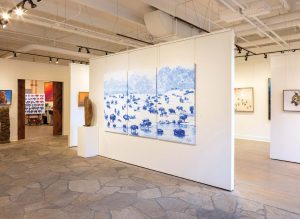
Just past Patricia A. Griffin’s oil painting, 1853, is Wild’s studio.
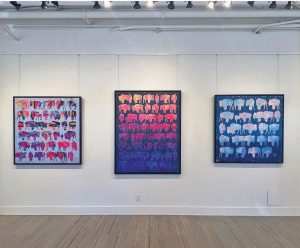
Wild’s own color-infused, Western-inspired artworks in acrylic with gold or copper leaf.
DHS: I’m not sure you can see a reflection of representing other artists in my work, but I do think you can see a difference in how much more time I spend looking at other people‘s work, and how much time I’m willing to spend talking with other artists about their work. It has definitely expanded my internal definition of making art. I am so much more interested in why everybody else makes art than I ever was before. I love finding something in each piece that makes me say, “Now that’s something I hadn’t thought of,” or “Ok, so that’s how they interpreted that scene,” or “What a brilliant use of color.”
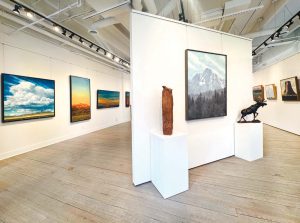
Wild represents a wide range of artists including sculptor Richard Burke, painter Bridgette Meinhold, sculptor Rip Caswell, and painters Caleb Meyer and Luke Anderson.
CW: Having the opportunity to work with collectors throughout my career and to help them find art that inspires them — whether it’s mine or another artist’s — has definitely influenced my work and the work in my gallery. I get to hear firsthand what collectors are searching for when adding art to their lives, and share that feedback with my artists so they can make the best decisions for their work and career.
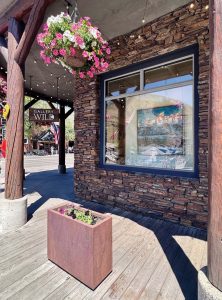
The location occupies a corner one block from the Jackson Hole Town Square.
WA&A: What’s been the steepest learning curve in owning a gallery?
DHS: I’ve always worked by myself in my studio, so the hardest thing to get used to after opening the gallery was communicating effectively with the people who worked with me. The enormous amount of time required to communicate well with artists, clients, staff, and advertisers was truly shocking. If I had not had a good first director of the gallery, Taryn Wise, I would not have made it.
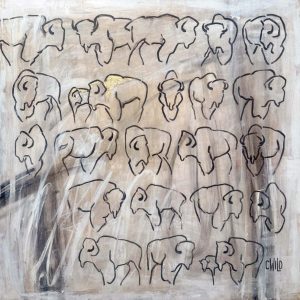
Rendezvous Twenty Four | Acrylic & Gold Leaf on Canvas | 48 x 48 inches
CW: I bring over 20 years of experience in sales and working one-on-one with clients to create custom experiences. I’ve been a professional artist for 15 years and was represented by other galleries before opening Gallery Wild. I’m also trained in marketing and graphic design with a background in advertising — so the forward-facing side of the gallery, and understanding what artists need, has come naturally. The steeper learning curve has been the administrative infrastructure that keeps a business running — and honestly, it’s my least favorite part. It requires a different skill set than what most artists and salespeople come in with. I’ve been deliberate about building the right support around me, and that has made all the difference.
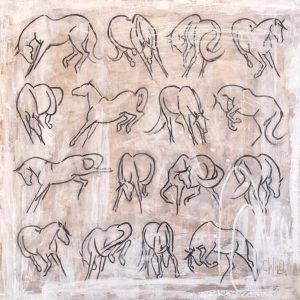
Rendezvous Buck Sixteen | Acrylic & Gold Leaf on Canvas | 40 x 40 inches
Longtime WA&A contributor Chase Reynolds Ewald is an author, editor, and consultant who helps creatives craft their stories. Her recent books include California Coastal with Heather Sandy Hebe\rt and By Western Hands: Functional Art from the Heart of the West. Chase’s titles with her longtime collaborator, Montana photographer Audrey Hall, include American Rustic, Cabin Style, and the multi-award-winning Bison: Portrait of an Icon. Their newest book, Modern West, was released in September. She lives in Montana.
No Comments