

03 Jul Creativity Unbridled
In the spring of 1998, a handful of the country’s finest Western craftsmen — a group that was, itself, not much larger than a handful — gathered to talk about heritage. And about legacy. They gathered in recognition that their specialized art forms — saddlemaking, bit and spur making, silversmithing, and rawhide braiding — once so integral to the life of the cowboy and to the mythos of the West, were in danger of going the way of the long-haul cattle drive. These artists rightly feared that theirs was a dying breed and that if they didn’t find a way to attract younger craftsmen and connect them with masters in those fields, an entire art form and with it, a way of life, a culture, might simply vanish.
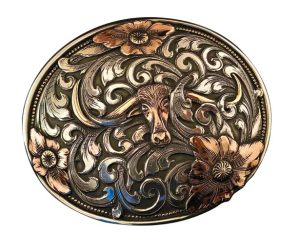
On top of a full scroll overlay in this silver buckle, Beau Compton hand sculpted the steerhead using rose gold for the head and yellow gold for the horns. The flowers on this buckle too are rose gold with yellow gold centers.
Scott Hardy was one of those artists. A cowboy from Saskatchewan and a widely respected silversmith already 17 years into his career, Hardy attended that first meeting in Hayden, Idaho, where 12 artisans shared their worries about the future of Western craftsmanship. “Within the first 15 minutes, it was just harmony,” he recalls. Together, they decided to create a culture of mentorship; a culture that celebrated learning and sharing over gatekeeping; a culture that educated collectors and the public about the history of the West and the extraordinary functional art these craftsmen could imagine and then create.
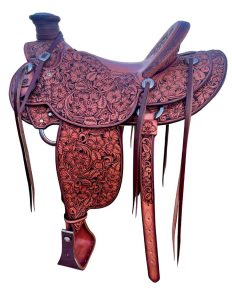
This saddle with California-style tooling was the piece Carol Gessell built to successfully apply for membership to TCAA in the spring of 2025. It features hand-tooled flowers that can be seen at a distance and tapaderos-style stirrups. “It was a nice decoration in my home,” she laughs, “but I’m glad it went to the museum.” Her saddle, which will be for sale, has been on display at the Craft In America Center in Los Angeles.
From that spirit and passion, the Traditional Cowboy Arts Association was born, and with it, a landmark exhibition, now in its 27th year, the TCAA Exhibition & Sale, which opens September 14 at the National Cowboy & Western Heritage Museum in Oklahoma City. This year’s show includes its celebratory sale weekend, September 25-26, and will be on display at the museum until October 18.
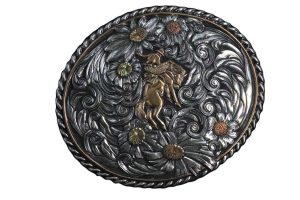
Scott Hardy’s silver belt buckle features a hand-sculpted 14K yellow gold horse and rider surrounded by intertwining scrolls and flowers with 14K gold centers. The buckle is bordered with a sterling silver twist rope edge and a 14K gold smooth wire interior edge.
Each active TCAA member — there are 14 active members today, and 18 emeritus — commits to creating three pieces of the utmost caliber, the best that they are capable of, to be exhibited and sold in the show. Hardy, the only founding artist still with an active membership in TCAA, starts his pieces for the exhibition in February and finishes them in July. Silversmith Beau Compton from Tombstone, Arizona — who won a TCAA fellowship in 2014, was admitted as a member in 2016, and is now the organization’s president — spends 250 to 300 hours per piece for his contributions to the show. And many of the TCAA artists work together on collaborative projects. One of Hardy’s pieces for the 2026 show, for example, is a sterling silver quirt, what he calls a “cowboy scepter,” that he worked on with saddlemaker Cary Schwarz, rawhide braider Nate Wald, and bit-and-spur maker Wilson Capron. Like every piece in the show, this one is a singular masterpiece.
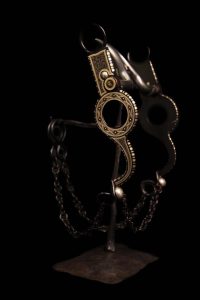
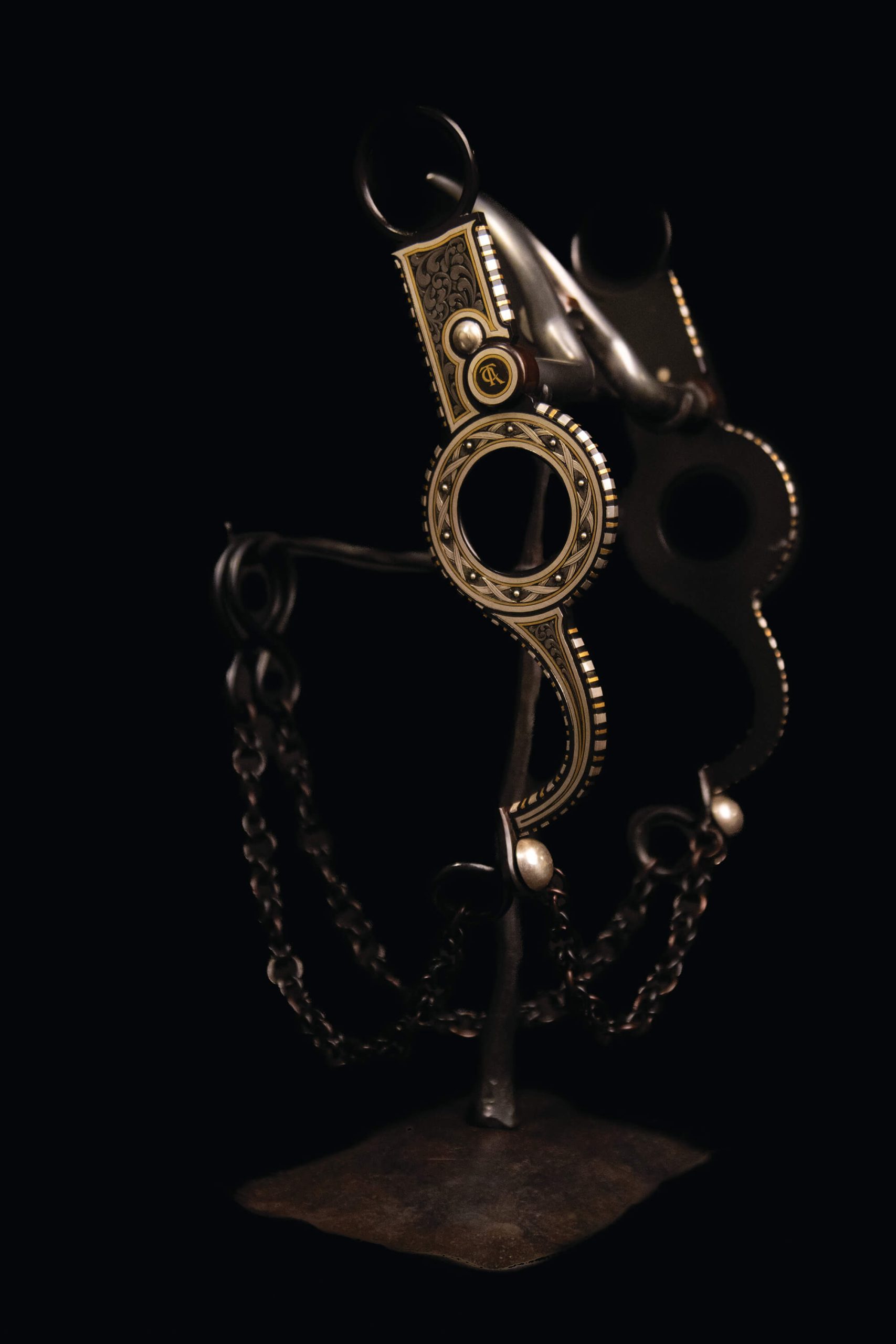
For the 2025 Circle Santa Barbara Bit, Wilson Capron designed ornamentation from architecture, fine guns and knives. The design is anchored by fine silver and 24K gold inlays that frame the shank. The mouthpiece is a timeless forged cathedral.
Beyond the exhibition that showcases the remarkable work that comes out of these traditional trades, the organization itself is responsible for advancing the crafts through education and collaboration. All active members agree to teach open workshops and offer training to two TCAA fellows each year. For Hardy, who is 44 years deep into his career and a beloved mentor to many, the goal is to keep learning. “You can never go far enough. You can never learn enough. You can never push your trade enough,” he says. “When you walk into the museum and see 45, 50, or 60 pieces, you can literally feel the energy in that room. Every piece is from somebody’s imagination and created by somebody’s hands. You will never find anything like it anywhere else.”
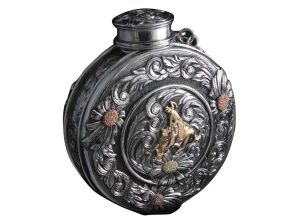
Hardy created this silver palm flask to honor the five generations of cattlemen in his family, featuring a heavy sterling silver body, 14K gold broncs (one on each side), scrolls and flowers with red, yellow, and green 14K gold centers.
Whether for a belt buckle, saddle silver, a flask, jewelry, or decorative work on cowboy regalia, Western silversmithing as an art form utilizes bright-cut engraving, patinas, and various stones in their elaborate designs.
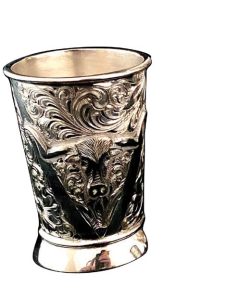
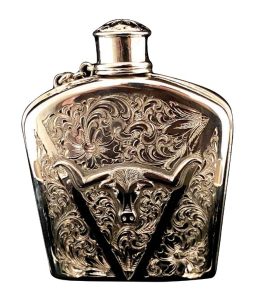
Compton wanted to create an all-sterling flask that was easy to handle and could fit in a shirt pocket. He hand sculpted the longhorns on both the flask and shot glasses and used bright-cut engraving throughout.
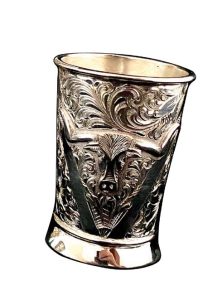
Not long after he graduated high school, Colorado-born silversmith Beau Compton met legendary maker Vic Vasquez. When Compton walked into Vasquez’s workshop, he knew he was being sized up. Compton told Vasquez he wanted to learn how to make bits and spurs, but Vasquez had other ideas, Compton remembers. “No, you need to start with silver work,” Vasquez had said. Master and apprentice got to work.
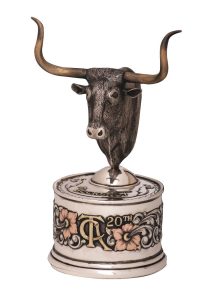
Compton spent roughly 300 hours on this hand-sculpted steerhead bust for the TCAA’s 20th annual exhibition and sale. He sculpted the head from a solid block of sterling silver, adding the ears and 10K yellow gold horns separately. He used a bandsaw, a grinder, and “lots of trial and error” to get the piece exactly how he wanted it.
It took another 15 years and a handful of other jobs including rodeoing and time on the railroads, before Compton was able to silversmith full time. In 2007 he met bit-and-spur maker Wilson Capron in Texas and even though he revisited his earliest desire to make bits and spurs, pure silversmithing still won the day for him.
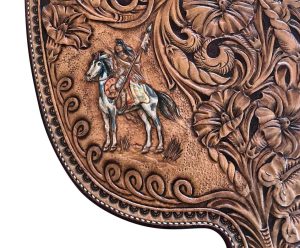
For the saddle she’s building for the 2026 TCAA Exhibition & Sale, Gessell took inspiration from Charlie Russell’s paintings, recreating various scenes which honor Native Americans. The morning glory flowers she tooled on the fender shown here represent renewal and resilience.
In 2014, Compton won the TCAA fellowship and studied under master silversmiths Scott Hardy and Mark Drain. “What I learned from them in a year,” Compton says, “it probably would have taken five or ten on my own.” Two years later, he became the first TCAA fellowship winner invited to become a full TCAA member. This year will be Compton’s tenth year bringing his best works to the TCAA Exhibition & Sale.
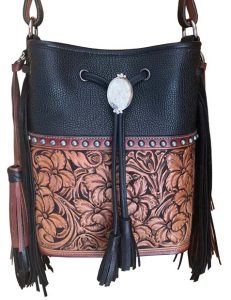
Gessell crafted this leather Western purse that is both practical and elegant, featuring a small interior pocket and silver accents by TCAA silversmith Beau Compton.
Perhaps the most important piece of equipment linking a cowboy and his horse, the Western saddle requires highly specialized woodworking, engineering, and the elegant details told in leather carving and stitching.
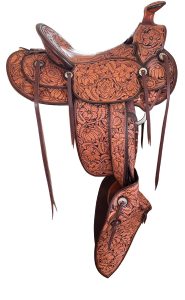
Focusing on both the practical elements of a saddle – it needed to be ready to ride – and its beauty, Gessell built this floral saddle for her first TCAA Exhibition & Sale in 2025. Built on a Wade tree by Dusty Smith, Gessell carved wildflowers that are each unique and used antique finish and various dye techniques for dramatic effect. Blue flowers on the cantle and sterling silver accents by TCAA member Scott Hardy make this piece unforgettable.
As a child, Montana saddlemaker Carol Gessell taught herself to make tack for her model horses with a Tandy leather kit. In 2025, eight years after she studied under master TCAA saddlemakers with a fellowship, and 27 years after she’d started her own leatherworking business, Gessell became the first woman TCAA member. This year will be her second TCAA Exhibition & Sale.
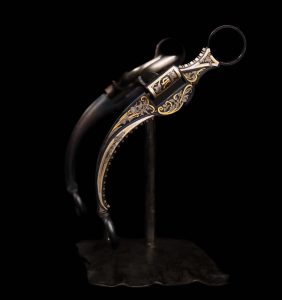
This 2023 Engraved TCAA Futurity Bit pairs contemporary shanks and mouthpiece with Capron’s own penchant for relief engraved scrolls and 24K gold inlays. Fine silver and 24K gold pinstripe inlays frame the decorations.
As tools for communication between a rider and their horse, the best bits and spurs are about fit, balance, shape, and precision in all things, from the mouthpiece to the shank to the heel bands. For TCAA artists, perfection in those elements adds up to rare beauty.
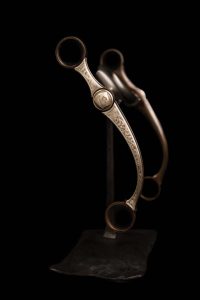
The Deadman’s Hand Bit incorporates solid shanks, a versatile mouthpiece and sterling overlays. On the concho, the detail of The Deadman’s Hand was inspired by the lore of the hand Wild Bill was holding – two black aces and two black eights, spades and clubs – when he was gunned down in a poker game in Deadwood.
“The TCAA represents a small portion of our culture that represents the elegance of the West,” says Wilson Capron, a West Texas bit and spur maker, and a member of the TCAA since 2004. Capron spent five years working under emeritus TCAA member Greg Darnall before launching his own business. Each piece for Capron speaks first to function — Will it work? Is it comfortable? — and then to artistry, which is the part, for him, where he can tell his story in steel.
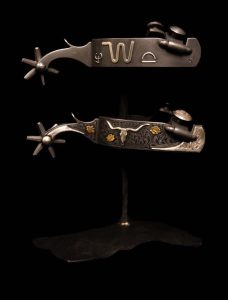
Wilson Capron’s great-great-grandfather trailed cattle from Kansas for the first time in 1880. His brand, the 7W, along with Capron’s father’s and grandfather’s brands show up in these TCAA 2025 Cattle Drive Spurs. The longhorn skull is sterling silver and 24K gold roses are surrounded by fine English scrolls engraved into the steel.
Starting with the preparation of the animal hide, then cutting and intricately braiding it into decorative and functional equestrian gear including quirts, reatas, bosals, hackamores, and reins, rawhide braiding requires ingenuity and patience.
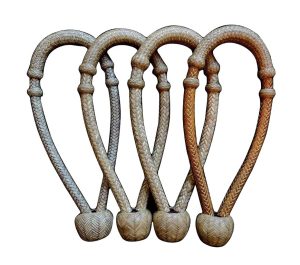
Wald sold these four hackamores, some with natural rawhide string and some with dyed string, at the 2025 World’s Greatest Horseman and Celebration of Champions. Today they are at use in the working cowhorse world.
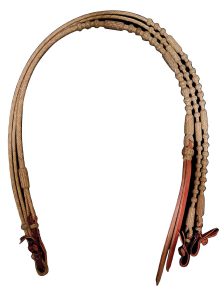
This pair of Wald’s natural rawhide reins and romal were part of a full bridle set that was awarded to the Open Bridle Horse Champion at the 2025 Celebration of Champions in Fort Worth.
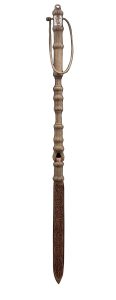
This quirt was braided with all natural rawhide for the TCAA Exhibition & Sale. “It was really nice hide and I cut it fine and put a lot of shape in the buttons,” Wald says. The silver was done by emeritus TCAA member Mark Drain. The popper was made by TCAA emeritus member Pedro Pedrini.
Rawhide braider Nate Wald was the first non-founding member, joining TCAA in 1999 as a craftsman, horseman, and rancher from Lodge Grass, Montana. Though he started braiding in college with what he learned from a book, Wald was the beneficiary of several good teachers early on in his career and, as his own hours at the bench grew into the thousands and tens of thousands, Wald has passed his knowledge along to numerous young braiders, including his own son and nephew. Wald prepares skins from his own herd for the rawhide he will transform with precision and creativity into such masterpieces as the 16-plait reins and romal, the California-style quirt and the red Angus hatband he brought to his 27th TCAA Exhibition & Sale in 2025.
No Comments