




03 Jul Rendering: Space That Resonates
Michael Hennessey, the founder of San Francisco-based Hennessey Architecture, is known as a minimalist, but his aims are far from minimal.
“Even though our work is very measured and composed,” Hennessey says of his firm, “my hope is that it elicits an emotional response. That’s the goal, which is very hard to get to, but I think every now and again, a project will reach the point of being magical. When people come into a space and gasp — that’s what we’re trying to get to. And it’s difficult, because we’re dealing with budgets and planning departments, and very technical things.”
The clients requested an outdoor shower in the backyard for use after a jog or bike ride.
The work of Hennessey’s staff of four reflects the restraint associated with minimalism, but the aim isn’t simply to pare design down to its essence; it’s to create homes that act as shelters, that escape into the calm that’s missing in today’s overwhelming world of technology.
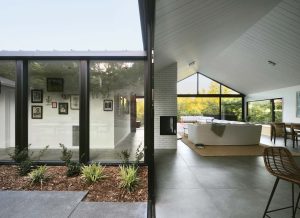
A cathedral ceiling in the open living space creates a comfortable volume that captures abundant natural daylight.
“I react negatively to spaces that have been over-designed,” Hennessey says. “Everywhere you turn there’s a lot of visual noise, so that when you layer in people’s lives on top of the visual noise, it becomes kind of maddening or heavy. I think in the world we live in now, with the influx of technology into all of our lives, this idea of home as refuge from the outside world is very interesting. That’s one of the amazing things about architecture in the time we’re in now. As AI is taking over, architects will have this amazing role as we deal with physical space.”
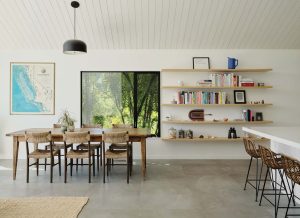
The wood shelves and adjacent window create a simple composition in the dining space.
Hennessey received his undergraduate degree at Arizona State University (ASU) where, in his first two years, he was influenced by instructors from prominent East Coast universities. In the second two years at ASU, a new director from Southern California’s SCI-Arc, steered the school in the direction of making and assembly. Hennessey went on to earn his masters degree from Berkeley’s architecture school. But for all the instructors from prestigious schools, one of the most profound impressions during that time was the light over Arizona’s deserts.
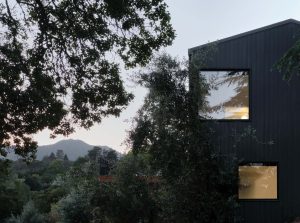
The vertical black cedar siding nestles the home into the landscape, with Mount Tamalpais looming beyond.
“For someone from the Bay Area, understanding the primal nature of the sun and what it means to create and inhabit space in a harsh environment, is vital,” he explains. “Even though the majority of our work is for more temperate climates, that initial, foundational relationship to sun and light and shadow is still something that carries on.”
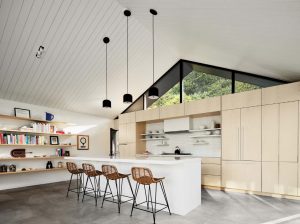
A triangular clerestory window above the kitchen’s ash cabinetry brings the landscape and morning light into the space.
He’s also been influenced by Japanese and European architecture, including the work of the late Barcelona architect Enric Miralles, who was known for daring, inventive designs. Hennessey was also moved by the work of Samuel Mockbee, who founded the Rural Studio program at the University of Alabama, giving students the experience of designing and building affordable structures for Southerners living in poverty. Mockbee came to Berkeley for a semester during Hennessey’s studies. He took the class out to California’s Central Valley and built a modest bus shelter.
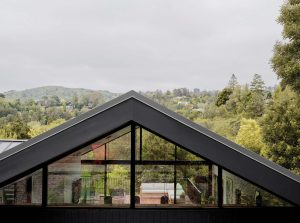
Creating a dramatic connection to the landscape was the primary goal of this new cathedral ceiling above the open living and kitchen space.
“I think that was my introduction to actually seeing architecture come to life,” Hennessey says.
While in grad school, Hennessey worked at William Stout Architectural Books. That’s where he discovered the work of San Francisco architecture firms Leddy Maytum Stacy (LMS) and Aidlin Darling, firms he worked for after college.
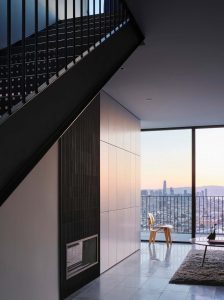
Twin Peaks is the redesign of a deteriorating 70-year-old single-family San Francisco house. To create three apartment units, two stories were added above and one below, thus adding five floors in the rear. Painted custom cabinetry conceals a TV in an upper unit, shifting the living room’s focus to the view of downtown San Francisco.
“I think the ethos that connected those two firms was an honesty of material, of light. At that time, honesty was kind of a big word in architectural discourse.” For instance, he explains, “With wood, you’re trying to embrace what the wood is. You want it to read very honestly and naturally, rather than getting into various finishes that make it something that it’s not.”
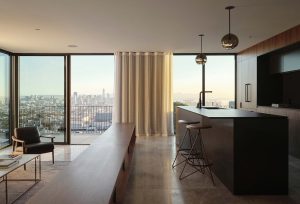
In the middle unit, a walnut combination bench/shelf is integrated at the height transition between the living room and kitchen.
In a room that might initially appear a bit austere, Hennessey may create warmth and a mood of calm with a wall of wood marked by a beautiful grain. He’ll use light in hallways, on staircases, or simply to frame a view of a garden or a cityscape.
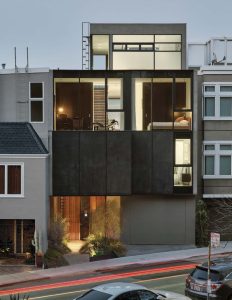
An entry garden and vertical wood slats at the steel gate invite people into the building. Cement plaster provides privacy for the bottom-floor bedrooms. The upper two floors are primarily composed of glass, as privacy is less of a concern there.
Hennessey opened the firm in 2009, and says of their work, “I feel like there’s a lot of European and Japanese sensibility in terms of detailing, composition, and material organization. And I think those ideas are something I’ve been thinking about more and more, and really diving into, because it’s not talked about much in architectural forums.” He discusses these crucial elements in talks given to aspiring young architects, whom he also encourages to take up the fine arts such as drawing, sculpture, and photography.
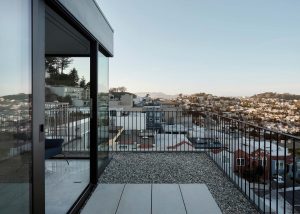
A view of the Corona Heights neighborhood is provided through the corner glass of the upper unit’s primary bedroom. Minimal vertical steel rods are incorporated to preserve as much of the view as possible.
Ultimately, though, architecture is a visual art bound by the constraints of the sites themselves, the clients’ needs, the budget, and local ordinances. “There’s so much beyond our control,” he says, “but what we do control is composition, color, the way that light is coming into a building, and proportion.”
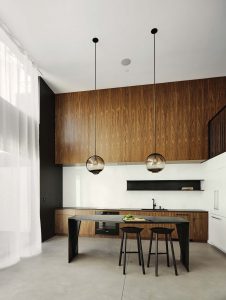
The double-height volume of the lower unit is framed by walnut panels and a full-height sheer curtain. A custom steel table is designed to serve as both a dining table and a kitchen island.
“I’m kind of quiet by nature so I think that might have an influence. And I just resonate with spaces that have only a handful of materials going on,” he says. “It’s about bringing natural light into spaces in a really compelling, interesting way, or engaging with the landscape in an interesting way. And that’s enough. I think there’s a kind of modesty to that as well: Our work might read as austere at times, but that’s not the goal. It’s more of an honesty of materials, a humbleness of space that we don’t have to come in and design with a capital ‘D.’ We want to create a backdrop for our clients to come in and bring themselves to the space.”
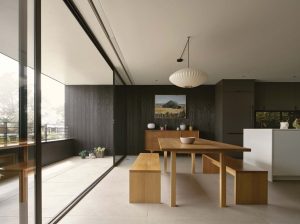
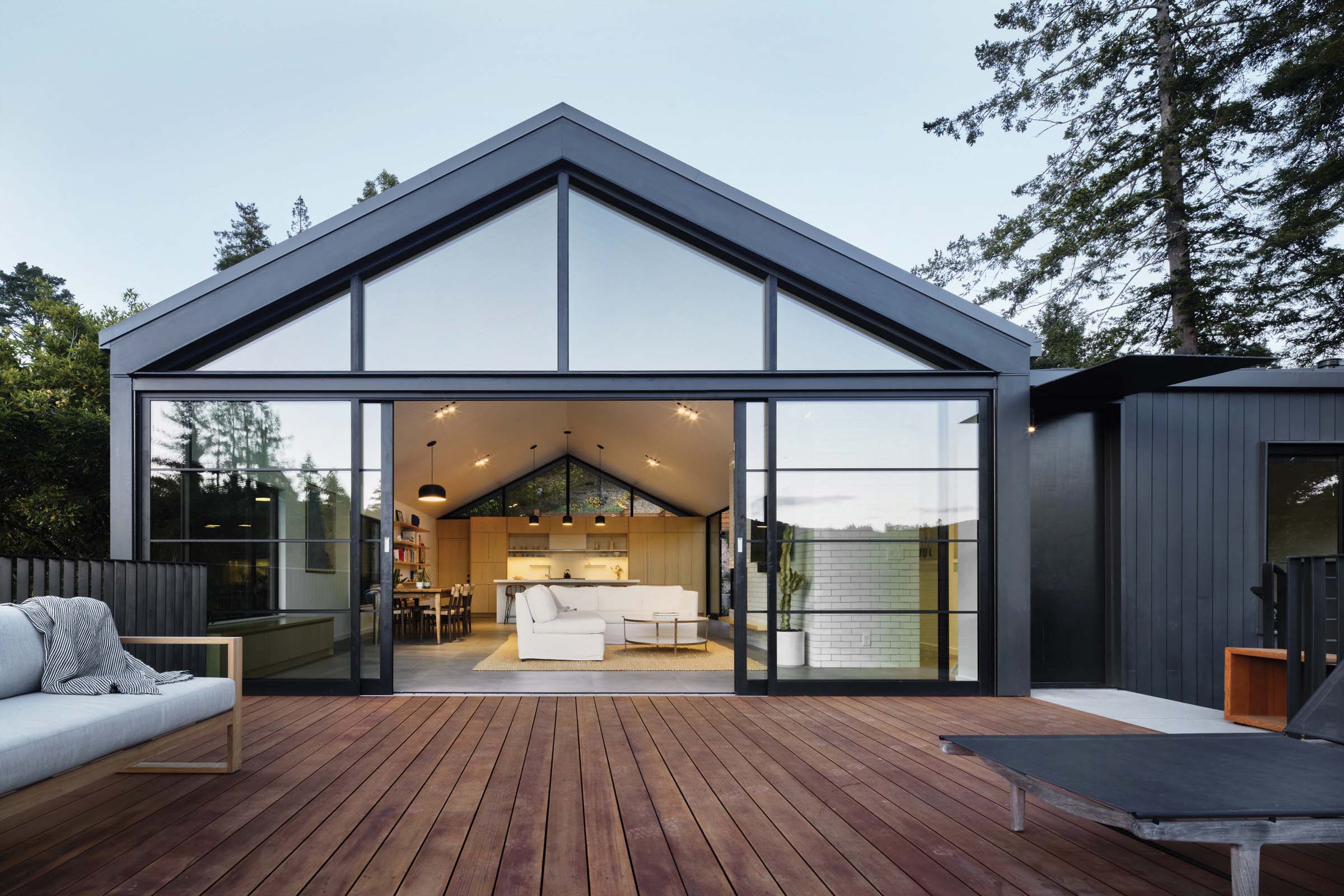
Up in the Clouds is a sensitive remodel of a 1962 Eichler house that had already suffered one clumsy redesign. Full-height sliding glass doors allow the floor, ceiling, and Shou Sugi Ban wood siding to seamlessly flow from the exterior deck into the dining space.
Hennessey’s initial introduction to architecture was a high school drafting course. “I took to it immediately, and even today, when starting a project, I still need to sit down at the Mayline — at the straight edge — and draft for a little bit before freehand sketching,” he says. “But it’s really that act of drafting that even now I need just to understand scale. And that hand-brain connection is still such a critical thing that’s hard-wired into us.”
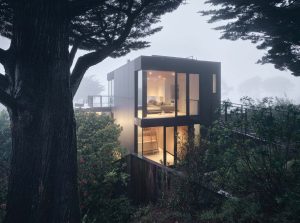
A family room was added to the existing three-story structure. Exterior cement board panels connect the new addition to the bedroom level below. Corner windows frame views of the surrounding Monterey Cypress trees.
After a brief questionnaire, drafting and sketching remain an important element in honing in on his clients’ needs and desires in a way that words alone cannot. So often clients have difficulty expressing their wants, but this process can provide Hennessey with insight and allow the design to be worked until it’s a combination of the client’s vision and Hennessey’s inspiration. Each client is different, each site is unique; Hennessey has worked hard to perfect the art of listening.
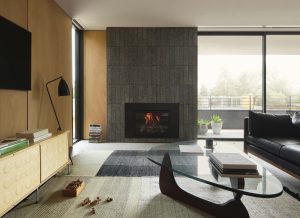
New concrete block at the fireplace and mahogany wood wall panels bring texture and color into the living room space.
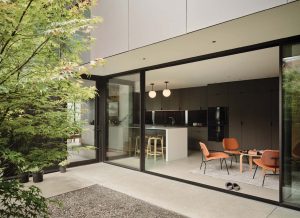
The kitchen and play area open to a Japanese Maple in the courtyard.
In nearly three decades as an architect, Hennessey has worked on a wide variety of projects, from ground-up custom houses to extensions, to careful rethinking of historic structures, including a much-photographed transformation of a single-family home into three unique apartments. He’s even designed a prefab house.
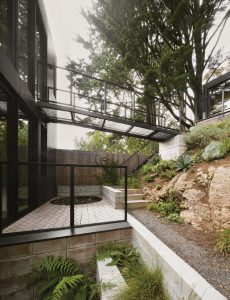
A steel bridge was incorporated to connect the new family room to the hillside in the rear yard. A sauna and workout shed are perched at the top of the hill, while a spa on the deck is a place to relax at the end of the day. New landscaping by Cobble & Forge complements the new board-formed concrete elements on the hill.
“The word beauty comes up again and again,” he says. “We don’t set out to make ‘beautiful world’ work — and it’s a very subjective thing, but I think it’s really important. And I think it’s something I’m talking more and more about with colleagues or younger folks who are interested in architecture. I think beauty is undersold as an artistic component of architecture, because that gets to our emotional response when we’re occupying space or engaging with the landscape and how space can improve lives. For me, it taps into this primal aspect of how we as humans occupy space and how light influences our mood.”
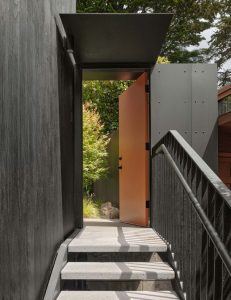
The entry door to the exterior courtyard is framed by a steel plate canopy, Shou Sugi Ban siding, and cement board panels.
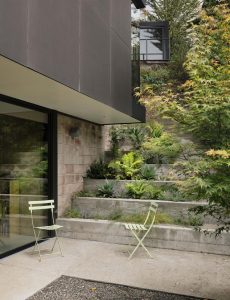
New board-formed concrete terraced planters/steps are designed to tie the courtyard space to the hill at the rear yard.
Laurel Delp is a frequent contributor to Western Art & Architecture and other magazines and websites, including Town & Country, Departures, Sunset, and A Rare World.
Based in San Francisco, California, photographer Adam Rouse is a trained architect who brings a unique focus to the exploration of light, structure, and space in his assignments that have taken him across the West, and into the Rocky Mountains and Eastern woodlands.
No Comments