


30 Apr Artist Spotlights: Jennifer Ghormley
Jennifer Ghormley found printmaking by chance. She wanted to take a class in fine art photography at a local college, to expand her commercial photography skills, but those classes filled quickly and she never could get in. Printmaking, however, had some openings, so, why not? She knew nothing about it but quickly discovered two things that set her on her path: First, printmaking and photography processes overlapped in key ways; and, second, printmaking studios tend to be welcoming, community-oriented spaces.
“I was also taking an art history course,” she says, “and learned of the wildly creative 1970s feminist art movement.” That knowledge inspired Ghormley to do a little experimenting herself with techniques, papers, and fabrics. Recognizing her eagerness to explore printmaking, one of Ghormley’s professors, E.C. Cunningham, asked her to help out in his studio and assist with his classes. Cunningham became her mentor and encouraged her to pursue a bachelor’s degree in fine art and then to go on for her masters, which she completed at the University of Nebraska.
Printmakers and photographers are the art world’s mad scientists — they are constantly experimenting. Early on, Ghormley embraced this mindset and found her tribe at national printmaking conferences where the diversity of concepts and experimental zeitgeist was on display.
But here’s the thing. As much variety as there is in prints, they are also ubiquitous; we are literally surrounded by prints from the label on a milk carton to drapery to that old Bonnie Raitt concert t-shirt. That familiarity can make it difficult for an artist to get her footing in printmaking and actually make a living.

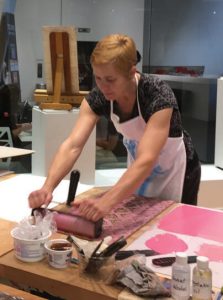
Process image of lasercut woodblock of stars, next to roller and ink slab. This was for a permanent installation at the Children’s Museum at the conclusion of Ghormley’s residency there.
“In general,” Ghormley says, “there is a societal misconception about the word ‘print.’ People don’t always make the distinction between a commercial or digital print and a hand-pulled fine art print. There’s a great essay by Walter Benjamin from 1935 called ‘The Work of Art in the Age of Mechanical Reproduction.’ He wrote about the ‘aura’ of a work of art, questioning if it loses that unique quality through industrial production. That has always stuck with me.”
And then there’s the inherent snobbery in the fine art world that questions whether printmaking and photography are even legitimate works of art because they are reproducible and rely on technology. But Ghormley has found that the majority of people she meets value handmade works of art, even if they sometimes expect commercial, mass-produced prices. “I see this as an opportunity to engage and educate people,” she says, “so they understand the value of what they are looking at and how it is made.”
Ghormley comes from a long line of sewers, quilters, and creatives, many of whom have influenced her art. “As a slightly rebellious child,” she says, “my inquiry through life has been to question the rules and push those established boundaries somewhat.” In grad school, this led to experimenting with site-specific artworks, and printing on fabric to create unique sensory experiences for viewers. “We wear fabric on our bodies, next to our skin, and often select clothing for its texture and feel,” she says. “An aspect of my work resonates with the emotion that comes with physical touch. Printing on fabric was a natural way to investigate this sensation.”
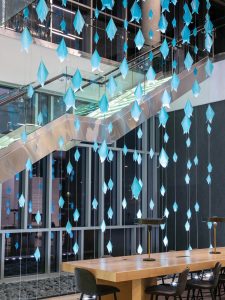
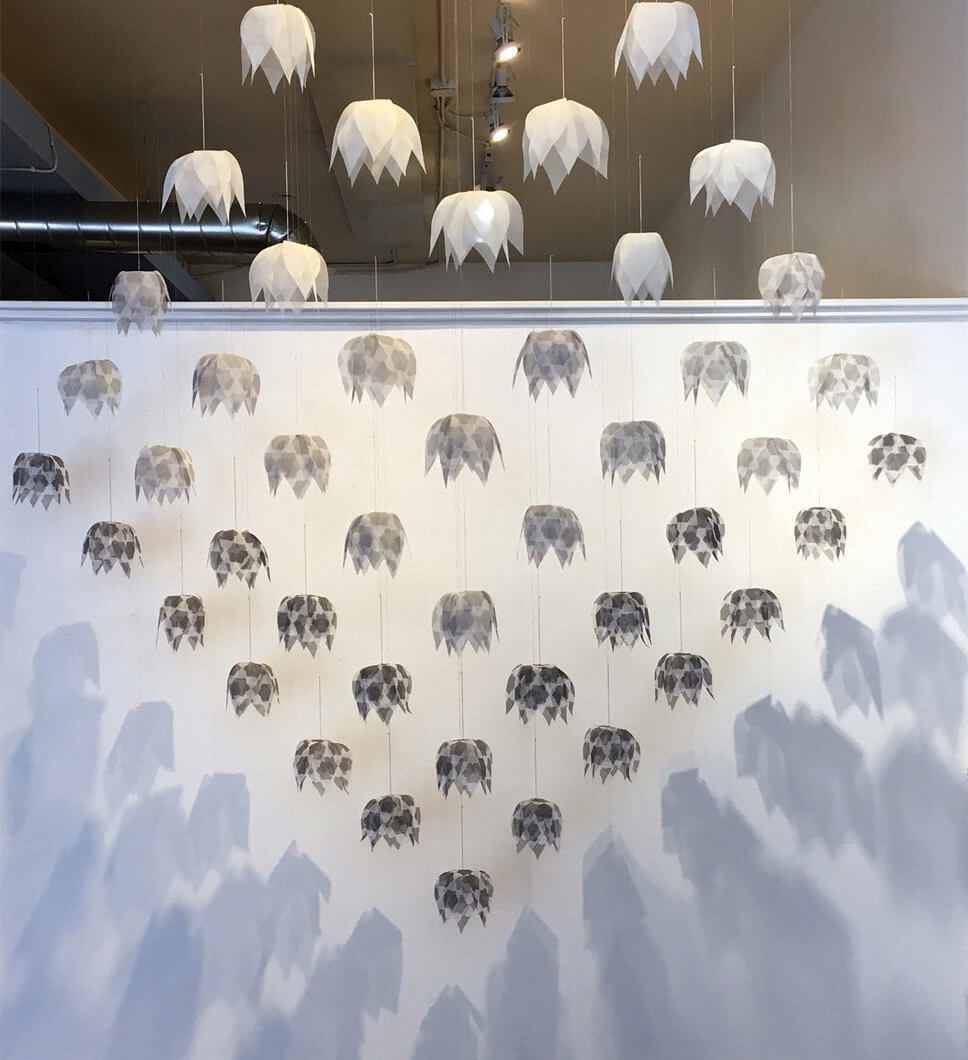
Bloom, commission for Springhill Suites | Woodblock Print on Frosted Mylar, Sewing, and Thread | 12 x 3 x 24 feet
Going big with site-specific installations has also been a welcome challenge for her. Because of the way she works, primarily in silk screen (serigraphy) and woodcut, often incorporating fabrics, her multi-media pieces make calming ethereal installations for public spaces such as hotels, gyms, and spaces for children.
These installations require hours and hours of creating multiple printed elements with slight variations that come together in a finished piece. “I never know how a piece will truly end up until the actual installation process happens,” she says. “Typically, hundreds of pieces are suspended individually from the ceiling in a flowing pattern so that the end result is smooth and seamless. The delicate nature of these installations makes them susceptible to air currents and movement, so that there is subtle interaction and engagement between viewer and artwork.”
And while traditional printmaking hasn’t changed much over the years, Ghormley says new technologies such as stencil cutters, laser cut machines, CNC router, 3-D printing, digital printing, even automated screenprint machines and presses, are making some aspects easier. “The thing that remains consistent in printmaking,” she says, “is the fact that ink is applied to a matrix and then transferred to a substrate.”
When you weigh all the factors that make printmaking beautiful and collectible versus its ubiquitous nature and availability in multiples, making a living as a printmaker can be tough. In 2010, Ghormley was running up against a whole bunch of frustrating issues that spilled into her personal life. Her solution? Separate out personal artwork — fine art prints and installations — from commercial goods: Think kitchen towels, napkins, table runners, tote bags, and apparel. “This was a great relief and freed me up to make personal figurative art as well as commercial work that didn’t need to be framed.”
From May through December, Ghormley presents her more commercial work at street art fairs. And while it might sound like a grind to attend art markets most weekends through the summer, Ghormley has developed a dedicated following of collectors as well as fellow artist vendors she enjoys seeing. “What I like about doing these markets is that it gives me immediate access to a wide audience base,” she says. “And I aim to keep my pricing as affordable as possible, so that just about anyone can find something that works for them. Interacting with thousands of people nearly every weekend provides direct feedback on my products and designs.”
Another big lesson: setting boundaries. “As my small business continues to grow, I am learning what my limitations are,” she says. “My desire to keep a home-based studio and maintain high quality handmade products keeps the business at a certain level, which I have come to terms with. My goals are not to become Jen G Studios available at Target or Amazon. I want my customers to meet me, the artist, and buy directly from me, the person who made everything.”
No Comments