






30 Apr Collector’s Eye: Nature Versus Nurture
If the love of art has a genetic component, Sue Simpson Gallagher’s penchant for collecting was surely passed down through many generations of hearty Westerners who helped cultivate art appreciation in the barren lands of Wyoming. My paternal great-grandparents were patrons and her maternal great-grandfather was a painter. Other relatives were early supporters of the Buffalo Bill Center of the West where, as a young girl, Simpson Gallagher spent countless hours in the Whitney Western Art Museum.

At home, her mother nurtured the love of art. “She had us play a game where we would name the artists of works of art from all over the world and different art periods,” Simpson Gallagher recalls. “I don’t remember a time when that kind of learning, that kind of education about art, wasn’t a part of my life.”
Travel was yet another learning opportunity. “My parents were cultural travelers. It was always very important to them that we knew about the local arts of the areas we visited.”
Even being uprooted during her sophomore year in high school contributed to a lifelong pursuit of art. “We moved from Cody to Washington, D.C. in 1978, which was difficult in the beginning, then became one of the most wonderful experiences, partly because we went to museums every weekend. We went to countless exhibitions at the Smithsonian, and they were all free!”

Scott Fraser, Ring Toss | Oil on Board | 11 x 7 inches
Not surprising, Simpson Gallagher chose to study art history in college. But Colorado College, where she earned her undergrad degree, didn’t offer a concentration in American art, so she studied the Italian Renaissance. After attending a Larom Summer Institute Class at the Buffalo Bill Historical Center taught by the brilliant art historian Barbara Novak, Simpson Gallagher says she became a groupie and later followed her to Columbia University in New York City, to continue her art education and pursue a graduate degree in American art.
With so many options for a career in the arts, why, we wondered, did she open a gallery in Cody, Wyoming? We caught up with her to find out.
WAA: I’m not sure you could have picked a more remote place than Cody to open an art gallery. Why not choose a bigger city with a concentration of collectors?
SSG: It wasn’t even a consideration to stay in the East and start a gallery in an urban area. Opening a gallery in Cody was my way of getting home. My husband, John, and I were living in New York City, and we would think, ‘Ok, if we’re going to return to Cody, Wyoming, what could we do there?’ John suggested that we could start a gallery. So, I reached out to the artists I loved and already knew from when I lived in Jackson, Wyoming, and worked at Trailside Gallery and the National Museum of Wildlife Art during and after college. I met Kathy Wipfler and Tim Lawson, Clyde Aspevig, Skip Whitcomb, Bob Barlow, Geoff Parker, Walter Matia, Bill Reese and Hollis Williford in Jackson, and they became the core group of people who joined my gallery. They introduced me to other artists they respected and who I, in turn, began to represent.

Interior of the gallery. Photo courtesy of Simpson Gallagher Gallery
Truly, there is a lot of trust and understanding that goes into signing on with a gallery in Cody. I’m only full time during the summer and fall and by appointment in the off season. Cody is a small tourist town that is really only busy for five months a year. But I recognized that I could still keep the gallery going while raising my children and living a balanced life.
WAA: When people think of Western art, it’s often with Remington and Russell in mind, but your focus has always been a little outside of that. How did you decide on what art you wanted to show in the gallery and collect?
SSG: I’m pretty sure working at Trailside was the impetus for me to have a more regional gallery. And I think because I identified so strongly as a Westerner, my grounding and my heart-home is in the Western landscape. When I drive across Wyoming, I think, ‘This is what I love.’ I love the way the light plays on the landscape. I love how a lone tree in the middle of that High Plains desert is a lot of what I think of as truly beautiful.
WAA: Were your parents collectors?
SSG: Yes, they couldn’t imagine a life not surrounded by art. My parents were collectors of lots of different things. My father was a book, coin, and stamp collector, and he loved history. And so, for him, collections told not only about his own history but also about the history of a place, particularly Western American history. And my parents were patrons of artists. They believed in supporting young artists because they loved contributing to their well-being, their lives, and their careers.
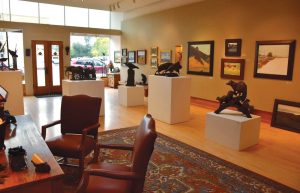
Simpson Gallagher Gallery displays naturalism paintings and sculpture, often hung salon style. Photo courtesy of Simpson Gallagher Gallery
When we lived in D.C., my mom would have art shows. That’s how I came to know Willy Matthews — my mom had a show for him. And when I became friends with Tim Lawson in 1985, I encouraged him to visit my mom in D.C. when he was driving east from Wyoming to paint New England. When Tim stopped by, my mom said, ‘I hope you have paintings with you.’ He said he did, so she called two friends, and sold all the paintings in Tim’s car, three of which she bought.
WAA: When did you start collecting art?
SSG: I think Christine Mollring at Trailside Gallery was the one who told me, ‘You don’t have to be wealthy to collect art.’ When I left Trailside after my internship in 1982, she gave me a bonus of a certain dollar amount in art. Christine helped me build a collection. But I’ve always been a collector. I collected dolls and books as a child — things based on my emotional response or remembrance of a time or place. And so that’s what happened with my art collection, too. It’s a landscape painting and wildlife sculpture collection, primarily, but it’s more than that. Certainly I bought my friends’ work. And in the early days of the gallery, any of my profit would be put into art purchases. I was a kid in a candy store. I still am.

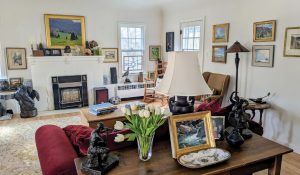
In her home, Simpson Gallagher displays art so that she sees objects in varying angles and light. Photos courtesy of Sue Simpson
WAA: Did that make it easier or harder to sell art you loved?
SSG: I always think of myself as more of an ‘art placer’ than an ‘art dealer.’ I’m finding homes for pieces, right? I’m not a good salesperson if I feel like you’re not all in. I don’t want to have to resell it when you decide you don’t want it. I’m never going to guarantee that it’s worth what you paid for it. I’m never going to guarantee that it will increase in value because there is no guarantee of any of that. And also, I’m not in the business for investment purposes. Art is not commodity to me.
WAA: I imagine you have quite a collection. Are you still collecting?
SSG: I find that my collecting has slowed down partly because I love everything I have, and not as many pieces call out to me. And I also can’t afford many of the pieces that do call out to me. There’s that. I can’t really afford most of what I have in the gallery; these artists are at a different level now. But I do have art in closets, and my children don’t understand it because if it’s not on the walls for someone else to enjoy, how can it still bring me joy? But the fact that it’s hidden away in a closet, it brings me joy, just knowing I have it and I can bring it out.
WAA: That’s the double-edge sword, right? You did such a good job promoting them that you now can’t afford to buy their art.
SSG: I’m no marketer, but I do have a good eye. I was raised by a mother and father, who are and were connoisseurs. And connoisseurship is very important in collecting.
WAA: We talk about that often in this magazine. How do you recommend people become connoisseurs?
SSG: You look and look and look. I never go anywhere without visiting museums and galleries. To become a connoisseur, you need to ask someone who knows something about art, whether that’s a museum curator or an art dealer, gallery owner, a writer, or an artist. Most importantly, I say, ask artists whom you admire, ask them who to learn about. Go into every gallery and museum you can, but most importantly, trust your gut. Why would you want to live with something that doesn’t move you? Why would you want to live with something that doesn’t make you feel good? And it doesn’t mean it has to be beautiful in the traditional sense. But I do believe it has to touch you.
WAA: Has your taste changed over time?
SSG: I think, in collecting, you shouldn’t cut yourself off from the possibility of growth or change of taste. And sometimes it is a matter of age. The more you know about life and the more you’ve seen, the more your perspectives change, including your perspectives on art. At least I found that for myself.
I think about Rothko, how I grew to admire his work. Did I ever have a negative response to Rothko? No. But I was unimpressed. And then I went to the Rothko Chapel in Houston, and I was so moved by it; it was a truly spiritual experience. I’m a Rothko fan now.
WAA: It seems that self-reflection and being open to the emotions art stirs in you is an important part of becoming a connoisseur.
SSG: Yes. And as I get older, I think about my own collecting quirks. I think it’s so good to be able to question why you have a specific response to art. You don’t have to love something to appreciate it. But I think you do have to love it to want to live with it.
Curator and writer Rose Fredrick shares her extensive knowledge about the inner workings of the art market on her blog, The Incurable Optimist, at rosefredrick.com.
No Comments