


30 Apr In the Studio: Artistic Evolution
Livingston, Montana, is a place of contrasts. It’s a railroad town with a hint of grit, a crossroads where the road from Yellowstone meets the interstate, and the closest sizable town from Bozeman on the other side of a pass just high enough to cause chaos in winter weather. It’s also a place that is said to have the highest concentration of writers per capita in the country, plus musicians, artists and artisans, and a variety of luminaries from the entertainment world. It also has a John Deere dealership, small-time casinos, and a couple of grain elevators. It’s a town whose main streets, lined with well-preserved historic buildings, lead the eye to dramatic mountainscapes. All day and all night train whistles reverberate through town and out into the surrounding countryside.
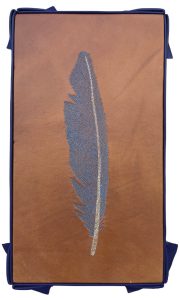
Great Blue Heron Feather | Stitched Leather | 18 x 10 inches
Located halfway down a block anchored on either end by two of the town’s most popular understated-but-sophisticated eateries lies a large, unassuming storefront. Instead of a sign over the entrance, there’s a small notice on the door. Windows flanking the doorway might display a single object. Views inside the shop are shielded by fabric. In short, it’s easy to miss. But when the artist is in, she leaves the door ajar.
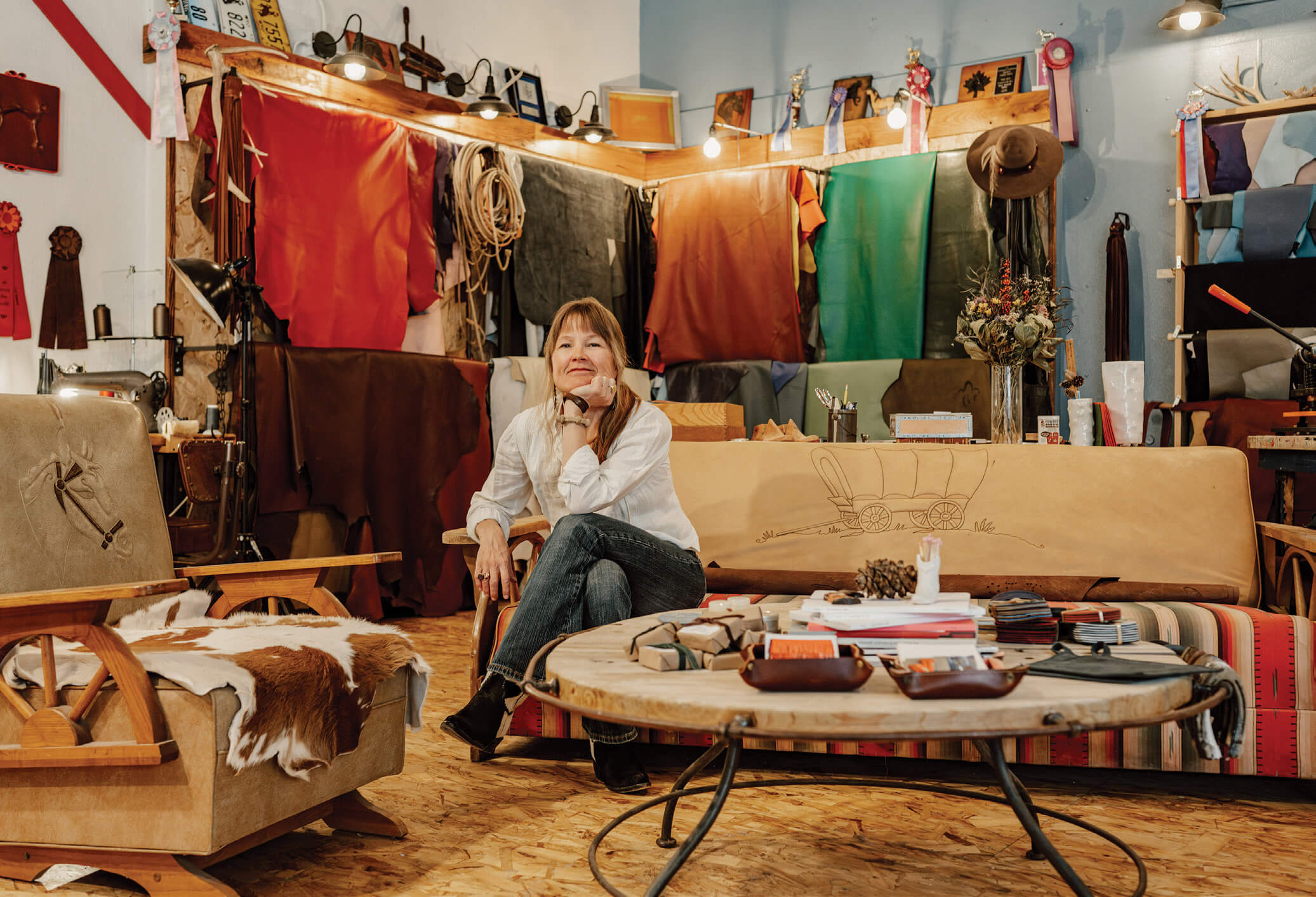
Inside, the roomy space opens up like a time capsule: High pressed-tin ceilings, bits of exposed brick and old-timey ranch furniture — a wagon-wheel sofa with Southwestern upholstery and a covered wagon motif on its leather back — inhabit a space anchored by a massive wooden workbench on wheels. Western bric-a-brac — dried flowers and antlers, vintage cigar boxes and packages of Lucky Strikes, old lariats, and battered Wyoming license plates — decorates every surface. And everywhere one looks there are hints of the artist’s craft. Heavy antique industrial sewing machines stand sentinel along the edges of the room. Whole hides of smooth leather in richly-dyed hues hang off rods in one corner. There are rows of wood-handled leatherworking tools, large spools of brightly colored thread and handcarved wooden lasts. There are small-batch functional items like sturdy woven leather totes, coaster sets and handbags whose straps are made from lariats.
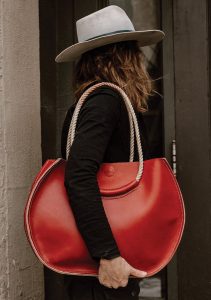
The ranching inspired Sac Lasso bag incorporates a lariat handle.
And then there are the one-of-a-kind art pieces crafted from leather by resident artist Chase DeForest.
In her collaged and stitched leather works, designed to hang on the wall as fine art, DeForest explores enduring themes of the American West, including the effects of human habitation on the landscape. She uses hides as conceptual jumping off points for her subject matter, which includes cattle, horses, ranching, wildlife and both native and invasive plants. She feels passionately about threatened habitats and the preservation of public lands and in her work might gently, and sometimes subversively, raise questions about their value to the viewer. “I like to do work that draws attention to the environment,” she notes, “sometimes as a form of activism and sometimes in recognition of beauty.”
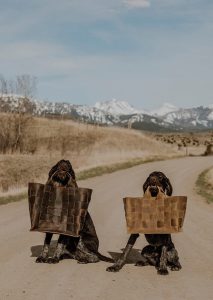
Professional bird dogs flushing the artist’s American oil-tanned tote bags.
In one series of artworks, each piece features a single species-specific feather of a threatened prairie grassland bird. Homages to iconic Western landscapes are rendered with lettering in the form of WPA-era posters. For her embedded tack series, she builds leather art around actual pieces of cast-off tack — bridles, bits, stirrups — that are past their functional life.
At times her work is influenced by the locale of an upcoming exhibition. For a show held on the edge of San Francisco Bay, she created a nautical-themed collection. For a recent art fair in Austin, Texas, she created a series of geometric Navajo-style trade blankets rendered in meticulously pieced leather.
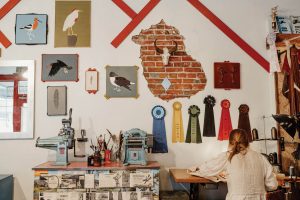
DeForest at work next to her vintage five-in-one and leather-splitting machines. Artworks on the wall include leather ribbons inspired by her 4H days. Photos: Chloe Nostrant
DeForest is a Westerner, a country girl who grew up in the idyllic 4H and hobby farm world of the rural Pacific Northwest. Artistically inclined from childhood, she went East to study studio art at Hampshire College in Massachusetts. Graduating with an MFA in furniture design from Rhode Island School of Design, DeForest pursued her craft while working for glass artist Dale Chihuly in Seattle, an architecture firm in Minneapolis and, for eight years, the Clyfford Still Museum in Denver. A chance conversation with a cowboy bootmaker caused an abrupt shift to her artistic focus. Ironically, it was at the exact moment her spouse’s career took them from Colorado to Washington, D.C.
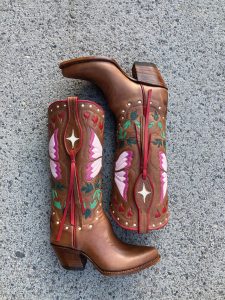
Wedding Butterflies | Cowboy boots commissioned for a bride
“I’d hit the wall with furniture making and needed a change,” she recalls. “Shop space is expensive, furniture is cumbersome to ship, and you’re competing with Ikea. As a medium, it’s not the be all and end all. When I met that bootmaker I thought, ‘How was I born and raised in a Western lifestyle without knowing about custom cowboy boots?’ In 2013 I quit my job and went to Texas for a two-week course with a third-generation master bootmaker. After I made my first pair, I thought, ‘How do I do that again?’”
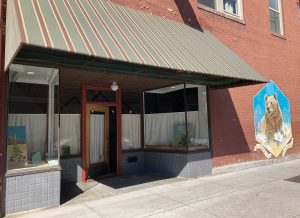
Studio front in downtown Livingston.
After a four-month apprenticeship in Sheridan, Wyoming, DeForest sold her entire woodworking shop to finance an unlikely professional pivot. “I flew to Dallas, rented a U-Haul, went to the tiny town where I made my first pair and bought an entire boot shop, including boot jacks and hand tools,” she recalls. She also bought sewing machines and a line sander, behemoths left over from the industrial shoe manufacturing era in America.
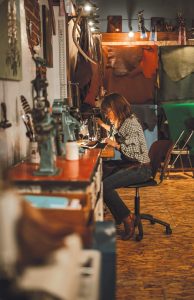
DeForest at work with her hide collection in the background. Photos: Chloe Nostrant
While she loved the discipline of making custom boots for a specific customer, within a few years she had started experimenting with leather as an artistic medium for original fine art. It seems counterintuitive that switching from furniture making to bootmaking would be less of a leap than bootmaking to leather art. But, she explains, “Boots and furniture are similar in that they’re both structural, functional, and use the same tool language. They are very craft-specific. It was more of a leap to make two-dimensional artworks. But I was really intrigued by hide and all the implications of cattle — on the landscape, as something we consume, and in the relationship to bison and ranching. There are so many issues surrounding cattle. And materially, leather is really rich to explore.”
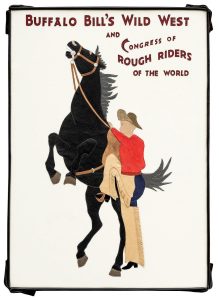
Rearing Bucker | Stitched Leather | 35 x 25 inches | An homage to the advertising genius of Buffalo Bill’s Wild West Show, based on original artwork by A. Hoen & Company
DeForest’s works are highly original, thought-provoking, and meticulously crafted. They are also beautiful, each a perfect balance of color, tone, and composition. And they represent a natural evolution of craft marrying art, the result wholly unique to an artist whose temperament and passions were forged in the West, honed in the East, and brought to full creative flowering through decades of inspiration and experience.
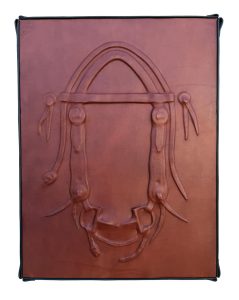
Western Pleasure | Bridle Embedded Stitched Leather | 34 x 26 inches | A piece from the artist’s embedded tack series
“When people ask me how long it takes to make something,” she says, “I usually answer ‘About 25 years.’ Theoretically you really can’t separate out garnering the technical know-how, working through a whole lot of ideas, interfacing with the creative world, and living enough life to have perspective. And, I’m hoping, a bit of wisdom. My inspiration works in much the same way; themes get honed over the course of time. I’m pretty productive and able to make quite a bit of work over the course of a year. That kind of continuity also really helps me work through, nurture, and grow other ideas about my work, as the processes for making it all come to fruition.”
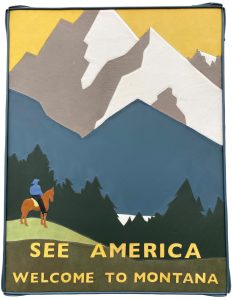
See America, Welcome to Montana | Stitched Leather | 34 x 26 inches | Inspired by the WPA federal poster project and based on original artwork by M. Weitzman
Longtime WA&A contributor Chase Reynolds Ewald is an author, editor, and consultant who helps creatives craft their stories. Her recent books include California Coastal with Heather Sandy Hebert and By Western Hands: Functional Art from the Heart of the West. Chase’s titles with her longtime collaborator, Montana photographer Audrey Hall, include American Rustic, Cabin Style, and the multi-award-winning Bison: Portrait of an Icon. Their newest book, Modern West, was released in September.
No Comments