

06 Mar An Honest Eye
In the fall of 2019, photographer Adam Jahiel got a call from Susan Wolfe, an art director he’d done some work for years ago. She had a project she wanted to run by him. The clients, she explained, were shy, sometimes difficult to read. They had trust issues, probably because they’d seen too much of the dark side of human behavior to think there was much else. But Wolfe had a feeling Jahiel’s calm, steady demeanor might put them at ease.
To Jahiel, this sounded like just the project he’d been looking for.
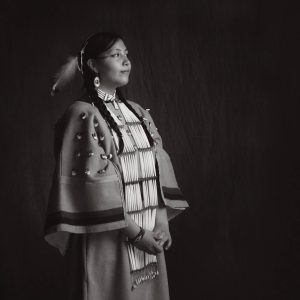
Shondine Kaline, Two Moccasin Woman, Neshe va, Silver Gelatin Print, 16 x 20 inches, 2023
It’s hard to say whether a camera makes a certain kind of man restless, or if a restless man enjoys wandering the globe with a camera in hand. Whichever order things played out in Adam Jahiel’s life, photography was not part of the original plan. Oceanography had been his dream, but that went by the wayside shortly after someone handed him an underwater camera. The next few years were a short hop into degrees in photography and photojournalism, an apprenticeship with a Hollywood celebrity photographer, followed by a stint on the 1987 French-American Titanic Expedition, which led to a teaching gig and a semester-at-sea in 1989 on a ship Jahiel calls a floating Motel Six for college students. This was still early enough in Jahiel’s career that there was nothing tying him down. “I put everything I had into storage and lived on this ship for four months,” he says. “It was perfect for me.”
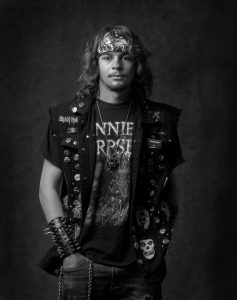
Isaac Westfall-Sheppard, Silver Gelatin Print, 16 x 20 inches, 2020
His teaching duties also included documenting the trip, which meant forays ashore in Spain, Turkey, the Soviet Union, India, China, Malaysia, Singapore, and Japan. The ship was outfitted with a darkroom, which reignited Jahiel’s love of black-and-white photography. “When I was in those countries,” he says, “I got such a heavy dose of reality and humanity and grit, and it was so fascinating to me that, on the way home, I started to think, there’s no way in hell I’m going back to Hollywood to do celebrity photography.”
Soon after he returned stateside, Jahiel left Los Angeles and headed north, where he got a job at the Sacramento Bee. There, an assignment to photograph the three-time world champion bucking bull, Pacific Bell, sent Jahiel down another road that led to a decades-long series of photographs. It all started with a cup of coffee.
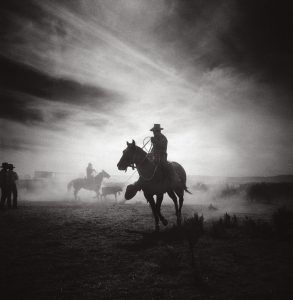
Top Hand, TS Ranch, NV, 1994, Silver Gelatin Print, 24 x 24 inches
“When I finished photographing the bull, I walked into this typical ranch cookhouse — a spare room with a flea-bitten couch at one end, whitewashed walls, and the ubiquitous red and white checkered tablecloth,” he recalls. “I felt like I’d walked into a Farm Security Administration photograph.” Inspired, he asked permission to make some pictures. “I kept my eyes open, and my mouth shut,” he says of the day that turned into a week. “I tried to stay out of the way and didn’t have much of a conversation with anyone, until the last day, when I told the ranch boss that I’d got what I needed, I’m going home. The boss didn’t say anything; he just rode away. A few minutes later, he came back and told me that if I wanted to do any more shooting, there’s the YP Ranch up the road and that I could use him as a reference. I have always thought his words were among the highest honors I’ve ever received.”
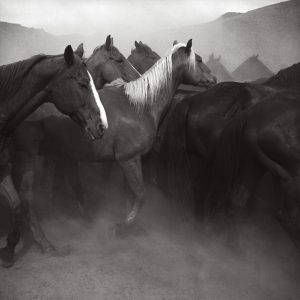
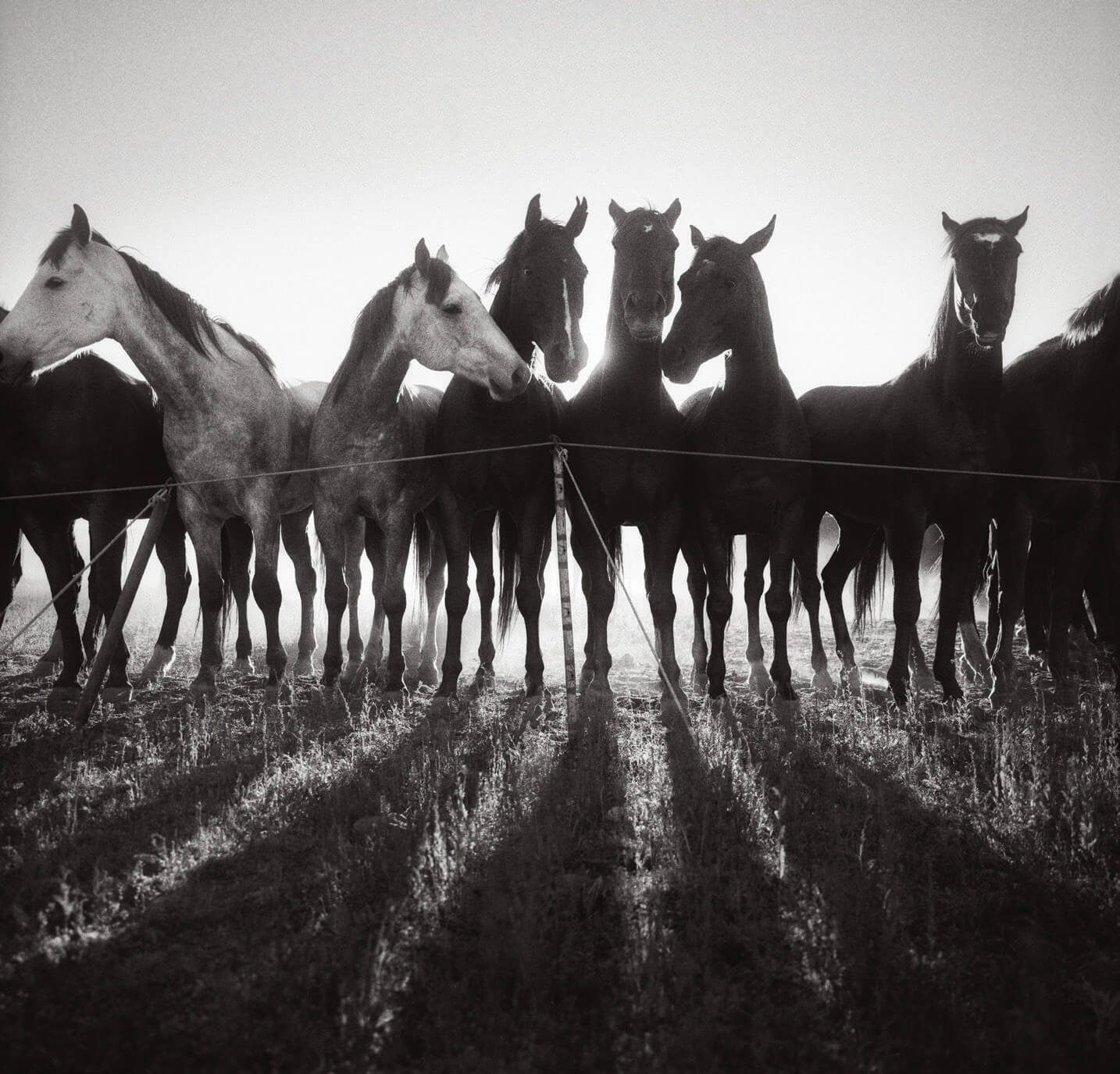
Remuda, Spanish Ranch 1995 | Silver Gelatin Print | 24 x 24 inches
After nearly 30 years and thousands of miles across barren lands of the Great Basin of Nevada and California, through Idaho, Montana, Utah, and Wyoming, Jahiel has created a major body of work capturing the authentic, unposed, and unsentimental life of American cowboys. “I think it’s much harder to let things unfold before your eyes and capture these little moments of truth that become symbolic of your subject. With the cowboy work, there isn’t a single posed picture.”
At a retrospective of this body of work held at the Northeastern Nevada Museum in Elko, in 2025, Jahiel was reunited with many of the cowboys and their families, widows and sons who have now taken over many of the ranches where he’d photographed early on in the series. All in attendance greatly appreciated the work he’d done and his honest eye. “I believe the importance of photography is to document humanity,” Jahiel says. “To freeze these moments that preserve a person, their soul, their community, and their history — that slice of life.”
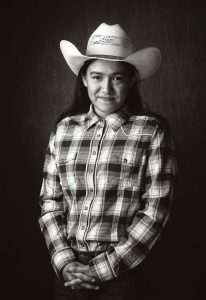
Baylee Small, Sunroads Woman, Ese’hemeona’e | Silver Gelatin Print | 16 x 20 inches | 2025
And like those cowboys, Jahiel too has grown older. Over the years, he put down roots in Story, Wyoming, near Sheridan, got married, and had kids. “It’s a funny little community we’ve got around here,” he says. “There are so many creative people that it feeds me more than it did when I was living in California.” After a pause, he adds, “L.A. is kind of a lonely place, you know?”
Lame Deer is 85 miles north of Sheridan, and a stone’s throw from the Little Bighorn, on the Northern Cheyenne Reservation. The Indigenous community struggles with serious economic and infrastructure problems. Lame Deer schools, kindergarten through high school, serve nearly 600 students whose math and reading scores have consistently fallen well below the national average. All students qualify for free lunch. By senior year, 30 to 35 students graduate — approximately 70 percent of the student body, which is up from 2017 when only 40 percent graduated. Because the school is three miles out of town, parental participation varies due to limited transportation options, illness, and financial hardship. That is, until graduation day: Ceremony, for this community, is everything.
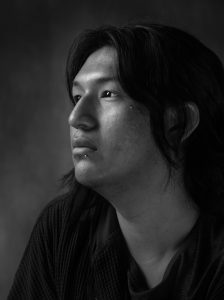
Loren Seminole, High Bear, Nah oxhoa’eho’oesestse | Silver Gelatin Print | 16 x 20 inches | 2025
Susan Wolfe drives an hour on barren, windswept roads to her teaching job at the Lame Deer Junior and Senior High School. She, like Jahiel, was a transplant to the West. She made her way from Minnesota in 1990 after riding in the Great Montana Centennial Cattle Drive of 1989. She’d discovered her deeper calling, left her comfortable job in advertising, and went back to school at Montana State University to earn a teaching certificate. She took a job in Lame Deer where she’s been the visual arts teacher for the last 16 years.
“It has been extremely challenging,” she says of the district and her school that was designated a ‘School of Promise’ in 2010. “That means we’re one of the lowest performing schools in the state. But,” she’s quick to add, “I remain hopeful.” That designation, along with being selected as one of eight schools nationwide for the ‘Turn Around Arts Initiative,’ has given the school eligibility for unique grants and opportunities to connect students with professional artists.
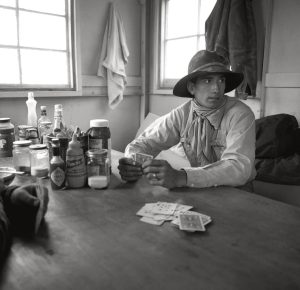
Riley Cleaver, Winters Camp, NV, 1994 | Silver Gelatin Print | 24 x 24 inches
To the great benefit of her students, Wolfe has gone after opportunities that have brought them to Los Angeles to make music videos; to the Oberon Theater in Boston to perform with members of the Silkroad Ensemble for Harvard University alumni; to Washington, D.C., to recite original poetry and play marimbas for President Barack Obama and First Lady Michelle Obama; and to Portland, Oregon, to participate in a show of Indigenous fashion.
And then, Covid hit. Social distancing spelled trouble for Lame Deer students who rely heavily on school for socializing. “And online learning was a disaster for the kids,” Wolfe says. But even worse was that their traditional high school graduation ceremony would be cancelled.
But Wolfe, ever on the hunt for opportunities for her students, had heard about a financial gift specifically for a photography project. Offered by a family in Atlanta with roots in Montana, the grant was made in memory of their son and brother, Paul. This gave Wolfe an idea. “I wanted to capture formal portraits that reflected each graduate’s state of mind on the actual day of graduation,” Wolfe explains. She envisioned the portraits in a bound book accompanied by quotes from each student. She knew, however, this would only work with a photographer who could treat the kids with professionalism and respect and would take the job seriously. That meant the person she hired needed to accept the kids no matter how they were dressed or what emotions they were struggling with. Jahiel, she believed, was the perfect person for the job.
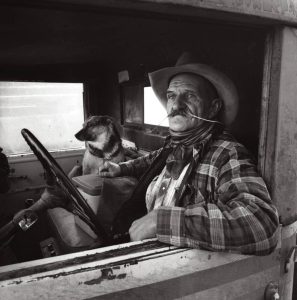
Fritz and Snooks, TS Ranch, NV, 1995 | Silver Gelatin Print | 24 x 24 inches
The financial support Wolfe received helped her to turn her art room into a serene, albeit makeshift, photo studio that would, she hoped, disarm the kids and help them feel safe when they met Jahiel. “Gaining their trust can take a long time,” Wolfe says. “Some of these kids may never trust. And they are very sensitive to their surroundings; you never know what emotions they might bring to the situation.” After a moment’s pause, she adds, “You can’t cheat these kids; too many people have.”
When I was in Hollywood,” Jahiel says, “I’d get some famous person to photograph, and I’d be thrilled. But I realized that, for those people, they just wanted to get it over with. It’s a completely different world on the Rez. I’ve always felt like people have an aura about them. With these kids, I might spend 10, 15 minutes talking to them, but when I look at the results, there’s the soul. It’s not just a recording. This is about capturing their essence.”
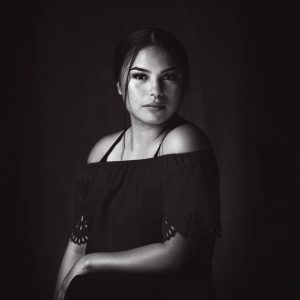
Kyleah Blackwolf, Red Painted Woman, Ma’etomona’e | Silver Gelatin Print | 16 x 20 inches | 2021
Now in the project’s seventh year, Jahiel says the students have given him as much as he’s given them, maybe more. “The kids taught me to let go and not try to control things. I respect who they are and what they want to present to the camera, if they want to present anything. And I always come out of it with a great deal of humility. I don’t say this about most of my work, but I really love these pictures, love these faces, and the backstories, even though there are a lot of incredibly tragic backstories.”
On a summer morning in 2024, another casket is wheeled into the Lame Deer High School gymnasium. In it, another young Native American gone too soon. And there, atop the casket, is a photograph, black-and-white, taken by Jahiel in 2022 on a graduation day when life still held a flicker of possibility. Over this last year, Wolfe says 12 of her former students have died tragically in car accidents, suicides, drug and alcohol overdoses, and murders.
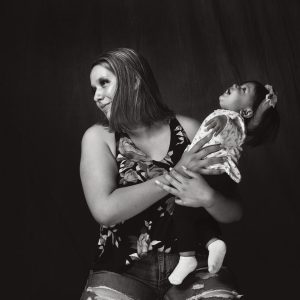
Chalayne Whistling Elk and Zendaya, Stands in Sight Woman, Me’eo’o’e | Silver Gelatin Print | 16 x 20 inches | 2021
“I can feel it starting to creep into me,” she says. “The PTSD. People talk about it but I’m only now starting to realize I might have a limit. Not yet though. I think I’ll know when I reach that point.” She says this as she’s driving to pick up a high school student and his mother to take them to a recording studio where the boy will meet with an up-and-coming Indigenous singer/songwriter and his producer. “This student has so much talent, but he was totally bored in school. He stopped coming, so I gave him a guitar. Now he comes to my pottery class and plays guitar and sings while the other kids work in clay.”
There’s a gentle but resolute quality to Wolfe’s voice as she adds, “That’s what keeps me going: finding the very best artists for them, like Adam, a kind person at the other end of the camera, who makes honest photographs. These kids, they deserve that.”
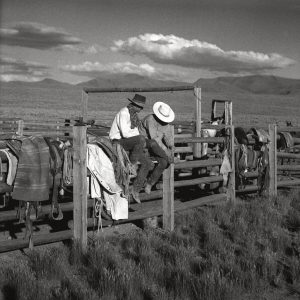
Jaybirds, IL Ranch, NV, 2019 | Silver Gelatin Print | 24 x 24 inches
To learn more about Adam Jahiel, please visit adamjahiel.com. To find out how you can support Susan Wolfe’s work with the Lame Deer Junior and Senior High School students, please email her at susanwolfe@lamedeer.k12.mt.us.
No Comments